


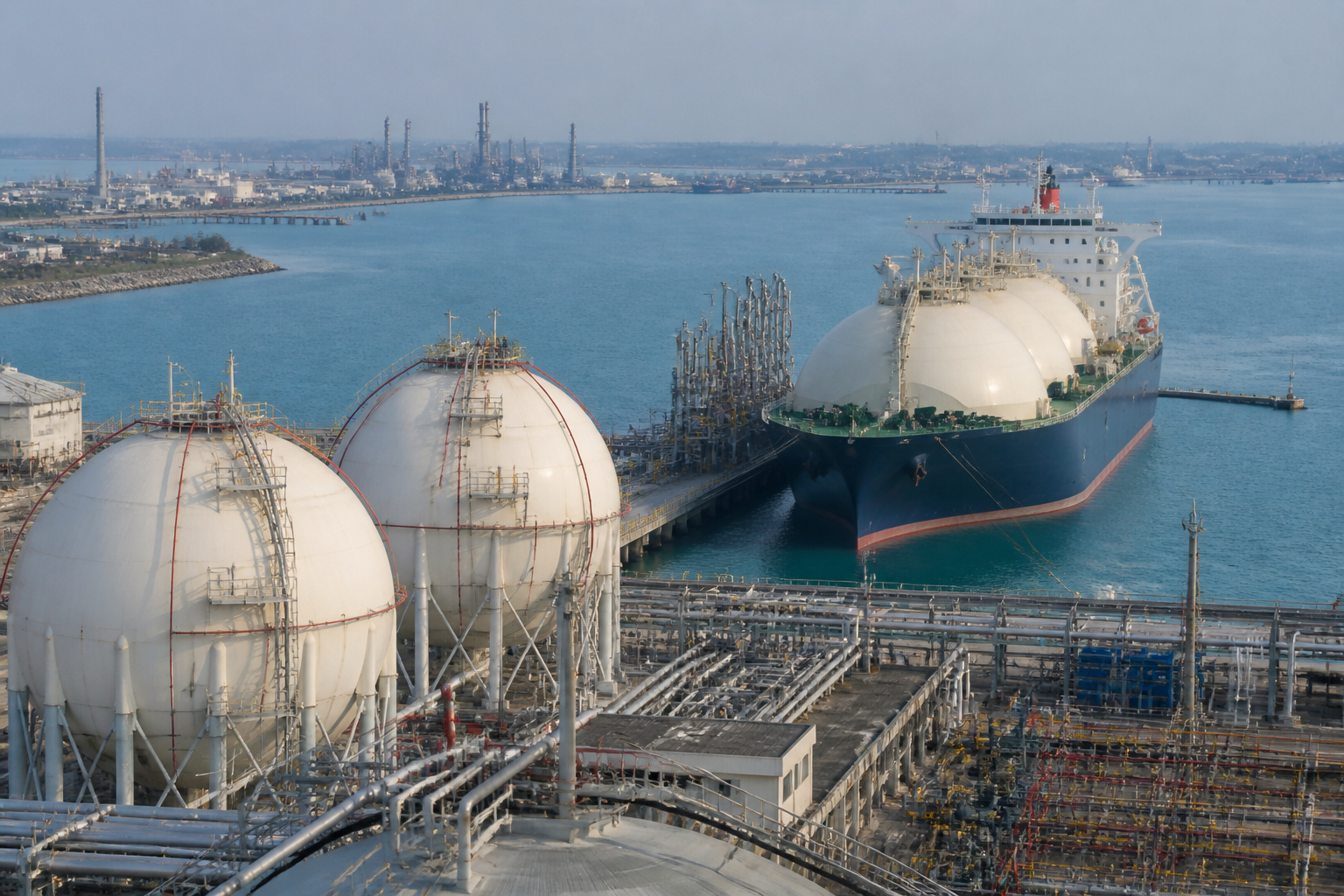
India’s LPG imports have undergone a sharp geographic shift in 2026, with the United States supplying more than half of the country’s imported cooking gas in August after disruptions in the Middle East curtailed the traditional Gulf supply route. The change is more than a temporary trade statistic. It exposes the logistics, pricing and energy-security pressures facing a country whose households increasingly depend on LPG and whose import requirements remain substantial.
The immediate trigger was the disruption around the Strait of Hormuz, through which much of India’s LPG traditionally arrives from the Middle East. The Times of India report, citing Kpler data and analysts, says the United States became India’s largest LPG supplier from March. Its share rose from about 12% in January to 36.9% in March, crossed 50% in May and reached 73% in July. In August, the US remained the leading supplier with a 55.4% share, although supplies from the United Arab Emirates, Algeria and Kuwait brought some diversification back into the mix.
That movement marks a significant departure from India’s normal supply pattern. The country imported 21.85 million tonnes of LPG in 2025, with about 90% of those imports coming from the Middle East, according to the report. Imports accounted for roughly 66% of domestic LPG consumption. Before the disruption, Gulf countries supplied approximately 85% to 90% of India’s imported LPG, while the US accounted for about 10%.
The change has been driven first by availability, not by a simple decision to replace one long-term supplier with another. Natalia Katona, a commodity analyst quoted by the Times of India, said the US was already the world’s largest LPG exporter and that its propane was cheaper than Asian alternatives before the conflict. Once Gulf cargoes became difficult to secure, Indian buyers were prepared to accept longer journeys and higher freight costs to maintain supplies.
The logistics are materially different. LPG shipments from Gulf suppliers could reach India in roughly three to four days. Cargoes from Houston may travel to India’s west coast through the Panama Canal, taking around 30 to 45 days depending on canal traffic, the report said. This requires buyers to plan further ahead and manage a longer period between loading and delivery.
The freight disadvantage has not disappeared. According to Katona, freight from Houston to India’s west coast rose from about $135 a tonne in early March to around $290 a tonne. Indicative freight rates from Saudi Arabia’s Ras Tanura increased from approximately $70 a tonne before the crisis to about $235 a tonne. Gulf cargoes remained cheaper even after the increase, but their availability became the decisive problem.
Pricing mechanisms also influence the comparison. Middle Eastern LPG is linked to Saudi Aramco’s announced contract prices, which are set monthly and heavily tied to crude oil benchmarks. US LPG is priced against the daily Mont Belvieu spot market, which reflects North American shale production and export capacity. Pankaj Srivastava of Rystad Energy said the US benchmark gives Indian oil marketing companies greater visibility around loading dates and can help smooth exposure to sudden monthly price changes.
That pricing flexibility does not eliminate the cost of long-distance transport. Instead, it changes the way buyers manage supply risk. A cargo from the United States takes longer to arrive, but it may offer a more predictable procurement option when nearby suppliers cannot guarantee delivery. Srivastava said the longer US voyage, combined with lower free-on-board prices at the US Gulf Coast, could reduce the impact of higher freight costs during the disruption.
The supply shock has also affected demand. India’s average LPG demand was about 1,042 thousand barrels per day between March 2025 and February 2026, according to Srivastava. From March to August 2026, the monthly average fell to 862 thousand barrels per day, a decline of nearly 20%. The report attributed the fall to higher LPG prices, measures to limit LPG use in alternative industries and a broader effort to prioritise cooking-gas availability.
At the same time, domestic refinery production increased, reducing the volume that had to be imported. Average imports before the disruption were about 785 thousand barrels per day, representing nearly 70% of demand. After the disruption, imports averaged around 440 thousand barrels per day, or approximately half of demand, according to Srivastava. The figures indicate that the change in supplier shares occurred alongside both lower demand and higher domestic production, rather than through imports alone.
The result is a more complicated picture than the headline US share suggests. India has become more dependent on American cargoes within a smaller and more pressured import market, while the overall import requirement has also fallen. Consumption declined by about 8% to 14.7 million tonnes in January-June 2026, and imports dropped 28% to around 7.5 million tonnes, the report said. Full-year consumption is expected to reach about 30 million tonnes, compared with a possible recovery to around 31 million tonnes in 2027.
The procurement shift is also becoming institutional rather than entirely spot-driven. The report said the government has asked Indian Oil, Bharat Petroleum and Hindustan Petroleum to source at least 15% of their 2027 LPG imports through annual agreements with US suppliers, although no decisions had been finalised. Reuters previously reported that India planned to source as much as 25% of its LPG imports from the US in 2027. The reported proposals suggest that diversification is being considered as part of procurement planning, not only as an emergency response.
Trade diplomacy is part of that calculation. US President Donald Trump has said India would increase purchases of US energy by between $10 billion and $25 billion, while the two countries have set a target of $500 billion in bilateral trade by 2030. The report cited analysts who said larger LPG purchases could support wider trade negotiations. However, the energy-security rationale remains distinct from the diplomatic one: Indian buyers need reliable cargoes, regardless of whether those purchases also serve broader trade objectives.
The central uncertainty is what happens if supplies through the Strait of Hormuz recover durably. Gulf cargoes have a substantial geographic advantage, and August already showed some return of Middle Eastern supply. The UAE’s share rose to 15.2%, Algeria accounted for 11.9% and Kuwait supplied 8.8%, while the US share declined from its July peak to 55.4%.
Katona expects the US share to fall if nearby suppliers can deliver reliably again, because Indian buyers would have less reason to pay the additional freight required for American cargoes. That does not mean the US will return to its previous position. Long-term contracts, future trade arrangements and the need for a reserve of alternative suppliers could leave American LPG with a permanently larger role in India’s import basket.
The broader urban issue is the resilience of a household fuel system that depends on international supply chains. LPG is not only an energy commodity; it is a daily utility for millions of households and a critical input in the functioning of cities. When shipping routes are disrupted, the consequences move through freight markets, refinery operations, procurement contracts, prices and household consumption.
The evidence in the current supply shift confirms that India can redirect LPG imports when its traditional route is impaired. It also shows the costs of doing so: longer voyages, higher freight exposure, lower demand and greater reliance on advance planning. Whether the United States remains above 50% of India’s LPG imports will depend chiefly on the reliability of Gulf supplies, the terms of future contracts and the balance between domestic production and consumption. The next major indicator will be how procurement agreements for 2027 are finalised and whether Middle Eastern cargoes recover consistently.
