


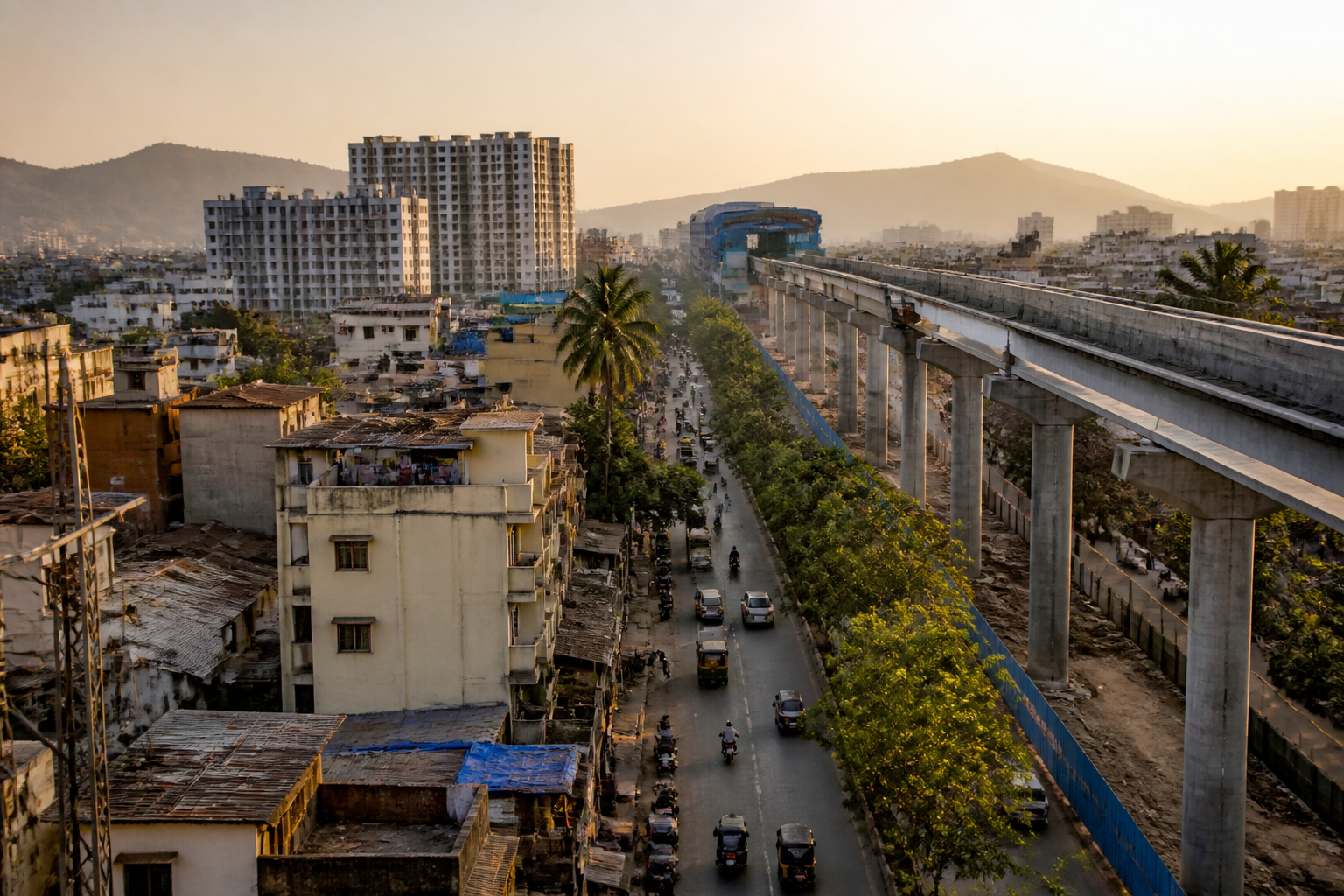
A dispute over the proposed Thane internal metro route through Lokmanyanagar has exposed a larger question facing transport projects in built-up cities: can a new corridor be justified if the process for protecting and resettling affected residents remains unclear?
The proposed route has become politically contentious after Maharashtra Transport Minister Pratap Sarnaik attended a meeting organised by the Lokmanyanagar Bachao Sarvapakshiya Kruti Samiti, a residents’ platform opposing the project. Sarnaik said development should not result in the displacement and destruction of residents, while Thane Municipal Corporation’s house leader Hanamant Jagdale has continued to support the project.
The disagreement is not over whether Thane needs better public transport. It is over the location, consequences and institutional preparation behind one proposed alignment. That distinction is important. A transport corridor can serve a broad public purpose, but its legitimacy depends on how authorities establish the route, identify affected households, explain the rehabilitation framework and respond to alternatives.
According to the report, the Thane municipal corporation’s recent general body meeting approved a resolution to develop a planned road in the Lokmanyanagar area. The road would connect Lokmanyanagar with Upvan. The proposed metro alignment is also expected to pass along this route, which has led residents to argue that the road is being developed primarily to facilitate the metro project.
The reported alignment would affect several homes. Residents have opposed the project because, they say, there is no clear explanation of how those affected would be rehabilitated. The supplied report does not establish the number of affected structures, the land acquisition process, the compensation framework, the relocation sites or a formal rehabilitation timetable. Those gaps are central to the dispute because the social cost of the corridor cannot be assessed without them.
Sarnaik’s intervention placed the rehabilitation question at the centre of the public debate. He said residents’ trust should not be compromised and that he would discuss the issue with Deputy Chief Minister Eknath Shinde. He also argued that alternative routes should be seriously examined so that the fewest residents are affected while the largest possible number of Thane residents benefit from the project.
He further pointed to the possibility of taking the corridor through the Upvan area, where, according to his statement, there is no residential population. The report does not provide an engineering assessment comparing that option with the Lokmanyanagar alignment. It also does not establish whether an alternative route is technically, financially or legally feasible. That makes the alternative-route proposal an issue for formal examination rather than a settled solution.
The dispute has also revealed a division within the ruling Shinde-led Shiv Sena’s local political network. Jagdale, who represents the Lokmanyanagar area in the municipal corporation, remains supportive of the internal metro project. He said there was no split within the party and described the disagreement as a difference of views that could be addressed through direct communication with residents.
Jagdale also said efforts had been under way for several years to develop the slum areas of Lokmanyanagar. His position connects the metro debate with a longer-running redevelopment question. In a densely occupied neighbourhood, transport construction and settlement redevelopment can overlap, but the supplied material does not clarify whether the proposed corridor is part of a formally approved redevelopment plan or how the two processes would be coordinated.
Other local political representatives have taken a stronger position against the current alignment. Shinde Sena divisional chief Santosh Dhamale said development should not be built on the destruction of Lokmanyanagar. Local corporator Rakesh Shinde alleged that some people were using Eknath Shinde’s image in videos to build support for the ring metro project and warned that residents would respond to what he described as misleading claims. These allegations are presented in the report as political statements and are not independently established in the supplied material.
The controversy had already extended beyond the ruling party. At a recent presentation of the internal metro project at the municipal headquarters, Nationalist Congress Party (Sharad Pawar) legislator Jitendra Awhad reportedly raised questions about rehabilitation and asked when metro services would reach the Kalwa-Mumbra area. He also questioned whether the project was being implemented for the benefit of a particular builder. The report provides no documentary evidence for that allegation, and it should therefore be treated as an unverified political claim rather than an established fact.
The available evidence points to three separate decisions that need to be distinguished. The first is the transport objective: whether an internal metro corridor is required and what areas it is intended to serve. The second is route selection: whether the Lokmanyanagar-Upvan alignment is the best available option. The third is the impact framework: how authorities will deal with households, structures and communities affected by construction. Public disagreement over the project has intensified because these questions appear to be moving at different speeds.
The municipal resolution on road development indicates that the local authority has taken a step connected to the proposed alignment. But a road resolution by itself does not answer the questions that residents are raising about the metro. A complete public case for the corridor would require clarity on the project’s approval status, the route map, land and property impacts, rehabilitation eligibility, compensation, construction staging and the authority responsible for implementation. None of those details is established in the supplied report.
This is where the Lokmanyanagar dispute becomes a broader urban governance issue. Metro projects are often presented through their citywide benefits: improved connectivity, faster travel and expanded public transport capacity. Those benefits matter, but they do not remove the need for neighbourhood-level accountability. The residents who bear the immediate cost experience the project through demolition risk, relocation, disruption and uncertainty long before they experience any network benefit.
The dispute also shows why route planning cannot be separated from housing policy. Where a corridor passes through established settlements, the question is not simply whether a structure stands in the way of infrastructure. Authorities must establish who has rights, what form of rehabilitation is available, where relocation would occur and how residents would maintain access to livelihoods and services. The supplied material shows that residents and political representatives are demanding these answers, but it does not show that a final framework has been publicly presented.
The political disagreement may eventually be resolved through discussions involving Sarnaik, Shinde, the municipal corporation and local representatives. But a political consensus would not substitute for a documented impact assessment or a transparent route comparison. The project’s credibility will depend on whether the administration can demonstrate that the alignment was selected on transport and public-interest grounds, and that affected residents will not be left to negotiate their future after the route is fixed.
For now, the evidence confirms that the Lokmanyanagar alignment remains contested, that the municipal corporation has approved development of the planned Lokmanyanagar-Upvan road, and that the rehabilitation of affected residents remains a central unresolved issue in the public debate. The next significant developments are likely to be the promised discussions with the deputy chief minister, the authorities’ response to alternative-route proposals and the publication of clear project and rehabilitation details.
