


Sterlite Technologies’ announcement of a ₹20,000-crore revenue ambition by financial year 2028-29 is more than a corporate growth target. It is also a statement about how the infrastructure beneath India’s digital economy is changing. The company’s Lakshya plan links its next phase of expansion to rising demand for optical fibre, the rapid build-out of data centres and the increasing fibre intensity of artificial-intelligence infrastructure.
STL Managing Director Ankit Agarwal announced the plan at an investor meeting on September 3. According to a transcript shared by the company, STL is targeting revenue of ₹20,000 crore by FY29, compared with consolidated revenue from operations of ₹4,745 crore in FY26. Agarwal described Lakshya as an ambition to build STL into one of the largest global players in digital connectivity while expanding the scale and position of the business.
The plan arrives as connectivity requirements are moving beyond conventional broadband expansion. Fibre remains central to fixed-line networks, mobile backhaul, cloud infrastructure and data-centre interconnection. The company’s account of the market suggests that demand is being shaped not only by the number of locations requiring optical connectivity, but also by the quantity of fibre required inside each location.
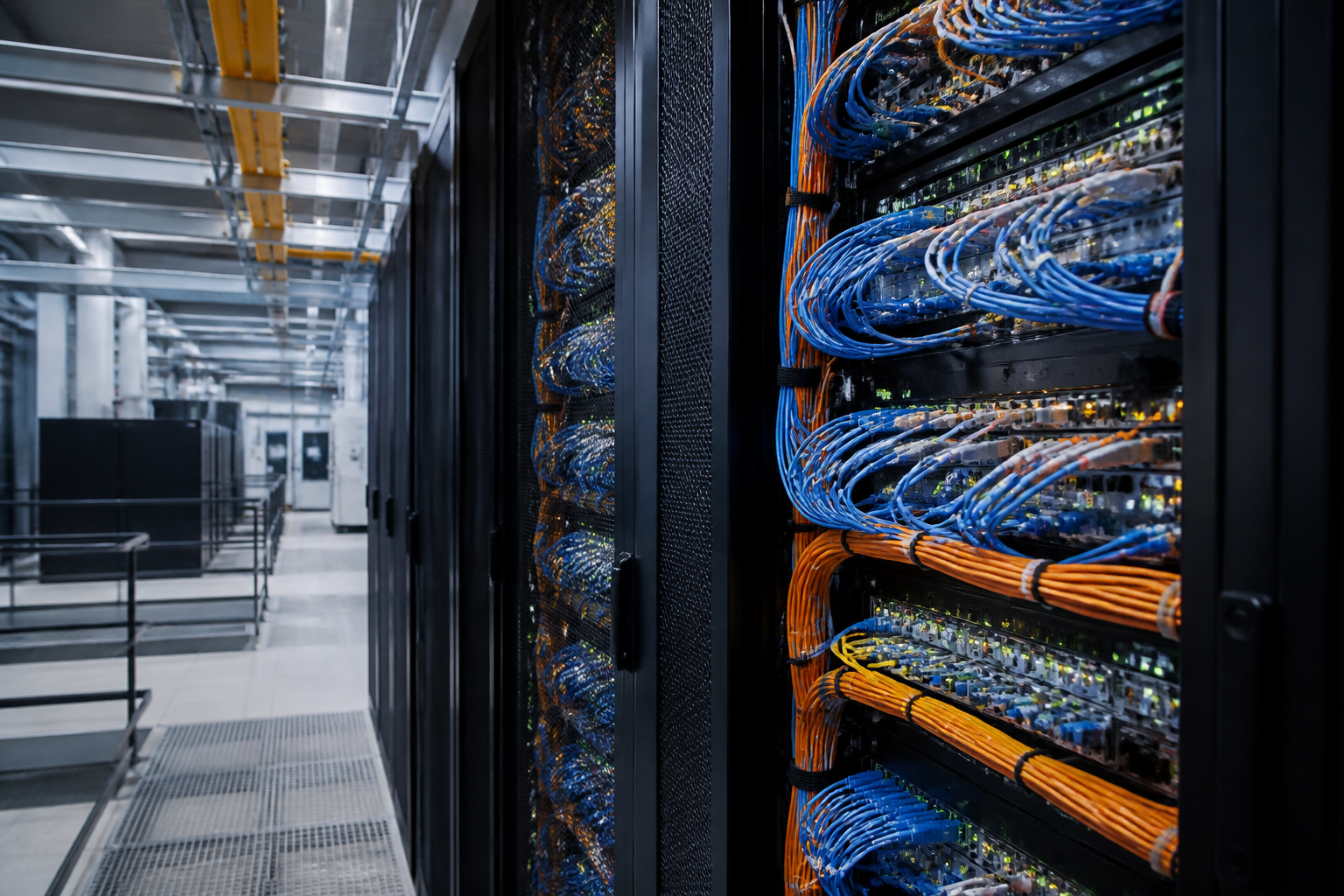
Agarwal specifically connected this shift to AI-led infrastructure. He said the fibre content associated with successive generations of AI hardware had increased substantially, citing approximately 4,000 fibres per AC for Hopper, around 16,000 fibres per AC for Blackwell and roughly 64,000 fibres per rack for the latest VERA Rubin systems. On the basis of those figures, he described the increase as a 64-fold rise in fibre content per rack across a few generations of infrastructure.
The figures were presented by STL as an indication of how quickly the physical connectivity requirements of advanced computing are changing. They do not, by themselves, establish the total fibre demand of India’s AI sector or determine how much of that demand will be supplied by STL. They do show the company’s core argument: the digital infrastructure market is becoming more fibre-intensive even where the immediate application is data processing rather than conventional telecommunications.
India’s data-centre market is the second major element of the company’s case. STL said India currently has approximately 1.5 gigawatts of data-centre capacity and that this could rise to 10 GW by 2030. The company attributed this expected expansion to a favourable policy environment, including a tax holiday extending to 2047, and the availability of power across multiple sites in the country.
The report does not provide a breakdown of the existing 1.5 GW capacity, the locations of the planned additions or the share of the projected 10 GW that would require STL’s products. Those distinctions matter because data-centre growth depends on more than demand from cloud and AI companies. It also requires land, electricity, cooling, network connectivity, permissions and reliable links to users and other facilities.
STL also pointed to international connectivity as part of India’s changing digital-infrastructure landscape. According to Agarwal, four submarine cables are under commissioning and three more are under planning. Submarine cable systems connect domestic networks to global data routes, but their benefits depend on the terrestrial fibre systems that carry traffic from landing stations to data centres, enterprises and consumers.
This creates a layered infrastructure requirement. International capacity can expand the amount of data entering and leaving the country, while domestic fibre networks determine how efficiently that capacity is distributed. Data centres add another concentration point, and AI facilities can increase the density of connections within and between campuses. The company’s Lakshya plan is positioned across this wider chain rather than around a single telecommunications product.
STL said it has approximately 9 per cent of the global optical-fibre market outside China, supported by a technology portfolio of more than 785 patents and over 10 advanced manufacturing facilities in key markets. These figures are company claims contained in the investor-meeting transcript. The supplied material does not provide an independent market comparison or explain how STL’s share is calculated, so the claim is best understood as the company’s description of its existing competitive position.
The financial and manufacturing commitments in the plan provide a clearer measure of the proposed expansion. STL Group Chief Financial Officer Ajay Jhanjhari said the company intends to invest approximately ₹1,000 crore annually over the next three financial years. The investment is intended to expand fibre and cable capacity by 50 per cent, allowing the company to scale production in line with visible demand.
That proposed capacity increase is significant in relation to the company’s broader revenue ambition, but the supplied announcement does not specify how the annual investment will be divided among plants, equipment, research, geographical markets or product categories. Nor does it provide a project-by-project timetable for the manufacturing expansion. The stated plan therefore establishes an investment direction rather than a complete implementation schedule.
The timing reflects a change in the infrastructure market’s centre of gravity. Earlier broadband expansion was primarily associated with connecting homes, offices and mobile networks. The demand described by STL adds large computing facilities, hyperscaler campuses and AI systems to that picture. These facilities require high-capacity links both within a site and between sites, while the growth of cloud services increases the volume of traffic moving through national and international networks.
STL said leading hyperscalers are making multi-billion-dollar investments in India across cloud, AI and data-centre infrastructure. The report does not identify the companies, announce specific projects or quantify the resulting fibre orders. It does, however, place STL’s growth plan within a market where technology companies are committing capital to physical infrastructure, not only software and digital services.
Policy support is another part of the company’s explanation. STL referred to the tax holiday available until 2047 and to power availability across multiple Indian sites. These conditions can support data-centre investment, but the announcement does not detail the eligibility requirements, the institutions responsible for implementation or the wider costs associated with building and operating such facilities. In practical terms, policy incentives are only one component of a data-centre ecosystem that also depends on power reliability, network access and local approvals.
The company’s stated expansion also raises a question about the relationship between demand visibility and manufacturing capacity. Jhanjhari said the planned investment would allow STL to scale with demand visibility. That wording indicates that the company is linking new capacity to its assessment of confirmed or emerging market requirements rather than presenting the investment as an unconditional expansion of supply. The available material does not disclose the order pipeline or customer commitments underlying that assessment.
What the announcement establishes is a clear sequence. STL is starting with a FY29 revenue ambition, plans approximately ₹3,000 crore of investment over the next three financial years, and expects to increase fibre and cable capacity by 50 per cent. It is pursuing that plan against a backdrop of projected data-centre growth, new submarine cable capacity and greater fibre requirements from AI infrastructure.
What remains uncertain is how much of the projected digital-infrastructure expansion will translate into STL revenue, how quickly the company’s manufacturing additions will be commissioned and whether the expected data-centre growth will occur on the timetable cited. The announcement also does not establish the commercial contribution of each segment or explain how STL will balance its domestic opportunity with its existing international operations.
The immediate significance of Lakshya is therefore not that it confirms a completed infrastructure build-out. It sets out how one optical-connectivity company is interpreting the next phase of India’s digital economy: as a market in which data centres, submarine cables, cloud platforms and AI systems will require substantially more fibre. The next evidence will be the company’s investment execution, capacity additions and reported revenue progress toward FY29.
