


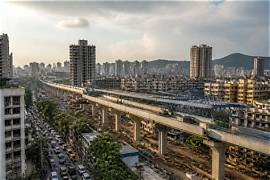
The Thane internal metro project has entered a politically contested phase in Lokmanya Nagar, where residents have opposed a proposed route and questioned how homes affected by the planned infrastructure will be rehabilitated. The disagreement has also exposed differing positions within the Shinde-led Shiv Sena, with Transport Minister Pratap Sarnaik attending a public meeting against the current approach while Thane Municipal Corporation’s House Leader Hanmant Jagdale continues to support the project.
The immediate dispute is not simply about whether Thane needs better public transport. It is about how a major urban mobility intervention should be aligned with an existing neighbourhood, a planned road, residential settlements and the rights of households that may be affected. The supplied report describes a project whose public case remains tied to route selection, land requirements and rehabilitation clarity rather than to a settled implementation plan.
According to the report, the municipal corporation recently approved a resolution to develop a road identified in the Lokmanya Nagar area’s development plan. The proposed road would connect Lokmanya Nagar with Upvan. The internal metro alignment is also expected to run along this corridor, and the road development is being undertaken in that context. Residents have raised objections because several homes could be affected, while they say there is no clear explanation of how rehabilitation would be carried out.
That gap has become the centre of the local opposition. Residents have formed the Lokmanya Nagar Bachao All-Party Action Committee and organised a meeting at Dawlenagar. The gathering was attended by citizens and leaders from different political parties. Sarnaik’s participation gave the opposition a senior political voice, although the report does not establish that the proposed alignment has been formally cancelled, modified or placed on hold.
Sarnaik’s stated position is that development should not be opposed in principle, but that displacement and destruction cannot be accepted in the name of development. He called for alternatives that would affect the minimum number of citizens while benefiting the maximum number of Thane residents. He also said that alternatives should be examined seriously and referred to similar suggestions attributed to Deputy Chief Minister Eknath Shinde. The report further says Sarnaik pointed to the possibility of taking the alignment through the Upvan area, where there is less habitation, although it does not provide a comparative technical assessment of that option.
This distinction between support for public transport and opposition to a particular alignment is important. Urban infrastructure disputes often become framed as a choice between development and resistance, even when the central question is the design of the project. In Lokmanya Nagar, the reported objections concern the consequences of the route: homes that may be affected, the absence of a publicly explained rehabilitation process and the relationship between the metro corridor and the proposed road. Those are implementation questions, but they can determine whether a project earns public legitimacy.
Jagdale has rejected the suggestion that the disagreement represents a split in the party. He said different people were expressing their views, that all sides wanted development and that misunderstandings would be addressed through discussions with residents. He also said efforts had been under way for several years to develop the slum areas of Lokmanya Nagar. His position, as reported, places the proposed project within a broader development agenda for the neighbourhood rather than treating it only as a transport corridor.
The contrast between the two positions reveals an institutional problem. Supporters of the project are presenting connectivity and local development as linked objectives. Opponents are asking whether the same intervention could damage established communities without a transparent rehabilitation framework. Until the route, affected properties, acquisition or clearance requirements and rehabilitation arrangements are publicly established, the debate is likely to remain political rather than technical.
The report also records criticism from Shiv Sena division chief Santosh Dhamale, who said residents would not accept the destruction of Lokmanya Nagar in the name of development. Local corporator Rakesh Shinde alleged that some people were using Eknath Shinde’s image in videos to build support for the ring metro project and warned against what he described as misleading claims. These statements indicate the intensity of the local contest, but they do not independently establish the motives of any participant or the technical merits of one alignment over another.
A separate set of questions was raised during a presentation of the internal metro project at the municipal headquarters. Nationalist Congress Party (Sharad Pawar) legislator Jitendra Awhad reportedly questioned the rehabilitation issue and asked when metro services would reach the Kalwa-Mumbra area. He also alleged that the project was being implemented for a construction developer. The supplied material provides no evidence substantiating that allegation, so it remains a political claim rather than an established fact.
The rehabilitation question is especially significant because the report describes Lokmanya Nagar as an area containing both established residential occupation and slum settlements. A transport project that requires a new road or corridor may involve different categories of affected occupants, each with distinct legal and administrative questions. However, the supplied report does not specify the number of affected homes, the land parcels involved, the eligibility criteria for rehabilitation, the proposed location of resettlement or the agency responsible for delivering it.
Those omissions limit what can be concluded about the project at this stage. The report establishes that residents fear displacement and that political leaders are demanding alternative routes or clearer safeguards. It does not establish the final alignment, the project’s approved cost, construction schedule, technical feasibility, funding structure or environmental and social assessment. Nor does it provide a formal municipal document setting out the road and metro plans in sufficient detail to compare competing routes.
That evidence gap matters because route changes are not neutral. A different alignment can alter land requirements, construction complexity, station access, travel patterns and the number of households affected. Yet claims about which route would serve the most people or cause the least disruption require published maps, ridership projections and an account of land and property impacts. None of those details is contained in the supplied report.
The dispute therefore places consultation at the centre of the project’s next stage. The residents’ committee is seeking protection for the neighbourhood, while project supporters are emphasising the need for development and improved connectivity. A credible decision would need to clarify how these objectives are being balanced. In practical terms, that means making the proposed corridor understandable to residents, identifying affected properties and explaining rehabilitation before implementation decisions become irreversible.
The political disagreement also illustrates the difficulty of delivering urban infrastructure through overlapping institutions. The municipal corporation is involved in the planned road and has hosted a project presentation. State-level political figures are engaged because the metro and transport system extend beyond a single neighbourhood. Local elected representatives are responding to residents, while different parties are using the dispute to question the project’s purpose and impact. The supplied material does not clarify the precise division of responsibility among these bodies.
For Thane, the larger urban question is not whether mobility infrastructure should expand, but whether expansion can be planned alongside existing communities. The Lokmanya Nagar dispute shows how a corridor can become contested when its transport benefits are discussed without equal clarity about land, housing and rehabilitation. It also shows why a project’s public acceptance depends on more than an announcement or presentation.
At present, the evidence confirms a live dispute over the route of the proposed Thane internal metro project and the possible impact on Lokmanya Nagar households. It does not confirm a final route, a construction start date or a settled rehabilitation plan. The developments that require monitoring are the municipal and state authorities’ response, any publication of route and impact details, the outcome of discussions with residents and whether an alternative alignment is formally examined.
