


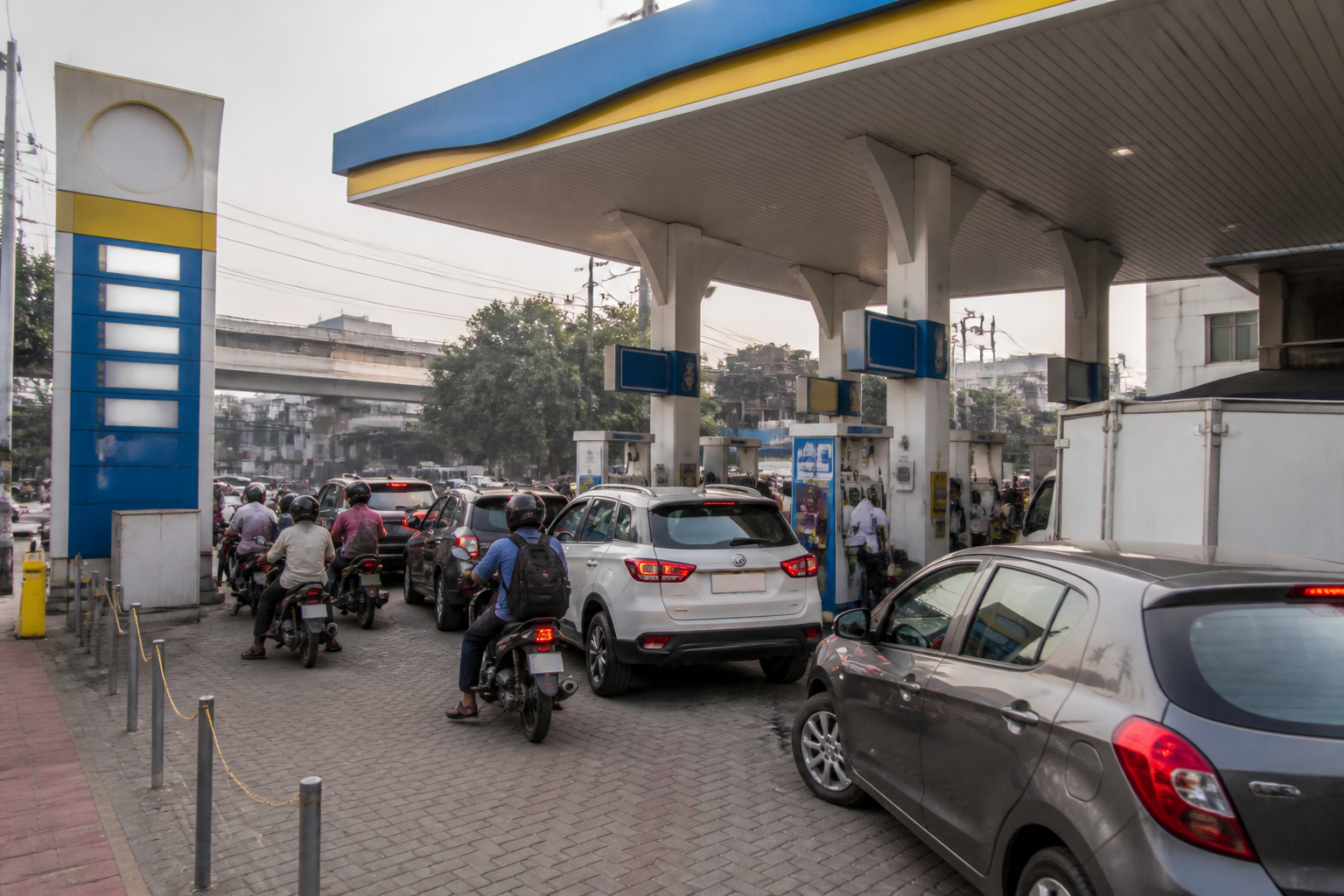
India’s fuel-price system is facing renewed pressure as the country’s average crude import cost approaches $100 a barrel, while petrol consumption continues to rise and retail prices differ sharply between cities. The immediate issue is not simply whether petrol and diesel become more expensive. It is how global oil volatility is transmitted through state taxes, local freight charges, household travel and the finances of the oil companies that keep prices stable at the pump.
The figures reported by Hindustan Times on September 7 show the scale of that urban variation. Petrol was listed at ₹102.12 a litre in New Delhi and ₹111.21 in Mumbai. In Bengaluru, the reported price was ₹110.82, while Gurgaon stood at ₹102.97. Diesel was priced at ₹95.20 a litre in New Delhi, ₹97.83 in Mumbai, ₹98.77 in Bengaluru and ₹95.64 in Gurgaon. Bhubaneswar recorded petrol at ₹108.97 and diesel at ₹100.68. Chandigarh was lower, with petrol at ₹101.54 and diesel at ₹89.47.
These differences mean that the same international crude shock does not create a uniform burden for Indian urban residents. Retail prices are shaped by state-level value-added tax and local distribution or freight charges. The cost of a daily commute, a delivery trip or a commercial vehicle operation therefore depends not only on the global price of oil but also on the fiscal and logistical structure of the city and state in which the vehicle operates.
The pressure begins upstream. According to the report, India’s average crude oil import basket has reached close to $100 a barrel, its highest level in three months. International prices have risen amid heightened volatility in oil markets linked in the report to conflicts involving the United States and Iran in West Asia. The report also states that OPEC members have decided to retain their production quotas for October, a position that is contributing to tighter global supply conditions.
For India, the exposure is significant because the country imports more than 88% of its crude oil, according to the earlier report cited by Hindustan Times. That dependence links domestic mobility costs to events far beyond Indian cities. A conflict-related disruption, a production decision by major oil exporters or a sustained rise in international benchmarks can increase the cost of the crude entering the country before the impact is visible at a neighbourhood fuel station.
Yet the relationship between international crude prices and retail fuel prices is not automatic or immediate. State-run oil marketing companies control more than 90% of India’s petrol pumps, the report says, and have kept retail prices largely unchanged despite the rise in international benchmarks. This has provided short-term stability for motorists, but the same stability creates pressure for the companies when pump prices do not move in line with their input costs.
The result is a tension between consumer protection and commercial recovery. If retail prices are increased quickly, households, commuters and transport operators face a direct rise in operating costs. If prices are held back, oil marketing companies may absorb more of the difference between international crude costs and domestic selling prices. The supplied report says industry experts believe public-sector retailers are finding it difficult to raise prices in line with international benchmarks while domestic demand continues to increase.
That demand is an important part of the story. Petrol consumption in India grew 7.9% in August to 3,824 thousand metric tonnes, according to the earlier report cited by Hindustan Times. The figure indicates that fuel demand is rising even as the import environment becomes more expensive and volatile. In urban areas, this demand is connected to everyday travel, private vehicle use, goods movement and the wider dependence of city economies on road transport.
The data does not establish why consumption rose by that amount, and the supplied material does not provide a city-by-city breakdown of demand. It does, however, show the structural imbalance facing the fuel system: India’s requirement for petrol is increasing at the same time that its crude supply remains heavily dependent on imports. Higher consumption can increase the volume of crude and refined fuel needed, while an international price shock raises the cost of meeting that demand.
The urban effect is distributed unevenly. A resident of Chandigarh, where the reported petrol and diesel prices were lower than in several other cities, does not face the same pump-price burden as a resident of Mumbai or Bengaluru. But price differences alone do not measure the full cost of mobility. Commuting distance, access to public transport, vehicle ownership, traffic conditions and the price of goods and services also shape how a fuel increase is experienced. The supplied report specifically identifies daily commuting and transportation as financial concerns for households and vehicle owners.
Fuel prices also operate through commercial activity. Road-based transport is embedded in the movement of goods and services across cities. When vehicle operating costs rise, the pressure can be felt by operators and businesses even before it appears as a separate line item for consumers. The supplied material does not quantify those pass-through effects, so their precise scale cannot be established from this report. What can be established is that fuel prices are connected to both household travel and the operation of transport-dependent businesses.
State taxation is central to the variation between cities. Because value-added tax differs between states and local freight charges also vary, a national crude-price movement is converted into different retail outcomes. This makes fuel pricing simultaneously a global, national and local issue. The global component is the price of crude. The national component is the country’s import dependence and the pricing decisions of oil marketing companies. The local component is the tax and distribution structure that determines what motorists pay in individual cities.
That division of responsibility also complicates public understanding. A price displayed at a fuel station reflects more than the cost of crude oil. It incorporates the consequences of international supply conditions, import costs, company pricing decisions, state taxation and local distribution. Without separating these elements, a city-level increase can be attributed too narrowly to one cause.
The current episode also highlights the limits of retail-price stability as an indicator of economic stability. Pump prices may remain broadly unchanged while the cost pressures beneath them increase. For motorists, this can delay the visible impact of an international shock. For oil companies, however, the pressure may accumulate through weaker margins or difficulty aligning domestic prices with global benchmarks. The supplied report does not provide company-level financial figures, so the extent of that strain cannot be measured here.
Nor does the report establish how long current retail prices can remain insulated from international crude movements. That depends on developments not resolved in the supplied material, including the direction of global crude prices, the duration of geopolitical volatility, the production decisions of oil-exporting countries, domestic consumption and future pricing decisions by oil marketing companies and governments.
The immediate evidence points to a system under pressure from several directions at once. Crude import costs are nearing a three-month high, India remains heavily dependent on imported crude, petrol consumption has increased, and prices remain materially different across urban markets because of taxes and distribution charges. Each factor matters on its own, but their interaction determines the burden faced by commuters and transport users.
For cities, the larger question is how dependent urban mobility remains on a fuel market exposed to international shocks. The supplied material does not provide evidence on public-transport ridership, alternative fuels or changes in travel behaviour, so it cannot establish whether residents are shifting away from private vehicles or whether cities have effective buffers against fuel-price volatility. It does show why such questions matter: when petrol and diesel costs rise, the consequences reach beyond the fuel station into commuting and the movement of goods.
What the evidence confirms is a widening gap between the stability visible at the pump and the pressure building across the fuel system. India’s crude import exposure, rising petrol consumption, uneven state taxes and local charges, and the pricing position of public-sector oil companies are shaping the next stage of the story. The developments that require monitoring are crude import prices, October production conditions, domestic consumption and any change in the retail prices charged across Indian cities.
