


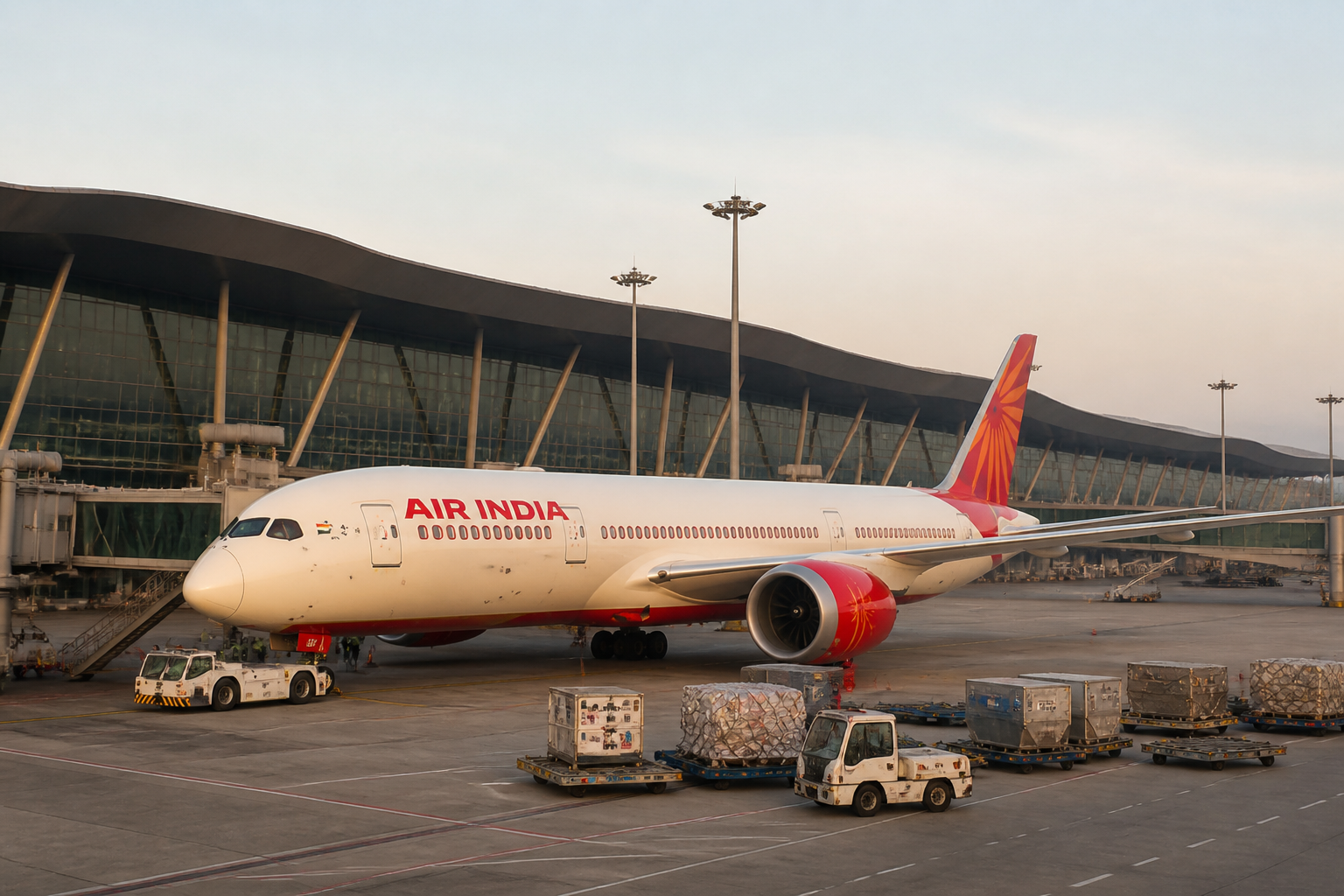
Air India’s incoming managing director and chief executive, Tewolde Gebremariam, has placed safety, operational reliability and employee accountability at the centre of his agenda as the airline enters another phase of its transformation under the Tata Group. His arrival follows a period marked by operational disruption, financial pressure and heightened scrutiny of the airline’s safety culture.
Speaking at an Air India town hall in New Delhi, Gebremariam said his objective was to help “make Air India great again”, borrowing the phrase from the US political slogan. The more consequential part of his message, however, was not the branding language. It was his emphasis on the basic systems through which an airline earns and retains passenger trust: safe operations, punctual departures and arrivals, reliable baggage delivery, clean aircraft and professional handling of disruptions.
That emphasis indicates the practical challenge confronting Air India. The airline’s transformation is not only a question of fleet, network or brand positioning. It also depends on whether a large and complex organisation can deliver a consistent passenger experience while maintaining confidence in its safety systems. Gebremariam described operational excellence as “getting the basics right every day”, linking customer experience directly to the reliability of the airline’s underlying operations.
The leadership transition comes after four years of restructuring and foundational work. Tata Sons and Air India chairman N Chandrasekaran said the group’s return of Air India, along with Air India Express, to the Tata fold in January 2022 was one of the most significant milestones of his career. He also acknowledged that the turnaround was not complete and that the airline’s next stage would require a stronger focus on safety, customer trust, execution, cost discipline and consistency.
Chandrasekaran’s comments reflect the difference between ownership change and operational transformation. Returning Air India to the Tata Group created a new institutional framework, but it did not by itself resolve the daily demands of running an airline. The next phase must convert that structural change into dependable performance across airports, aircraft, crews, engineering, customer service and disruption management.
The airline’s safety position has acquired additional importance following the deadly Ahmedabad crash last June, which the company’s leadership referred to during the town hall. Chandrasekaran said Air India should aspire to a safety record that not only matches the best airlines in the world but is better than the best. Gebremariam similarly called safety-first culture the organisation’s foremost priority and said it had to be lived every day rather than simply stated.
The available account does not establish the causes of the Ahmedabad crash or attribute responsibility for it. It does, however, show that the incident has become part of the leadership conversation about trust and safety. For Air India, the challenge is therefore both operational and cultural: the airline must maintain formal safety systems while ensuring that employees feel able to identify and escalate concerns before they become larger failures.
Gebremariam said employees should be empowered to stop when something is not right and raise concerns, adding that he would support such a culture. That commitment places frontline staff at the centre of the proposed reset. Safety performance is not created only through executive statements; it is also shaped by the decisions made by pilots, cabin crew, engineers, ground staff, airport teams and managers when schedules are under pressure or disruptions occur.
The same logic applies to the airline’s customer-facing operations. On-time performance, baggage delivery and aircraft cleanliness may appear routine compared with fleet expansion or route announcements, but these are the visible points at which passengers judge whether an airline is dependable. Gebremariam’s formulation makes consistency, rather than isolated service improvements, the core operational test.
Air India’s recent difficulties have not been attributed to a single cause by its leadership. Chandrasekaran cited geopolitical disruptions, airspace closures, fuel volatility and the Ahmedabad accident as factors that affected operations and performance during the past 18 months. These pressures illustrate the exposure of an airline to events beyond its direct control. They also make internal execution more important: when disruptions occur, the airline’s ability to communicate, reroute, assist passengers and restore schedules becomes part of the customer experience.
The leadership’s stated response is not to separate safety from financial sustainability. Chandrasekaran called for greater cost consciousness and said every individual in Air India could contribute to improving cost efficiency. This places two imperatives alongside each other. The airline must control costs and become financially sustainable, while ensuring that efficiency does not weaken safety, maintenance, staffing or passenger care.
That balance will be central to the credibility of the transformation. Cost discipline can strengthen an airline when it removes waste and improves coordination. But the town hall’s emphasis on safety suggests that Air India’s leadership is presenting efficiency as an organisational responsibility rather than as a substitute for operational standards. The supplied account does not provide financial figures or a detailed cost-reduction plan, so the practical design of this balance remains unspecified.
Gebremariam’s background also gives the transition a particular institutional context. The incoming chief executive previously led Ethiopian Airlines Group and recalled Air India’s position in the industry during his time in Mumbai in the 1990s. He described Air India as an iconic global aviation brand with a strong heritage and significant potential. His task is to connect that heritage with contemporary reliability, rather than relying on legacy alone to rebuild the airline’s standing.
The company’s leaders presented the transformation as work already in progress. Gebremariam credited Chandrasekaran, outgoing chief executive Campbell Wilson and the wider Air India team with completing substantial foundational work. Wilson, who is due to leave the airline the following week, said the turnaround remained unfinished but that the transformation would continue.
This continuity matters because a chief executive transition can create a new set of priorities before existing programmes have been fully implemented. The statements from Chandrasekaran, Wilson and Gebremariam suggest an attempt to frame the change as a next chapter rather than a complete restart. The incoming chief executive is taking responsibility for the next stage while acknowledging the systems and work established by the current leadership.
Air India’s public significance also distinguishes it from an ordinary corporate turnaround. Chandrasekaran said the airline belongs to a billion people and is a business that attracts unusually broad public attention, criticism and support. That description captures the relationship between a national airline and the urban systems around it. Air India connects cities, supports business and leisure travel, operates through airports and depends on a large network of ground and aviation services. Its performance is experienced not only as a corporate result but also as a part of the country’s transport infrastructure.
The evidence in the town hall points to three tests for the next phase. The first is whether safety can become an everyday organisational behaviour rather than a leadership theme. The second is whether operational basics can be delivered consistently across the airline’s network. The third is whether cost discipline and financial sustainability can be pursued without weakening the systems that support safety and customer care.
The source material does not provide a new timetable, performance targets, financial metrics or a detailed implementation plan for these priorities. It therefore cannot establish how quickly the proposed reset will produce measurable results. What it does establish is the direction of the incoming leadership: safety first, more reliable operations, stronger customer trust, greater employee participation and tighter cost awareness.
Air India’s transformation will ultimately be judged less by the language of revival than by the reliability of ordinary journeys. The next phase begins with a stated commitment to safety and execution, but its credibility will depend on how those commitments are translated into daily decisions across the airline. The developments to monitor are the formal completion of Gebremariam’s appointment after security approval, the continuation of the transformation programme and the airline’s progress in delivering the operational consistency its leadership has promised.
