


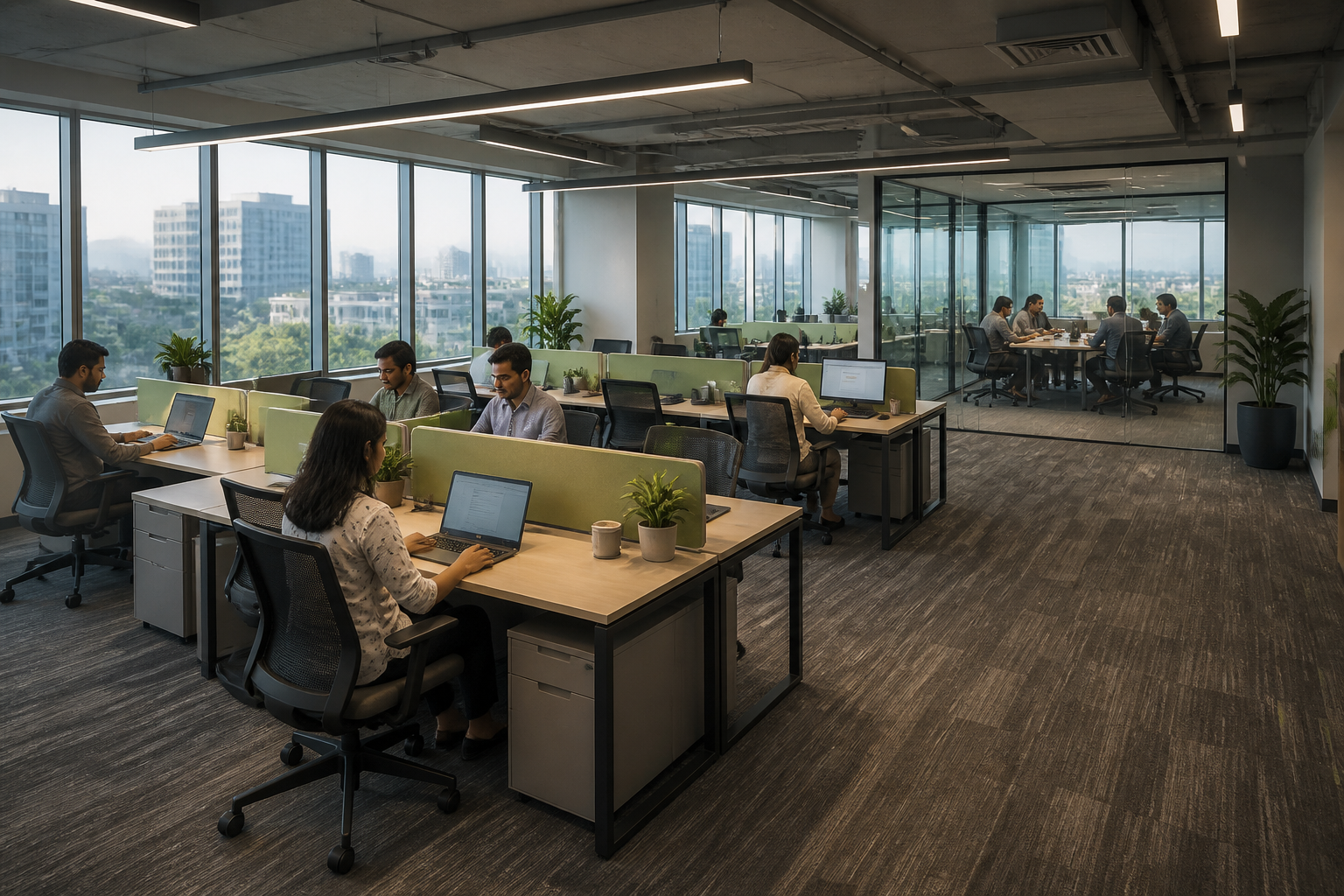
The latest office-market figures point to a change in how multinational companies are entering and expanding in Mumbai and Pune. Rather than committing immediately to independent corporate offices, more companies are choosing flexible office and coworking spaces. The shift is especially visible in the first half of 2026, when coworking operators leased 20,900 seats in Pune, a 27% increase from the 16,352 seats leased during the same period in 2025.
The numbers do not indicate that conventional offices are disappearing. They show that flexible space is becoming a more important part of the office-market structure. Across eight major Indian cities, coworking operators leased 191,306 seats between January and June 2026, 68% more than in the corresponding period of the previous year. Flexible offices accounted for 20% of total office transactions during the period, according to the report by Cushman & Wakefield cited by Loksatta.
That proportion is important because it places coworking beyond the category of a niche option for freelancers, start-ups or small businesses. The supplied figures show that large companies and global capability centres, or GCCs, are now a major source of demand. GCCs accounted for 44% of coworking transactions in the first half of 2026, up from 37% in the first half of 2025.
The underlying change is therefore not simply about companies renting desks. It is about the way multinational firms are sequencing their real-estate decisions. Flexible offices can provide managed space without requiring a company to establish an independent workplace from the outset. The report describes these facilities as effective, flexible and managed workplaces, qualities that are increasingly being preferred by companies establishing or expanding operations in Indian metropolitan areas.
Pune’s position in this shift is significant. The city recorded 20,900 coworking seats leased in the first half of 2026, placing it behind Bengaluru, Hyderabad, Mumbai and Delhi in the supplied table. Yet the Pune figure remains materially higher than the volumes recorded in Chennai, Kolkata and Ahmedabad. Its 27% year-on-year growth also indicates that flexible office demand is expanding alongside the city’s wider role as a destination for multinational and technology-linked activity.
Mumbai shows a much sharper acceleration. Coworking operators leased 25,820 seats in the city during the first half of 2026, compared with 11,226 in the same period of 2025. That represents a 130% increase. The contrast between Mumbai and Pune is useful: both are major corporate destinations, but the growth in flexible offices is not uniform. It reflects differences in the maturity of office markets, the availability and cost of conventional commercial space, and the types of companies seeking premises. The supplied report does not provide enough evidence to establish which of these factors contributed most in each city.
Bengaluru remained the largest market by volume, with 57,487 seats leased during the period. Its figure was 31.8% higher than the 43,616 seats recorded a year earlier, giving the city 30% of total coworking transactions across the eight markets. Hyderabad followed with 40,451 seats, up from 14,936, while Delhi recorded 21,970 seats, compared with 8,693 a year earlier.
The comparison shows two distinct patterns. Bengaluru represents scale: it accounted for nearly one-third of the transactions in the supplied eight-city data. Mumbai, Hyderabad, Delhi and Ahmedabad represent faster expansion, with reported growth of 130%, 170%, 152% and 570%, respectively. Ahmedabad’s percentage increase was the highest, although its absolute volume remained 4,927 seats, considerably below the larger markets. Percentage growth therefore needs to be read alongside the size of the underlying market.
Chennai recorded 16,297 seats in the first half of 2026, up 3.6% from 15,731. Kolkata recorded 3,454 seats, compared with 2,334 a year earlier, a 48% increase. These figures reinforce the broader conclusion that flexible offices are expanding across the eight markets, but at different speeds and from different market bases.
The strongest structural signal in the report is the growing role of GCCs. Global companies have increasingly preferred India for GCC investments, and the report links that investment flow with rising demand for flexible office space. The increase in the GCC share of coworking transactions, from 37% to 44%, suggests that these centres are not using flexible offices only as temporary accommodation at the margins of their operations. They are becoming a major source of demand for the sector.
However, the supplied material does not establish how long companies remain in coworking facilities, whether flexible offices later lead to independent corporate campuses, or how much of the demand represents new employment growth rather than relocation from conventional offices. Those questions matter for understanding the long-term effect on commercial real estate in Pune and Mumbai. The available data confirms increased seat leasing, but does not by itself explain the full business strategy behind each transaction.
The shift also changes the relationship between office providers and companies. In a conventional arrangement, a company typically makes a larger, longer-term commitment to a dedicated premises and manages more of the fit-out and workplace operations. In the model described in the report, the office operator supplies a managed environment, allowing the occupier to secure capacity without independently creating every workplace function. The appeal, as described by Cushman & Wakefield’s Executive Managing Director Ramita Arora, lies in the effectiveness and flexibility of these managed facilities.
This has an urban consequence. Office demand is no longer measured only by the construction of large, dedicated corporate buildings. It is also expressed through the conversion, management and leasing of flexible capacity within existing commercial districts. The source does not identify the locations of these facilities or assess their effect on transport, housing, utilities or local services. It does, however, provide evidence that the office market is absorbing demand through a more varied set of workplace formats.
For Pune, that matters because the city’s office economy is connected to a wider metropolitan system rather than a single commercial district. The supplied report does not provide a breakdown of demand by submarket, employee profile or industry. It therefore cannot establish whether the increase is concentrated in established office corridors, emerging business areas or locations close to residential and transport infrastructure. That information would be necessary to assess the effect on commuting patterns, parking demand and the relationship between employment centres and housing.
The policy landscape is similarly not detailed in the source. No specific government scheme, municipal policy, zoning change, tax measure or infrastructure intervention is identified as the cause of the increase. The evidence instead describes a market-led change involving multinational companies, GCCs and coworking operators. This distinction is important: the figures demonstrate a change in office transactions, but they do not support a conclusion that a particular public policy produced the change.
For city administrations and planners, the data nevertheless raises questions about how office infrastructure should be understood. If a growing share of employment space is delivered through flexible operators, planning and service requirements may need to account for workplaces that can expand, contract or change occupiers more quickly than conventional corporate offices. The supplied material does not answer how regulations or public infrastructure are responding, so that remains an area requiring further reporting rather than a settled conclusion.
The figures also show why the coworking market cannot be assessed through headline growth rates alone. Ahmedabad’s 570% increase is striking, but the city’s 4,927 seats represent a small base compared with Bengaluru’s 57,487 or Hyderabad’s 40,451. Pune’s 20,900 seats and 27% growth place it in a different category: the city has a substantial flexible-office market, but its expansion is more measured than the sharpest increases recorded elsewhere.
Taken together, the evidence confirms three changes. Flexible offices have become a larger part of India’s metropolitan office market; GCCs are contributing a growing share of that demand; and Mumbai and Pune are participating in the shift, with Mumbai recording particularly rapid growth and Pune showing sustained expansion. What remains uncertain is whether coworking will serve mainly as an entry and scaling mechanism for multinational companies or become a lasting substitute for a larger share of independent offices.
The next useful indicators will be the durability of the leased-seat growth, the share of GCC occupiers that move into dedicated premises, and the locations and infrastructure conditions associated with new flexible-office demand. For now, the first-half 2026 figures show that India’s corporate geography is being shaped not only by where companies invest, but also by how they choose to occupy the city.
