


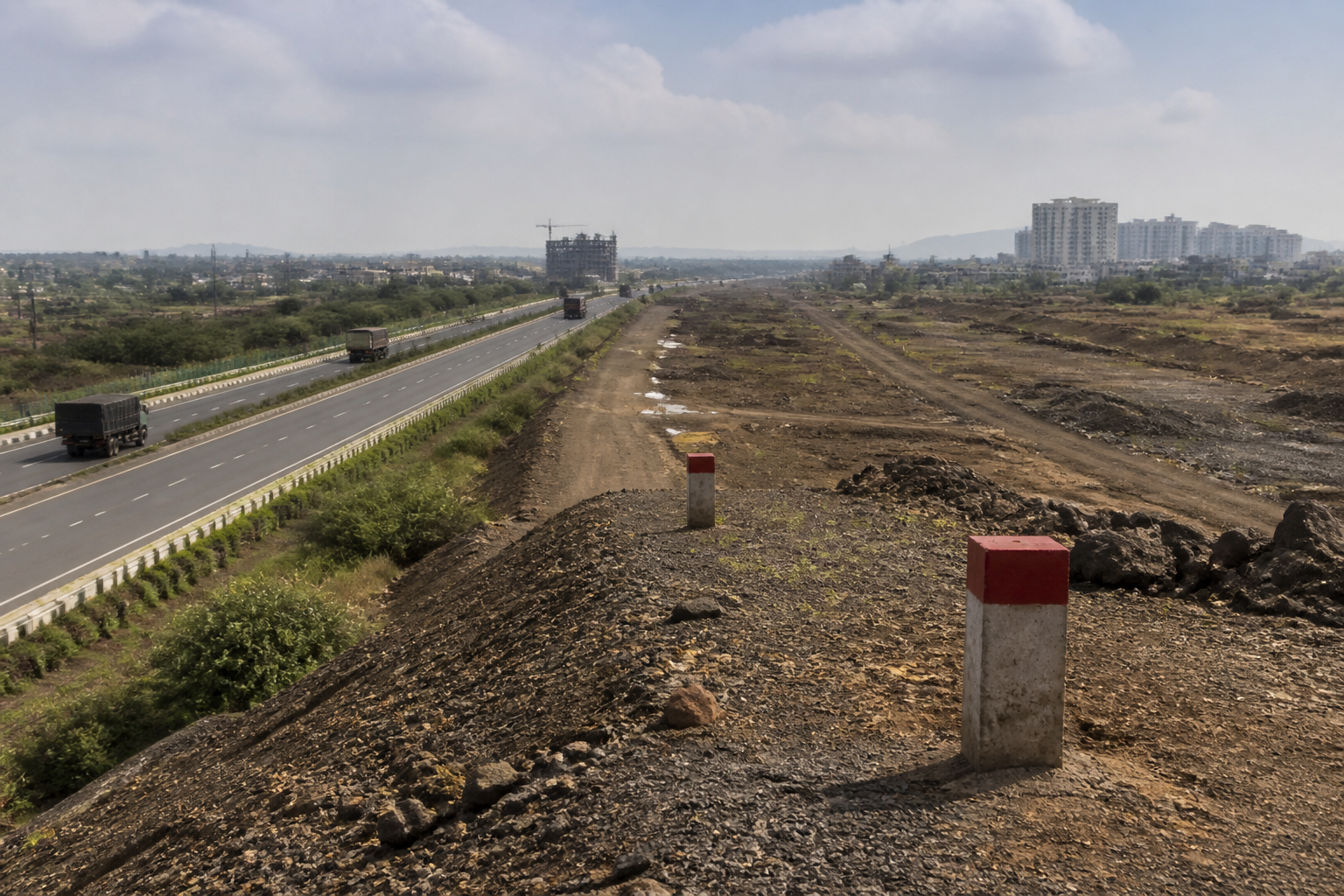
Pune-Mumbai third expressway construction was expected to begin on the Pagote–Chowk section, but the project remains held up by incomplete land acquisition and pending environmental approvals. The National Highways Authority of India has extended the tender deadline more than 15 times, and the tender was expected to open on October 1, according to a report by Loksatta – Mumbai.
The delay is not simply a question of a contractor waiting to be appointed. It reflects a more basic condition of infrastructure delivery: whether the land, statutory clearances and project documentation are ready before construction procurement moves to its decisive stage. In this case, the tender process has advanced and then repeatedly been extended because the conditions required for construction have not yet been met.
The proposed road is part of an extension of the Pune–Bengaluru Expressway towards Mumbai. The plan is to create a third high-speed road connection between Mumbai and Pune, alongside the two existing routes. The wider corridor is planned from Atal Setu through Chowk and Shivare in Pune, covering about 130 kilometres.
The project has been divided into two sections. The first, from Pagote to Chowk, is approximately 30 kilometres long. The second, from Chowk to Shivare in Pune, is expected to cover about 100 kilometres. The Pagote–Chowk section was therefore intended to form the first construction package for the larger Mumbai–Pune connection.
The stated rationale for the corridor is future traffic demand. The report links the project to plans to develop the Mumbai Metropolitan Region as a growth hub and to establish new urban centres, described in the source as a third and fourth Mumbai. As these areas expand, the number of vehicles travelling between Mumbai and Pune is expected to increase. The third expressway has been proposed on the assumption that the two existing Mumbai–Pune highways could become insufficient for that future demand.
That assumption creates a planning challenge. A road designed for future regional growth must be delivered before congestion and development pressures reach the point at which existing infrastructure is overwhelmed. But starting construction before land and environmental requirements are secured can create a different set of risks, including disputes, redesign, stoppages and further cost or schedule pressure. The present delay shows the tension between these two timelines.
The first tender for the Pagote–Chowk section was issued in 2024 after the project plan was finalised. It was extended repeatedly and was eventually cancelled in 2025. A fresh tender was issued in August 2025, but that tender too has received multiple extensions. The report says the deadline has now been extended more than 15 times, with October 1 identified as the next expected date for opening the bids.
The repeated extensions are significant because a tender opening is not the same as construction commencement. Tender opening allows the authority to examine bids and proceed with the procurement process. Construction can begin only after the project meets the applicable land acquisition and approval requirements and after the contract is awarded and mobilised. The current position therefore indicates that even if bids are opened, work would still depend on subsequent procedural and site-readiness milestones.
NHAI regional manager Anshumali Shrivastava confirmed that the tender had been extended again. According to the report, he said that under NHAI rules, 90 per cent of the project’s land acquisition must be completed and all environmental approvals must be obtained before construction can begin. He also stated that land acquisition and the required permissions were still pending.
Officials associated with NHAI said the land acquisition process was under way and would be completed soon. However, the report does not provide a current percentage for land already acquired, a detailed parcel-wise schedule, the status of individual environmental permissions, or a revised construction start date. Those omissions matter because the 90 per cent threshold is the clearest available indicator of whether the project is close to physical execution.
The project’s present status also illustrates the difference between announcing a corridor and making it buildable. A highway can have a defined alignment, a stated length and an identified strategic purpose while still remaining unavailable for construction. Land acquisition converts a planned line on a map into an accessible worksite. Environmental permissions establish whether and under what conditions the project can proceed. Until both processes reach the required stage, procurement cannot reliably translate into physical progress.
The sequence of the tender history suggests that procurement has been running ahead of site readiness. The first tender was released in 2024, cancelled in 2025 and replaced with a new tender in August 2025. Since then, the authority has continued to extend the deadline rather than move directly to construction. The source attributes this pattern to the pending land acquisition and environmental approvals, not to a reported failure of bidders or a disclosed technical redesign.
This distinction is important for assessing what the delay does and does not establish. It establishes that the Pagote–Chowk package has not reached construction and that the tender has been extended repeatedly. It does not, on the basis of the supplied information, establish the final cost of the project, the extent of compensation disputes, the number of affected properties, the specific environmental issues involved, or whether the October 1 deadline will be met.
The 130-kilometre scale of the planned corridor adds another layer of coordination. The first package is only about 30 kilometres, while the second section is expected to account for roughly 100 kilometres. Work on one section cannot by itself demonstrate that the entire Mumbai–Pune extension is ready. The corridor’s effectiveness will depend on how the two sections connect, how access is integrated with existing roads and how the route interacts with the urban growth areas identified in the plan. The supplied report does not provide those implementation details.
Nor does it establish how the new expressway would affect the existing Mumbai–Pune Expressway and the old Mumbai–Pune highway. The stated policy logic is that future traffic growth could make the current routes inadequate, but the report contains no traffic counts, capacity assessments or forecasts. The case for the third expressway is therefore presented as a regional planning rationale rather than as a quantified traffic analysis.
This is the central evidence gap in the project narrative. The need for a new corridor has been connected to anticipated growth and rising vehicle numbers, but the available information does not show the baseline traffic volumes, projected demand, planned interchanges or expected travel-time benefits. Without those figures, it is not possible to assess whether the proposed road is being timed against a clearly measured capacity problem or a broader development vision.
The institutional framework is clearer. NHAI is responsible for the highway project and its tendering process. Land acquisition and environmental permissions are prerequisites that involve processes beyond the act of awarding a construction contract. The regional manager’s comments indicate that NHAI is applying a readiness threshold before construction begins. That threshold may delay visible progress, but it is also intended to reduce the risk of launching work on land or under approvals that are incomplete.
For the cities and regions connected by the project, the immediate issue is therefore not only whether a third expressway will eventually be built. It is whether the project’s land, environmental and procurement processes can be brought into alignment. The report indicates that land acquisition is continuing and that approvals remain pending, while the tender deadline has moved repeatedly. Until those elements converge, the project will remain in a pre-construction phase regardless of the strategic importance assigned to the corridor.
The next test is the tender opening expected on October 1. That date will show whether bids are received and examined or whether another extension is announced. It will not, by itself, resolve the larger readiness question. The more consequential milestones will be the completion of 90 per cent land acquisition, receipt of the required environmental permissions and the announcement of a confirmed construction start. The supplied information confirms the delay, but not yet the timetable for overcoming it.
