


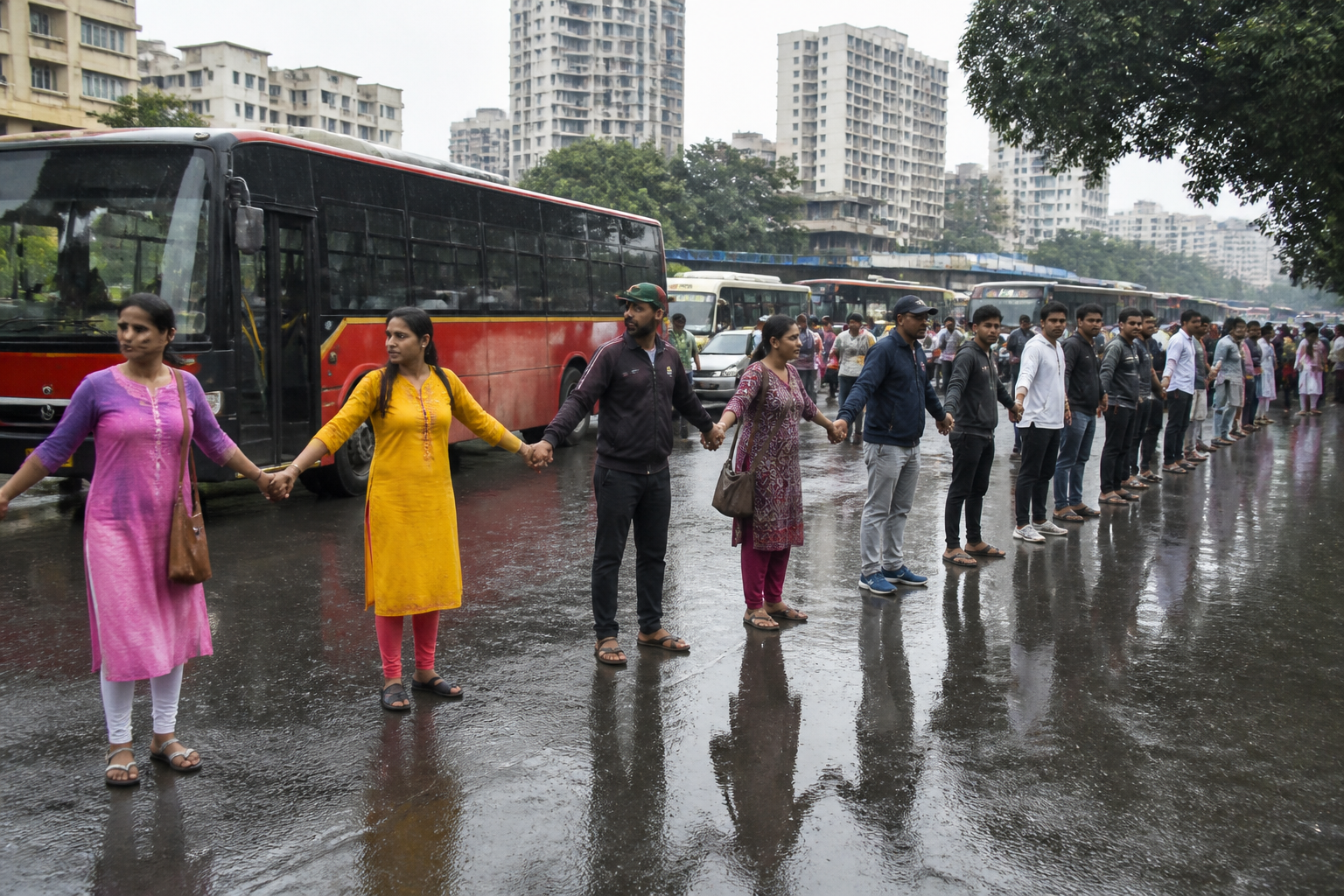
The proposed Rs 12,100-crore Thane Integral Ring Metro has moved from a transport infrastructure proposal to a broader test of how the city defines mobility, displacement and public accountability. Several hundred residents protested on Sunday, forming a human chain from Swami Junction to Prashant Corner and demanding that the government improve buses and roads before committing to another major rail corridor, according to a PTI report published by Mid-Day.
The demonstration, organised by the Thane Against Ring Metro group, was not limited to opposition to a single construction project. Protesters questioned whether the city’s immediate mobility problems are being addressed in the right order. Their demands included a larger Thane Municipal Transport fleet, higher service frequency and better road connectivity to areas with limited public transport. The argument is straightforward: a new metro may expand the city’s rail network, but it cannot by itself resolve gaps in the everyday system that takes passengers to and from stations.
That distinction is important because the debate is not simply between metro supporters and metro opponents. It is about the relationship between a large, long-term capital project and the existing public transport network. Activist Radhika Rane, according to the report, called for ridership figures from Thane’s existing metro lines to be properly assessed before the government commits to another major rail project. The demand places evidence of current use at the centre of the decision-making process, although the report does not provide those ridership figures or indicate whether a formal assessment has been released.
The proposed corridor is also generating concerns beyond transport performance. Environmentalists and protesters raised objections over the possible cutting of around 3,900 trees. Activist Rohit Joshi said the city had been without a Tree Authority Committee for nearly six months, meaning citizen objections had not been formally considered through a public hearing. The report records the claim but does not establish the full administrative status of the committee or the precise stage of permissions for tree removal. Those details will matter because the environmental question is tied to the project’s approvals, alignment and construction method rather than to the headline tree count alone.
The project’s route is similarly unsettled in the public discussion. A high-level presentation at the Thane Municipal Corporation on Friday brought together elected representatives and citizens’ groups, but participants said displacement surveys were incomplete and that there was insufficient clarity over the proposed alignment. MahaMetro Managing Director Shravan Hardikar made the presentation. Representatives said concrete rehabilitation plans had not yet been provided for an estimated 1,400 to 1,500 families likely to be affected in Lokmanya Nagar, Manoramanagar and Sevalal Nagar.
This makes rehabilitation a central measure of project preparedness. Land acquisition and construction feasibility can be presented as technical stages, but the route passes through lived neighbourhoods whose residents may face relocation, access changes or prolonged construction disruption. If surveys are incomplete, the administration’s understanding of the social cost is also incomplete. The reported estimate of affected families therefore remains a planning figure that needs to be matched with household-level surveys, eligibility criteria, relocation arrangements and a publicly explained timeline.
The political and administrative coordination around the corridor has added another layer of uncertainty. State Transport Minister Pratap Sarnaik expressed displeasure at being excluded from discussions on route-alignment decisions, according to the report. NCP-SP MLA Jitendra Awhad criticised the administration, claiming that about 30 per cent of slum surveys remained incomplete. These statements do not by themselves establish the final status of the surveys or the decision-making process, but they show that the project’s institutional chain is not being presented as settled by all stakeholders.
At the same time, MahaMetro has provided some technical information. It said underground tracks near Thane station would be built at a depth of around 20 metres and that safety clearances would be required for construction of buildings within five metres of the underground alignment. These details indicate that the project involves more than the visible construction of elevated infrastructure. The underground section will affect building controls, construction permissions and coordination with existing properties around the station area. The report does not specify the full length of the underground section, the number of properties affected by the five-metre rule or the process through which those clearances will be administered.
Thane Municipal Commissioner Saurabh Rao said around 70 per cent of the proposed route alignment was already available and that land acquisition would be accelerated. He also said the civic body and MahaMetro would prioritise the rehabilitation of affected residents. Rao further said written suggestions from elected representatives and other stakeholders would be collected and considered for inclusion in the Detailed Project Report, or DPR. The DPR is expected to be prepared by January 2027, according to the report.
These assurances place the project at an important intermediate stage. The route is sufficiently developed for land availability and rehabilitation to be publicly discussed, but the DPR has not yet been completed. That means the project’s final configuration, cost assumptions, implementation details and mitigation measures may still be subject to change. The reported 70 per cent alignment availability should not be read as 70 per cent land acquisition or construction readiness; the report does not equate the two. The distinction is essential in a project where the remaining alignment could contain some of the most difficult properties, settlements or environmental constraints.
The dispute also exposes a recurring challenge in urban transport planning: the tendency to evaluate infrastructure modes separately rather than as a network. Residents’ demand for more TMT buses and better roads does not necessarily answer whether the Ring Metro is needed. Conversely, the proposal of a new metro does not answer how passengers will reach stations, how underserved areas will be connected, or how service quality will be maintained during construction. The supplied report provides no comparative analysis of bus capacity, existing metro ridership, projected demand or the cost of improving surface transport. Those gaps are precisely what the public debate is now asking authorities to address.
The project’s reported cost of Rs 12,100 crore also makes the quality of the evidence significant. A capital commitment of this scale requires clarity on the problem being solved, the areas to be served, the expected users, the construction risks and the people who will bear the disruption. Yet the available account shows that several foundational questions remain active: the alignment is still being discussed, slum surveys are reportedly incomplete, rehabilitation plans have not been concretely provided, and the status of tree-related public consultation is contested.
The environmental issue cannot be separated from route design. If around 3,900 trees are potentially affected, the public needs to know whether that figure refers to trees directly on the alignment, construction sites, access roads or associated facilities. The report does not provide that breakdown. Nor does it state the proposed mitigation or compensatory measures. Until those details are placed in the public record, the environmental cost remains a prominent but incompletely defined part of the proposal.
Similarly, the social impact cannot be resolved through a general assurance that rehabilitation will receive priority. The affected locations named in the report—Lokmanya Nagar, Manoramanagar and Sevalal Nagar—will require a clear account of who has been surveyed, who qualifies for assistance, where residents would be moved and how livelihoods and access to services would be protected. The report does not establish whether a rehabilitation framework has been approved. It does establish that elected representatives and citizen groups say the available information is insufficient.
The next formal milestone is the DPR expected by January 2027. Before then, the administration has said it will collect written suggestions and accelerate land acquisition. That sequence creates a need for public clarity about what can still change through consultation and what decisions have already been taken. It also raises a procedural question: whether consultation will influence the route and rehabilitation design, or merely record objections after the principal choices have been made.
The Thane Ring Metro debate therefore remains unresolved on three connected fronts. The first is transport: whether the city’s existing bus and metro systems have been assessed sufficiently to justify another rail investment. The second is land and housing: whether displacement surveys and rehabilitation planning are complete enough to support the proposed alignment. The third is governance: whether the civic body, metro agency, elected representatives and affected communities are operating from the same set of verified project documents.
What the protest confirms is that the project’s public legitimacy will depend on more than its engineering case. What remains uncertain is the evidence supporting the demand forecast, the final route, the number and status of affected households, the tree-impact assessment and the relationship between the Ring Metro and TMT improvements. The DPR, the completion of surveys, the treatment of written stakeholder submissions and the promised rehabilitation details will be the next documents and decisions to watch.
