


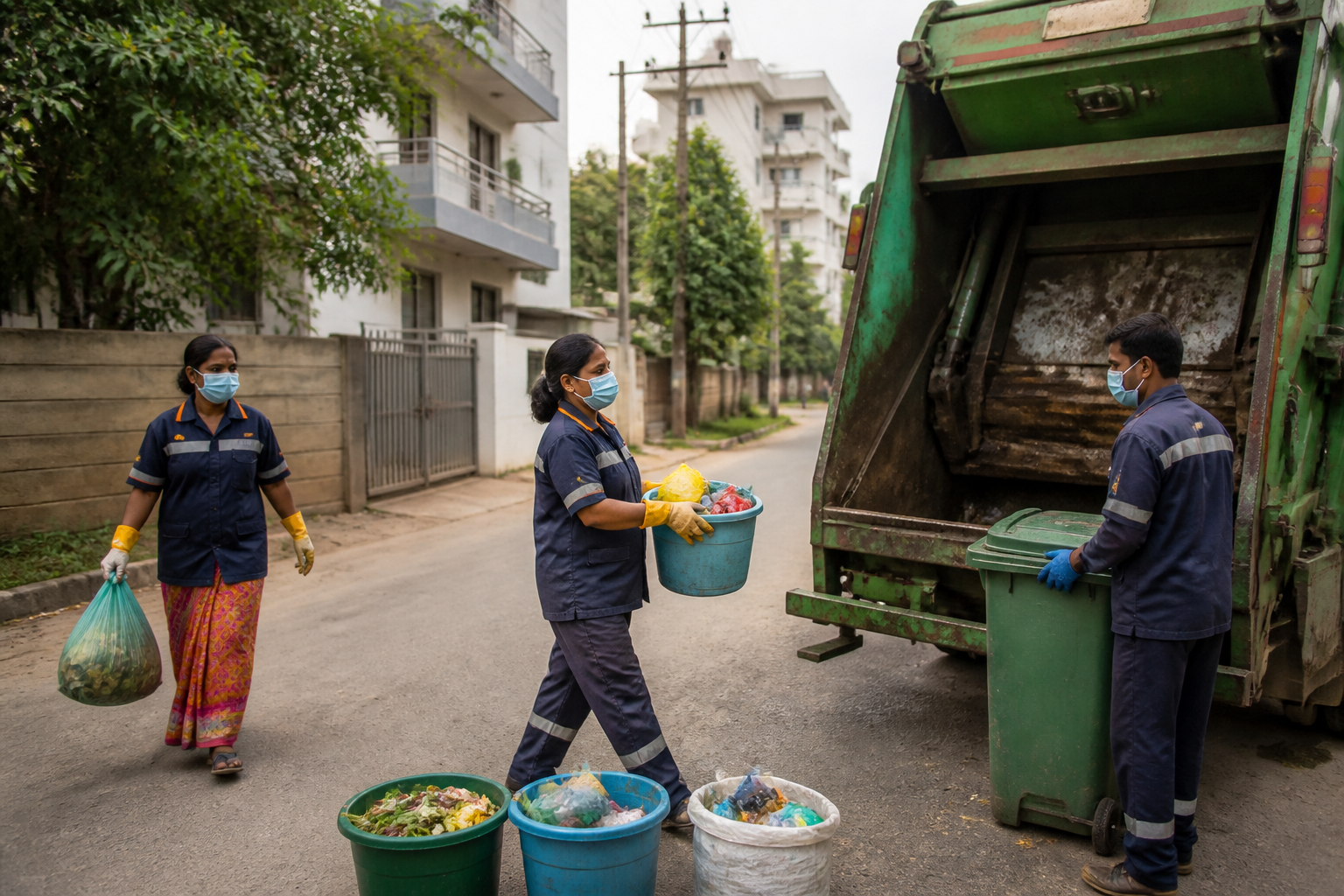
A minister’s remarks about absenteeism among Bengaluru’s pourakarmikas have triggered a wider debate about how the city organises sanitation work. The immediate dispute concerns whether workers who do not report for duty should be considered for permanent employment. But the response from labour activists has shifted attention towards wages, safety, caste, contractor control, waste segregation and the administration’s responsibility as an employer.
The controversy began after Bengaluru Development Minister Krishna Byre Gowda questioned pourakarmikas demanding regularisation. According to the report, the minister said that 30% of workers did not report for work daily and asked whether they should be made permanent when the city remained unclean and residents blamed the government. The comment was criticised by activists, who argued that attendance concerns should be addressed administratively rather than through public condemnation of workers.
The dispute is not simply about a minister’s choice of words. It exposes a tension at the centre of municipal service delivery: cities expect sanitation workers to maintain public spaces and remove household waste, while the employment arrangements governing that work can leave many workers without stable pay, social security or adequate protection. The available account does not establish the minister’s attendance figure independently, nor does it provide a complete official breakdown of the workforce. It does, however, record a detailed set of concerns from named activists about the conditions under which sanitation services are delivered.
Vinay Sreenivasa, a labour activist quoted in the report, said the government should focus on decent wages, safe working conditions and protection from exploitation by contractors. He also questioned why sanitation workers should remain on contract when senior administrative positions are not generally treated in the same way. In his view, any attendance problem should be dealt with through administrative mechanisms, while workers who regularly report for duty should not be made to bear the burden of wider staffing or management failures.
That distinction matters because absenteeism can be both an individual conduct issue and a symptom of an institutional problem. If attendance records are inaccurate, supervision is weak or workers are deployed through multiple contractors, the administration may struggle to determine where responsibility lies. If workers are absent without authorisation, the city needs a fair and enforceable process. If staffing shortages, delayed wages, excessive workloads or poor working conditions are contributing to absence, disciplinary action alone cannot resolve the service failure. The report presents these possibilities as part of the activists’ critique; it does not provide enough evidence to determine their relative importance.
The social composition of the workforce is another central part of the debate. Sreenivasa said most pourakarmikas are Dalits and that a majority are Dalit women. Clifton D’Rozario, another activist cited in the report, similarly said sweepers are primarily Dalit women. These observations place sanitation work within a longer history of caste-linked labour, in which certain communities have been disproportionately assigned or recruited into work involving waste and human exposure to hazardous materials.
D’Rozario also drew a distinction between different categories of sanitation workers. He said sweepers were made permanent during Siddaramaiah’s tenure as chief minister, while workers associated with garbage-collection vehicles continued under contract arrangements. According to his statement, those contract workers lacked monthly pay, weekly holidays, Employees’ State Insurance and provident fund benefits. These claims are attributed to D’Rozario in the source report and would require official employment records for independent verification.
The distinction between sweeping and waste collection is important for understanding why the term pourakarmika can conceal different employment realities. A worker sweeping a street, a worker collecting household waste and a worker travelling with a garbage vehicle may face different supervisors, contracts, equipment requirements and payment arrangements. Treating them as a single category can make it harder to identify which workers receive job security and social protection, and which remain dependent on contractors.
The report also raises questions about the physical process of waste collection. D’Rozario described workers handling rotting waste without adequate protection and referred to workers travelling on top of garbage-laden autos. He questioned whether Dalit women were being required to drag bags of garbage and whether workers were handling waste with their bare hands. These descriptions are activist allegations, not independently documented findings in the supplied material. They nevertheless point to a basic administrative question: whether the city’s sanitation system is designed around safe work procedures or depends on workers absorbing risks that should be managed through equipment, training and operational planning.
Waste segregation is part of the same chain. Activists argued that responsibility for segregation should begin with households and other waste generators, rather than being shifted entirely to sanitation workers after mixed waste has already been discarded. Sreenivasa asked whether the same criticism directed at workers would be applied to residents from middle- and high-income groups who fail to segregate waste at source. D’Rozario also referred to penalties for residents who do not comply with segregation requirements.
This argument does not remove the need to address worker attendance. It changes where the administration looks for accountability. A sanitation system depends on several linked actions: households must separate waste, collection systems must operate on schedule, supervisors must maintain attendance records, contractors must meet employment obligations, and the civic authority must monitor safety and service quality. A failure at one point in that chain can increase pressure on workers at another. Blaming the final worker in the process may therefore leave the preceding failures unexamined.
D’Rozario referred to the 1976 IPD Salappa report and the 2013 Three-man Committee report, saying both had highlighted occupational health hazards associated with sanitation work. He also questioned what had happened to a decision to provide workers with regular health check-ups. The source report does not reproduce the recommendations or implementation status of those documents, so it cannot establish whether the commitments were adopted, funded or monitored. Their mention does, however, suggest that the concerns being raised are not entirely new and that the city has previously examined the risks attached to sanitation labour.
The institutional problem is therefore one of continuity as much as policy. Reports and committees can identify hazards, but workers benefit only when recommendations become enforceable procedures, budgeted programmes and monitored obligations. Regular medical examinations, protective equipment, weekly leave, timely wages and social-security coverage require clear responsibility. Where work is outsourced, the administration must also ensure that contractual arrangements do not obscure who is responsible for compliance.
D’Rozario called for weekly leave, legal holidays, timely payment, safety equipment, social security and job security. He also demanded an end to exploitation through contract and outsourcing systems and advocated direct payment to workers. These are policy demands rather than established changes in the city’s system. The report does not state whether the government has accepted them or announced a response.
Ashwin Mahesh, another activist quoted in the report, offered a more qualified view of the attendance dispute. He said absenteeism among workers expected to be on duty must be addressed, but argued that workers who regularly attend should not be required to compensate for systemic failures. His formulation captures the administrative challenge: a city needs both service discipline and fair employment conditions. Neither objective can be secured by ignoring the other.
For Bengaluru, the larger question is whether sanitation is being managed as a public service or treated primarily as a low-cost labour function. The answer can be seen in the details of employment, equipment, payment, supervision and waste handling. It can also be seen in whether residents are required to segregate waste and whether those rules are enforced consistently. The controversy has brought those connected responsibilities into the same frame.
What the available evidence confirms is that a public argument over absenteeism has exposed unresolved questions about the organisation of sanitation work. What remains uncertain is the scale of absenteeism, the number of workers affected by contractual employment, the extent of compliance with wage and social-security obligations, and the current status of occupational-health measures cited by activists. Those are the facts the administration would need to publish if it wants the debate to move from accusation to accountability.
