


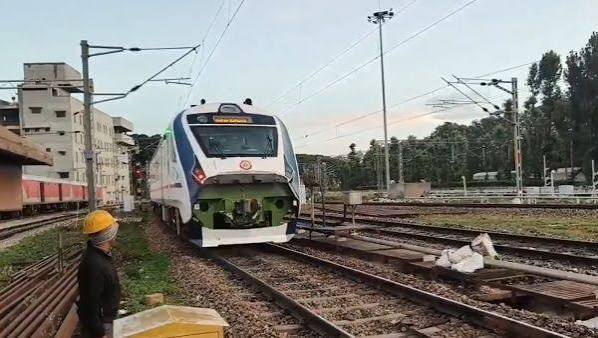
The trial run of a 16-car Vande Bharat Express between Yesvantpur and Mangaluru Central is a limited operational step, not yet a confirmed passenger-service launch. Announced by the Bengaluru divisional railway manager on September 5, the exercise is intended to assess running times on the route. Its larger significance lies in how Indian Railways is testing the operational fit of a premium semi-high-speed train on a roughly 360-kilometre corridor linking Bengaluru with Karnataka’s coastal region.
The announcement places the Yesvantpur–Mangaluru Central route within a wider expansion of Vande Bharat services. The source report describes the proposed service as Karnataka’s 13th Vande Bharat connection, following the operation of 12 pairs of such trains in the state. It also identifies the trial as a potential strengthening of connectivity between Bengaluru and Mangaluru. At this stage, however, the available information confirms a trial and its assessment objectives; it does not confirm a commercial inauguration date, passenger timetable, fare structure or final stopping pattern.
That distinction matters because a trial run is designed to produce operating information before a regular service is approved. The Bengaluru DRM said the exercise would examine the timing of the run. The official communication also stated that senior officials and staff from operations, electrical and traction distribution, engineering and mechanical departments would monitor operational and safety factors. The trial therefore represents a coordinated railway assessment rather than a public-service launch announcement.
The route itself is central to understanding the development. Yesvantpur is a major railway location in Bengaluru, while Mangaluru Central serves the coastal city of Mangaluru. The reported corridor is approximately 360 kilometres long. A Vande Bharat service on this alignment would connect the Bengaluru metropolitan region with the coast through an existing railway route, but the supplied material does not provide the route’s detailed gradients, curves, signalling constraints, station schedule or current passenger-service timings. Those factors would be relevant to any final decision on commercial operations, yet they remain outside the evidence available in the announcement.
The use of a 16-car train is another confirmed feature of the test. The white-and-blue train shown in the video shared by the Bengaluru DRM is described as a new Vande Bharat rake. The train’s configuration indicates the scale of the proposed operation, but it does not by itself establish the number of seats that would be offered to passengers, the service frequency or whether the same rake would operate the eventual commercial schedule. Those details would need to come from a formal railway notification or timetable announcement.
The trial also shows how the introduction of a premium train depends on more than rolling stock. The departments identified in the official communication cover several parts of railway operations: train movement, electrical and traction systems, civil engineering and mechanical performance. Their involvement suggests that the exercise is intended to examine the interaction between the train and the route as a complete railway system. The source does not disclose the measured timings, speed profile, technical observations or any restrictions identified during the run, so no conclusion can yet be drawn about the final journey duration.
This is particularly important for a service marketed around faster and more comfortable travel. The source report describes Vande Bharat trains as premium chair-car services and says their network has expanded since the series began in 2019. But the benefit of a new service is determined not only by the train’s design. It also depends on the condition and capacity of the route, the number of existing services, maintenance requirements, timetable priority and the ability to sustain the promised operating pattern. None of those final commercial parameters is established by the trial announcement.
The announcement therefore provides evidence of intent and testing, not of completed implementation. A trial can help the railway determine how the train performs on a particular corridor and how long the journey may take under the conditions examined. It can also give operating departments an opportunity to review safety and technical factors before a service is considered for passengers. The official statement is clear about the purpose of the run, but it does not state that all approvals have been completed or that bookings will open.
The wider Vande Bharat programme gives the trial its national context. According to the supplied report, 162 Vande Bharat services are currently operating across the country. The report also says the railway system is expanding beyond daytime chair-car services towards overnight journeys through Vande Bharat sleeper trains. It cites a January 2026 occupancy figure of more than 100 percent for Vande Bharat Sleeper, but the source does not explain the methodology, route coverage or period used to calculate that figure. It should therefore be treated as a reported claim rather than an independently assessed national performance measure.
The report further refers to a plan for 260 Vande Bharat sleeper rakes, with production attributed to Bharat Earth Movers Limited, Chennai’s Integral Coach Factory, Kinet Railway Solutions and the Titagarh-BHEL grouping. These figures describe a reported manufacturing plan and concern the wider sleeper programme, not the Yesvantpur–Mangaluru trial. They should not be read as evidence that sleeper trains are planned for this Karnataka route. The train tested on the route is specifically described as a 16-car Vande Bharat service, while no coach type beyond that description is confirmed for a future passenger operation.
The Karnataka figure also requires careful reading. Calling the proposed route the state’s 13th Vande Bharat service indicates the scale of the state’s participation in the programme as described by the source. It does not mean that the state will receive a completely separate network independent of national railway planning. Vande Bharat services operate within the broader railway system, and their launch depends on decisions involving route feasibility, rolling-stock availability, operating schedules and formal approvals. The announcement does not identify which of those steps remain pending.
For passengers, the immediate question is not simply whether the train has appeared on the track, but when and under what conditions it can be used. The supplied material does not provide a launch date, ticket price, reservation status, intermediate halts or weekly frequency. It also does not establish whether the proposed service would replace, supplement or be coordinated with existing trains on the corridor. Those are the practical details that will determine the service’s effect on travel between Bengaluru and Mangaluru.
For the railway administration, the next stage is to convert trial information into an operating decision. That process would require the results of the timing assessment and the observations made by the operational, electrical, engineering and mechanical teams. The source does not disclose the findings of those teams. Until an official timetable or service notification is issued, the trial should therefore be understood as evidence that the route is being evaluated for Vande Bharat operations, not as confirmation that regular passenger service has begun.
The Yesvantpur–Mangaluru trial thus captures both the momentum and the limits of India’s semi-high-speed rail expansion. It shows a new train being tested on a regional corridor and places Karnataka within the reported growth of the Vande Bharat network. At the same time, it demonstrates that a visible trial run is only one stage in the process. What is confirmed is the 16-car test and its assessment of timings and operational and safety factors. What remains to be established is the final timetable, commercial approval, passenger fare, stopping pattern and launch date. Those are the developments that will determine whether the trial becomes a regular connection between Bengaluru and Karnataka’s coast.
