


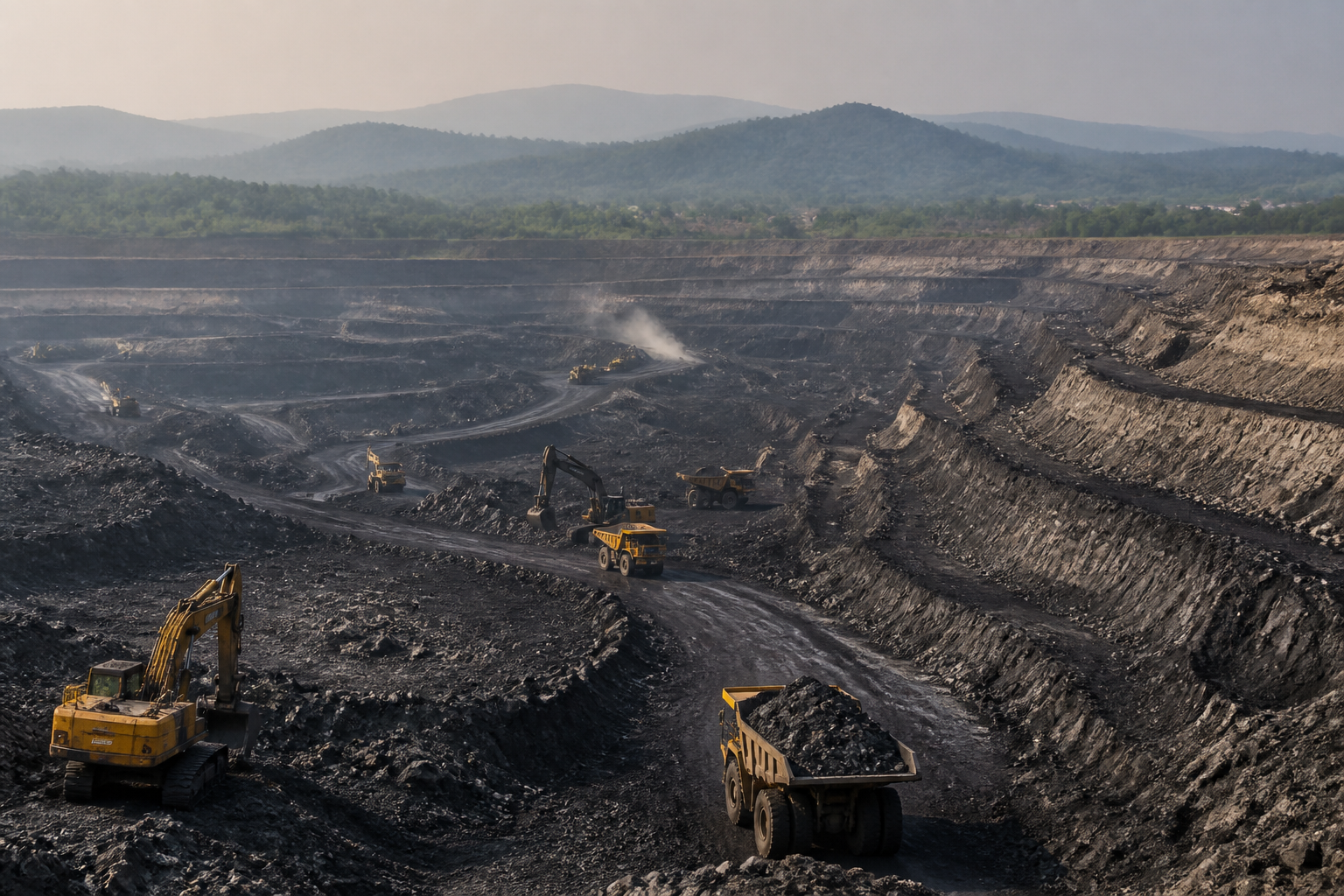
NMDC is preparing to begin commercial thermal coal production in the October-December quarter and plans to sell up to 1 million tonnes of the fuel in FY27. The move marks the first visible step in the state-owned mining company’s effort to reduce its near-total dependence on iron ore and become a broader supplier of minerals used by India’s industrial economy.
The announcement, made by NMDC Chairman Amitava Mukherjee in an interview with PTI, is significant because the company remains overwhelmingly identified with iron ore. Hyderabad-based NMDC operates under the Ministry of Steel and, according to the report, supplies around 20 per cent of India’s iron ore requirement. Its diversification into thermal coal and coking coal therefore represents more than an additional mining project. It is an attempt to reposition the company within the wider chain linking mineral extraction, steel production, power generation and infrastructure construction.
Mukherjee said NMDC had reached the coal seam at the Tokisud North coal mine and that production would begin by the next quarter. The company acquired the Jharkhand mine through an auction conducted by the coal ministry. Tokisud North has reserves of 52 million tonnes and an annual peak rated capacity of 2.3 million tonnes, according to the information provided in the report.
NMDC’s immediate sales target is considerably below the mine’s stated peak capacity. The company expects to sell a maximum of 1 million tonnes of thermal coal in FY27. That gap is important because it indicates that the first phase of the project will be about establishing commercial production and building operating capacity rather than immediately using the mine’s full rated potential. The report does not provide a detailed production ramp-up schedule, customer list or expected revenue contribution from the asset.
Thermal coal is primarily used in power generation, while coking coal is an important input for steel manufacturing. NMDC is also developing the Rohne coking coal block in Jharkhand, which it won in the same auction process. The block has reserves of 191 million tonnes and a peak rated capacity of 8 million tonnes. Mukherjee said development would begin within FY27, with production potentially starting as early as FY28.
Together, the two projects give NMDC exposure to two different parts of the industrial raw-material system. Thermal coal expands the company’s presence in fuel used for power generation. Coking coal creates a link with steelmaking, the sector in which NMDC already has a strategic position through its iron ore operations. The company’s stated plan is therefore not simply to add another commodity, but to build a portfolio that covers more of the mineral requirements of growing industries.
That strategy is reflected in the company’s stated 2030 objective. Mukherjee said he wanted at least 20 per cent of NMDC’s revenue to come from minerals other than iron ore by 2030. He described the company as currently being 99.9 per cent an iron ore business and said NMDC would continue looking for opportunities in more minerals, both in India and abroad. The report does not identify the additional minerals under consideration or specify how the company will finance and sequence those acquisitions.
The diversification plan also has to be read against NMDC’s continued expansion in iron ore. The company reported revenue of Rs 31,554 crore in FY26, a 33 per cent increase from Rs 23,668 crore in FY25. It produced a record 53 million tonnes of iron ore in FY26, compared with 44 million tonnes in FY25, representing a 20 per cent year-on-year increase. NMDC remains on track, according to Mukherjee, to achieve its goal of producing 100 million tonnes of iron ore by 2030.
This creates a two-track growth strategy. The first track is the expansion of the existing iron ore business, supported by operations in the Bailadila sector of Chhattisgarh and the Donimalai sector of Karnataka. The second is the development of a multi-mineral portfolio through coal and potentially other resources. The challenge for the company will be to execute both without allowing diversification to weaken the production trajectory of its core business.
For construction and infrastructure markets, NMDC’s plans are relevant because the availability of mineral inputs influences the capacity and cost structure of industrial development. Iron ore supports steel production, while coking coal is another key raw material in the steelmaking process. Thermal coal is connected to power generation. The supplied material does not establish how NMDC’s planned output will affect prices, regional availability or import dependence, but it does show an effort by a major public-sector miner to participate in multiple points of the industrial supply chain.
The institutional structure behind the projects is also notable. NMDC’s existing role is closely associated with the Ministry of Steel, while the coal blocks were secured through auctions conducted by the coal ministry. Moving from block allocation to commercial production will require the company to complete the development and operational steps associated with mining the two assets. The report confirms the production targets and capacities, but does not provide details on approvals, mine plans, infrastructure connections, environmental compliance or logistics arrangements.
Those missing details will determine how quickly the announced strategy becomes an operating business. For Tokisud North, the immediate milestone is the start of commercial production in the October-December period and the sale of up to 1 million tonnes in FY27. For Rohne, the next milestone is development during FY27, followed by a possible production start in FY28. The company’s broader 2030 goal will be measured by the share of revenue generated from non-iron-ore minerals, rather than by announcements alone.
The available evidence confirms that NMDC is moving from a predominantly iron-ore model towards a broader mineral portfolio. It also shows that the company’s core business is expanding at the same time, with record iron ore production and higher revenue in FY26. What remains uncertain is the scale, timing and commercial contribution of the coal assets, as well as the identity of the other minerals NMDC may pursue. The next developments to watch are the start of Tokisud North production, the first reported thermal coal sales, progress at Rohne and any further disclosure on the company’s 2030 diversification roadmap.
