


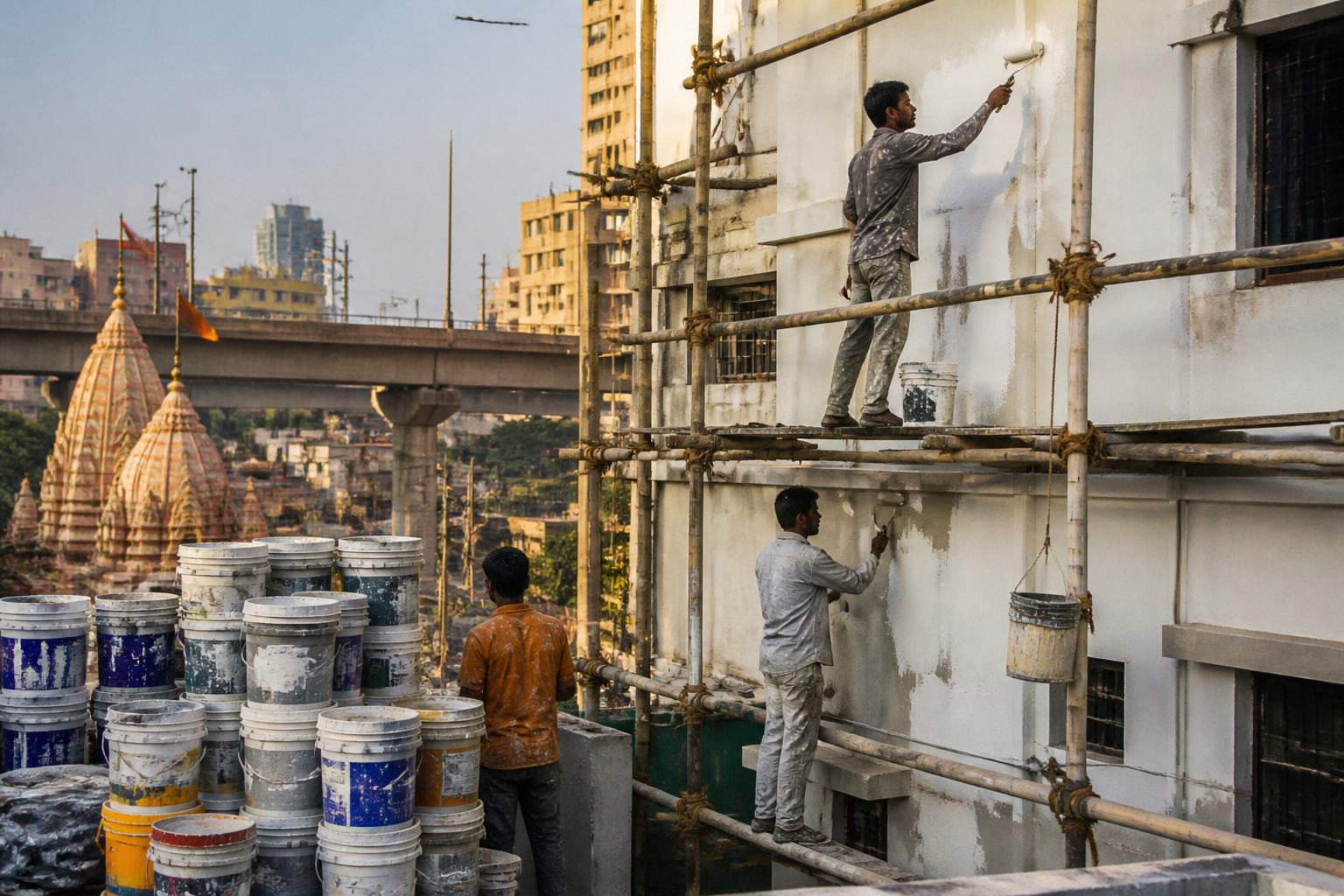
India’s leading paint companies are entering the festive season with a relatively clear message: demand remains supportive, but growth is becoming harder to convert into margins and market share. Asian Paints, Berger Paints, Kansai Nerolac and JSW Dulux have all indicated that housing, infrastructure, construction and automotive activity should continue to support sales. At the same time, companies are raising prices to offset input costs and confronting stronger competition across economy, premium and luxury categories.
That combination makes the current outlook less a simple demand-recovery story than a test of how India’s paint industry is adapting to a more contested market. Companies are reporting healthy or double-digit growth expectations, but they are doing so against a backdrop of crude-linked raw materials, geopolitical uncertainty, supply-chain risks, currency depreciation and aggressive efforts to win contractors, dealers and consumers.
Asian Paints, the country’s largest paintmaker, expects volume growth of 8-10 per cent for FY27. Managing Director and CEO Amit Syngle described demand conditions during the June quarter as “decent” and said the company expected the festive period to support activity through the later quarters of the financial year. The company reported a 39.6 per cent rise in consolidated net profit to Rs 1,559.45 crore for the June quarter of FY27, while revenue from operations increased 18 per cent to Rs 10,541.94 crore.
The numbers, however, point to a differentiated geography of demand. Syngle said growth in metro and large urban markets, classified by the company as T1 and T2 markets, trailed growth in smaller towns, or T3 and T4 markets. The shortfall in larger cities was offset by government-led business-to-business spending, according to his comments. This suggests that the paint cycle is being supported by more than one source: household and smaller-town demand on one side, and public or institutional spending in larger urban centres on the other.
That distinction matters because paint demand is closely linked to the condition of the built environment. Decorative paints receive support from home construction, renovation and repainting, while industrial paints are connected to infrastructure, manufacturing and automotive activity. When urban household demand is uneven, infrastructure and institutional projects can provide an alternative channel for volume. The information available from the companies does not establish how large each channel is, but it shows that manufacturers are watching them separately rather than treating the market as a single national trend.
Berger Paints has also projected double-digit revenue growth through FY27. Managing Director and CEO Abhijit Roy said volume growth in the second quarter could be around 7.5-8 per cent, compared with 8.5 per cent in the first quarter. Price increases of approximately 7.5-8.59 per cent, varying by category, are expected to contribute to revenue growth. The full-quarter effect of price increases taken in the second quarter is also expected to support the company’s reported performance.
This distinction between volume and value is central to understanding the sector’s outlook. Revenue can grow through a combination of higher sales volumes and higher prices, but the two signals do not mean the same thing. Volume indicates demand for the physical product, while price increases reflect the companies’ response to costs, product positioning and competitive conditions. In the current cycle, companies are attempting to preserve revenue momentum even as input expenses remain uncertain.
Kansai Nerolac has described the cost environment as a continuing risk. Managing Director Pravin Chaudhari cited geopolitical conflicts, supply-chain disruptions, elevated crude oil prices, uncertainty over raw-material availability, rupee depreciation and higher import costs. Petroleum-derived resources account for a large share of paint production costs, making the industry particularly exposed to changes in crude-linked inputs and imported materials.
The company had already taken a price increase of roughly 5 per cent in the first quarter. Chaudhari indicated that decorative paints could see an additional increase of about 3 per cent in the second quarter, while industrial paints could see another 3-5 per cent. These increases show how cost pressures are being passed through different segments, although the supplied material does not establish how much of the increase will ultimately be absorbed by customers, dealers or manufacturers.
JSW Dulux, formerly Akzo Nobel India, has offered a similarly positive assessment of demand. Joint Managing Director and CEO Rajiv Rajgopal said the company continued to target double-digit growth in both volume and value. He also said July, which is typically a weaker month because of a delayed monsoon, delivered healthy numbers and that festive demand was expected to remain strong.
The companies’ confidence in festive demand is therefore not based on a single market. It reflects expectations across residential activity, infrastructure, construction and automotive demand. Yet the outlook remains conditional. A strong festive season can support sales, but it does not remove the cost risks associated with crude, imports or currency movements. Nor does it settle the question of how much market share each company can retain when competitors are discounting and adding capacity or products across price segments.
Competitive intensity has increased over the past five to six years as new players entered the market. Pidilite launched Haisha Paints, Grasim entered with Birla Opus and JSW expanded its presence in paints. According to the company executives cited in the source material, competition is now visible across the market rather than being concentrated in a single category or among a small number of companies.
Asian Paints has described rivalry as intense across economy, premium and luxury products. The economy segment is particularly competitive because companies use heavier discounts to attract contractors and dealers. Contractors and dealers are important parts of the distribution system, and the comments indicate that competition is being fought not only through consumer-facing brand positioning but also through trade relationships and pricing. Syngle said the pressure gap between the economy and premium segments was not significant, suggesting that even higher-value categories are not insulated from the contest.
The market structure adds to the significance of this shift. Asian Paints, Berger Paints and Kansai Nerolac are major industry participants, and reports cited in the source material estimate that leading companies control more than three-fourths of the Indian paint market. New entrants therefore face an established distribution and brand landscape, while incumbent companies face the possibility that additional competition will weaken pricing power or increase promotional spending.
For the built environment, the immediate implication is that demand remains a supportive factor rather than the sector’s main constraint. Housing, construction and infrastructure activity are providing a base for sales, and government-led business-to-business spending is helping larger urban markets. But manufacturers must convert that demand while managing the price and supply risks embedded in their cost structure.
The policy landscape is visible mainly through the role of public spending and the broader infrastructure and construction cycle. The supplied material does not identify specific government programmes, allocations or project pipelines. It does, however, attribute part of the support in larger cities to government-led B2B spending and identifies infrastructure and construction as continuing demand drivers. That makes public expenditure an important context, though not one that can be quantified from the available evidence.
The data reported by the companies also shows why headline growth needs to be read carefully. Asian Paints’ 18 per cent revenue increase and 39.6 per cent profit increase in the June quarter sit alongside an 8-10 per cent volume-growth expectation. Berger’s expected 7.5-8 per cent volume growth is paired with price increases of roughly 7.5-8.59 per cent. The comparison indicates that value growth is being shaped by both demand and pricing, rather than by volumes alone.
What remains uncertain is whether the companies can sustain these expectations if raw-material costs rise further or if discounting becomes more aggressive. The executives’ comments establish that these are recognised risks, but they do not provide a common forecast for crude prices, future input costs or the eventual effect on margins. Nor do they establish whether smaller-town demand will continue to offset slower growth in major urban markets.
The current evidence confirms a paint sector with firm demand but limited room for complacency. Festive sales, housing, infrastructure and automotive activity are supporting growth expectations, while price increases are helping companies respond to costs. At the same time, new entrants and sharper competition across every price segment are challenging the market’s established structure. The next indicators to watch are actual festive-season volumes, the durability of demand in metros and smaller towns, the pass-through of announced price increases, and the effect of crude-linked and imported inputs on company performance.
