


Rentomojo’s public-market debut is being presented as a growth story, but the more consequential question for India’s cities is whether a rental business can keep extracting value from the same physical assets as it expands. The company’s red herring prospectus shows that its FY2017 asset cohort generated revenue equivalent to 5.12 times its original cost. That figure places refurbishment, redeployment and repeat rentals at the centre of the business model rather than treating each customer transaction as an isolated sale.
The company’s initial public offering, scheduled to open on September 9, comprises a fresh issue of ₹150 crore and an offer for sale of ₹1,106 crore. At the upper end of the price band, the issue values Rentomojo at about ₹4,246 crore, according to the supplied report. Managing director and chief executive Geetansh Bamania said the company did not have a primary need for capital and that part of the proceeds would be used to reduce its cost of capital by repaying higher-cost debt.
That distinction matters. Rentomojo is not raising most of the IPO proceeds to build an entirely new operating platform. The larger portion is an offer for sale, while the fresh capital is earmarked partly for borrowings and warehouse and experience-store costs. The issue therefore puts the company’s existing economics under public scrutiny: how efficiently can it deploy, maintain, recover and rent out physical goods across multiple customer cycles?
The answer so far appears to depend on asset productivity. Rentomojo reported asset occupancy of around 83-84 per cent in FY26. Bamania described that level as a practical balance. Higher occupancy could leave the company without enough inventory to serve new customers, while excessive inventory would tie up capital in assets that are not being used. The operating model consequently has to manage two risks at once: insufficient stock in a growing market and under-utilised stock on the balance sheet.
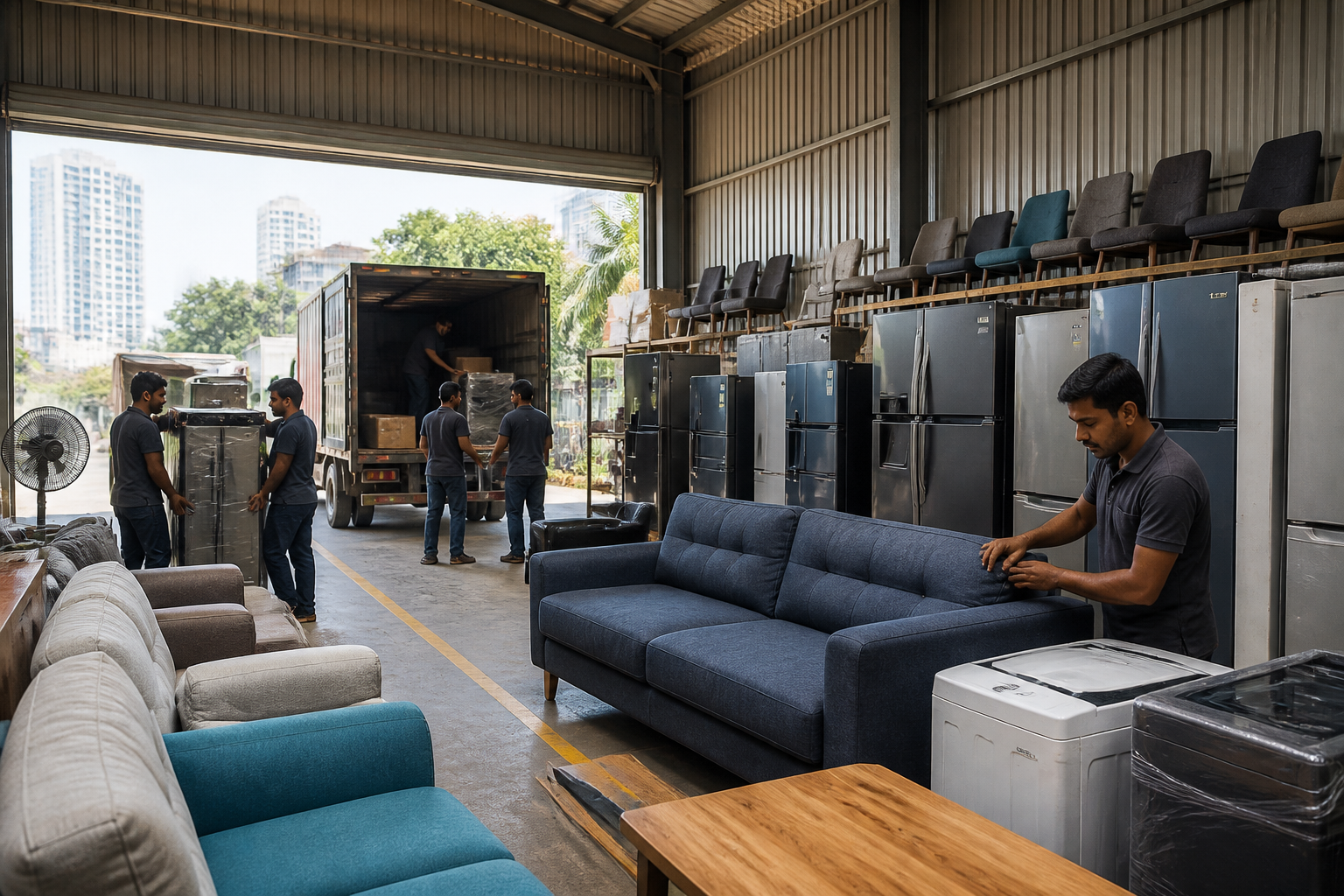
This is different from a conventional retail model, where the transaction generally ends when a customer purchases a product. In a rental model, the asset remains part of the operating system. A sofa, refrigerator or other appliance has to be delivered, maintained, collected, refurbished and placed with another customer. The company’s reported 5.12-times revenue multiple on its FY2017 asset cohort suggests that repeated use can materially extend the economic life of an asset. It also means that the economics of the business cannot be judged only by the number of new subscribers added in a particular period.
Rentomojo’s financial performance has strengthened alongside this model. Its operating revenue rose 45.5 per cent to ₹387 crore in FY26, while profit after tax more than doubled to ₹104.3 crore from ₹43.1 crore a year earlier. The company had 2.54 lakh live subscribers across 29 cities as of March 2026. These numbers indicate a business that has moved beyond a small, single-city rental operation, although the supplied material does not establish how subscriber growth was distributed across individual locations or customer categories.
The company’s own description of cash flow highlights why expansion requires careful sequencing. Delivery, repair and maintenance costs are incurred upfront when an asset is deployed, making Rentomojo a “front-ended cash flow business”, Bamania said. Rapid growth can therefore put pressure on the EBITDA margin even when demand is increasing. Each new customer may add recurring revenue, but serving that customer also requires inventory, transport capacity and service expenditure before the full value of the rental relationship is realised.
This makes the geography of growth especially important. Rentomojo’s revenue remains heavily concentrated in its established markets: 89.51 per cent of FY26 revenue came from its top 10 cities, according to the RHP. The company also said that 98.19 per cent of operating revenue came from furniture and appliance rentals. The figures show both the strength and the limits of its current position. It has a substantial base in a limited set of cities, but its revenue profile is not yet broadly distributed across the urban market.
The company sees further headroom in Bengaluru, Delhi-NCR and Hyderabad, where it believes awareness of renting as an alternative to ownership remains low. It is also entering markets such as Indore and Lucknow, partly following existing customers who have relocated there. That expansion route is notable because it links the rental market to the movement of workers and households between cities. Customers who move may not want to buy or transport bulky furniture and appliances immediately, creating a potential role for rental platforms in periods of relocation and temporary residence.
The supplied material does not establish the precise reasons customers choose rental products in each city. It does, however, show that Rentomojo is attempting to use existing demand signals to decide where to expand. Following customers into new locations may reduce some of the uncertainty associated with entering an unfamiliar market, but it does not remove the need for local inventory, warehouses, delivery networks and repair operations.
That is the central city-scale test. A rental platform can be relatively efficient in a dense, established market because assets can be moved among a larger pool of customers and service operations can be concentrated. In a newer market, the same company may need to carry more inventory before demand reaches a level that supports high utilisation. Warehousing and logistics costs can rise faster than revenue if the company has to position assets in anticipation of demand rather than in response to established rental patterns.
Rentomojo’s IPO documents reflect this physical requirement. Of the ₹150 crore fresh issue, ₹70 crore is to be used towards repayment or prepayment of borrowings and ₹42.5 crore towards lease rentals or licence fees for warehouses and experience stores. The allocation shows that the business is not only a digital interface connecting customers to products. Its growth depends on a network of physical locations and the financial capacity to keep those locations operating.
The model also raises a broader question about ownership and access in Indian cities. Renting furniture and appliances can offer households a way to furnish a home without making a large upfront purchase, particularly when the household expects to move or is uncertain about how long it will remain in a location. The supplied report does not provide a demographic breakdown of Rentomojo’s customers or quantify the share of renters among its subscribers, so the extent of this relationship cannot be established from the available material. What is clear is that the company is positioning rental as an alternative to ownership rather than merely as a short-term convenience.
For cities, the significance lies in how such models change the circulation of everyday assets. A product that is repaired and redeployed several times may generate more service activity and revenue than an asset sold once. At the same time, that system requires reverse logistics, maintenance capacity and storage. The environmental or resource implications of repeated use cannot be concluded from the supplied figures alone, because the report does not provide information on product lifespans, refurbishment rates, disposal practices or transport emissions. The operational evidence does show, however, that reuse is central to the company’s stated economics.
The concentration figures also place a limit on how far the model’s current success can be generalised. A cohort-level return of 5.12 times original asset cost is significant evidence about the reported performance of one group of assets, but it does not demonstrate that every product category or new market will produce the same result. Similarly, occupancy of 83-84 per cent describes the company’s reported overall level in FY26; it does not show whether occupancy is uniform across cities, products or stages of an asset’s life.
This is why the IPO is less a simple expansion announcement than a test of replicability. Rentomojo has demonstrated reported growth in revenue, profit and subscribers, alongside a repeat-use model that can generate revenue from the same asset over multiple customer cycles. The next question is whether those economics hold when the company moves beyond its strongest markets and adds the physical infrastructure required to support them.
The company’s stated next steps are defined by the IPO timetable, the use of fresh capital to reduce borrowing costs and the expansion of its warehouse, experience-store and city network. The evidence currently confirms a rental business with a substantial urban customer base, high reported occupancy and concentrated revenue. It does not yet establish whether the model will perform similarly across newer cities. That gap between proven asset productivity and the cost of geographic replication is the issue investors, urban businesses and policymakers will be watching as Rentomojo enters the public markets.
