


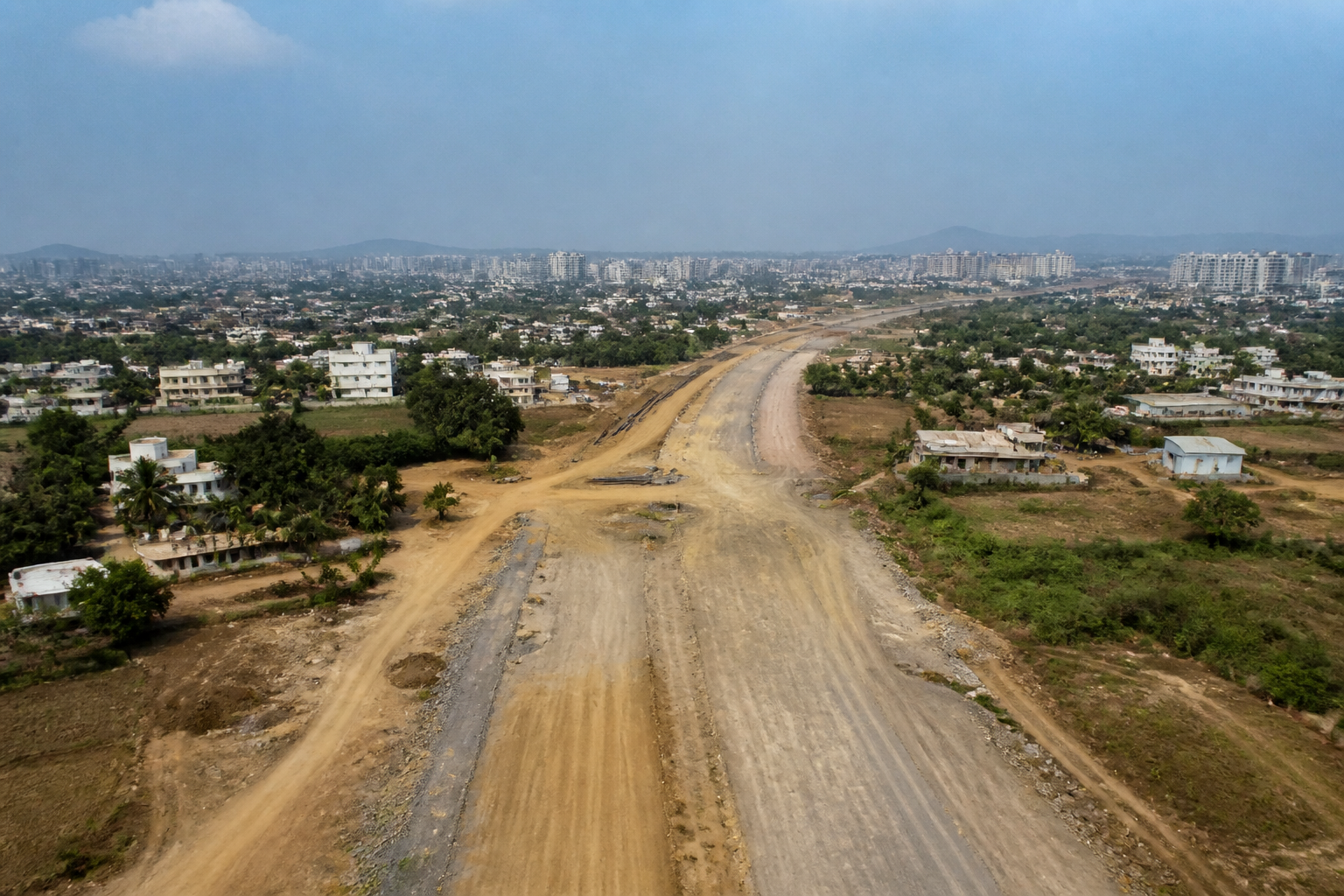
The proposed third Mumbai-Pune expressway is facing another delay before construction has begun. The 30-kilometre Pagote-Chowk section, planned as the first stage of a larger highway linking Mumbai with Pune and the Pune-Bengaluru corridor, has seen its tender extended more than 15 times. The immediate reasons cited are incomplete land acquisition and pending environmental clearances.
The delay is significant because the project is being presented as part of a wider expansion of the Mumbai-Pune transport system. The proposed route would connect Atal Setu and Chowk with Shivare near Pune, creating a 130-kilometre expressway intended to extend the Pune-Bengaluru highway towards Mumbai. The project is divided into two sections: Pagote to Chowk, covering about 30 kilometres, and Chowk to Shivare, Pune, covering approximately 100 kilometres.
According to the report, the Pagote-Chowk alignment was finalised and its construction tender was issued in 2024. The tender was subsequently extended several times before being cancelled in 2025. A fresh tender was issued in August 2025, but that process too has been extended repeatedly. The tender was expected to open on 1 October, although the report indicates that another extension remained possible.
The repeated extensions point to a familiar sequencing problem in large highway projects: construction procurement is moving ahead while essential pre-construction conditions remain incomplete. The National Highways Authority of India has indicated that work cannot begin under its rules until 90 per cent of the required land has been acquired and all relevant environmental permissions have been obtained.
Anshumali Shrivastava, the NHAI regional manager cited in the report, confirmed that the tender had been extended again. He also said that the project’s land acquisition and required permissions were still pending. Officials associated with NHAI said the land acquisition process was under way and would be completed soon.
The issue is therefore not simply that a contractor has yet to be selected. The tender itself is being kept open while the project’s legal, land and environmental conditions are addressed. Until those conditions are sufficiently advanced, opening the bids may not translate into an immediate construction start. The 90 per cent land-acquisition threshold described by NHAI is particularly important because a highway contractor cannot efficiently mobilise across an alignment where parcels, access or statutory permissions remain unresolved.
The project’s stated rationale is tied to expected growth in travel between Mumbai and Pune. The report describes the development of the Mumbai Metropolitan Region as a growth hub and refers to plans for new urban expansion, including the development of a “third” and “fourth” Mumbai. Against that backdrop, NHAI has argued for an additional expressway because the two existing Mumbai-Pune routes could eventually face capacity pressure as traffic increases.
That rationale places the highway within a broader regional development model. The proposed road is not an isolated link between two cities. It is intended to connect new growth areas, the Atal Setu, the Mumbai-side highway network and the Pune-Bengaluru corridor. Its performance will consequently depend on more than the construction of the main carriageway. Connections at Atal Setu, Chowk and the Pune-side terminus will determine how effectively traffic can enter and leave the route.
However, the present delay also shows how a regional infrastructure project can remain exposed to local implementation constraints. Land acquisition must be completed across the alignment, while environmental permissions must be secured before construction can proceed. These are not peripheral administrative tasks. They define whether a project is ready to be tendered, awarded and built without later interruptions.
The history of the Pagote-Chowk tender illustrates this distinction. The first tender was issued in 2024, but the process did not lead to construction. It was eventually cancelled in 2025, followed by a new tender in August that year. More than 15 extensions to the new tender have now kept the procurement process open. Each extension may provide additional time for the authority to address outstanding conditions, but it also postpones the point at which the market can submit final bids and the project can move towards award.
The information available in the report does not establish the exact proportion of land already acquired, the number of affected parcels, the cost of compensation, or the specific environmental permissions still pending. It also does not provide a revised construction completion date or a detailed schedule for the 100-kilometre Chowk-Shivare section. Those gaps matter because the status of the first 30-kilometre section cannot by itself determine when the full 130-kilometre corridor will become operational.
The project’s two-stage structure creates another scheduling dependency. Even if the Pagote-Chowk tender is opened on 1 October, the first section will remain part of a larger corridor whose second section extends to Shivare in Pune. The supplied report does not indicate the procurement status or construction schedule of the second section. As a result, the opening of the first tender would mark progress in one part of the project, but not completion of the Mumbai-Pune connection.
The policy question is whether highway construction should be tendered before most of the land and statutory approvals are in place. NHAI’s position, as reported, is clear: work cannot start until 90 per cent land acquisition and the required environmental permissions are complete. Yet the repeated tender extensions suggest that the procurement calendar and the land-acquisition calendar have not moved in step.
For public authorities, this creates a balance between maintaining project momentum and avoiding a contract that cannot be executed. A tender that remains open for too long can delay price discovery and contractor mobilisation. A contract awarded before the right-of-way and permissions are ready can create its own implementation risks. The report does not state that a contract has been awarded, which means the current delay is occurring before the construction phase.
The project also raises questions about how future urban growth is being matched with transport capacity. The stated expectation is that new development around Mumbai and the wider metropolitan region will increase the number of vehicles travelling towards Pune. The proposed expressway is designed as a response to that anticipated demand. But the report provides no traffic forecasts, capacity figures for the existing two highways, or estimates of how much traffic the new route would divert.
That absence limits what can be concluded about the project’s urgency. It is clear that NHAI considers an additional corridor necessary in the context of planned growth and possible traffic increases. It is not yet possible, from the supplied material, to assess whether the proposed capacity matches future demand, how quickly that demand is expected to materialise, or whether other transport investments form part of the same regional strategy.
The immediate test is therefore procedural rather than operational. The question is whether the Pagote-Chowk tender will open on 1 October or receive another extension. Beyond that date, the more consequential milestones will be the completion of the required land acquisition, receipt of environmental permissions, award of the construction contract and the start of physical work.
The evidence currently confirms a large regional road proposal, a 130-kilometre two-stage plan and a first-stage tender repeatedly delayed by land and clearance issues. It does not yet confirm a construction start date or a revised delivery schedule. Until NHAI publishes a definitive tender status and the project satisfies its own pre-construction conditions, the third Mumbai-Pune expressway remains a planned connection rather than an active construction project.
