


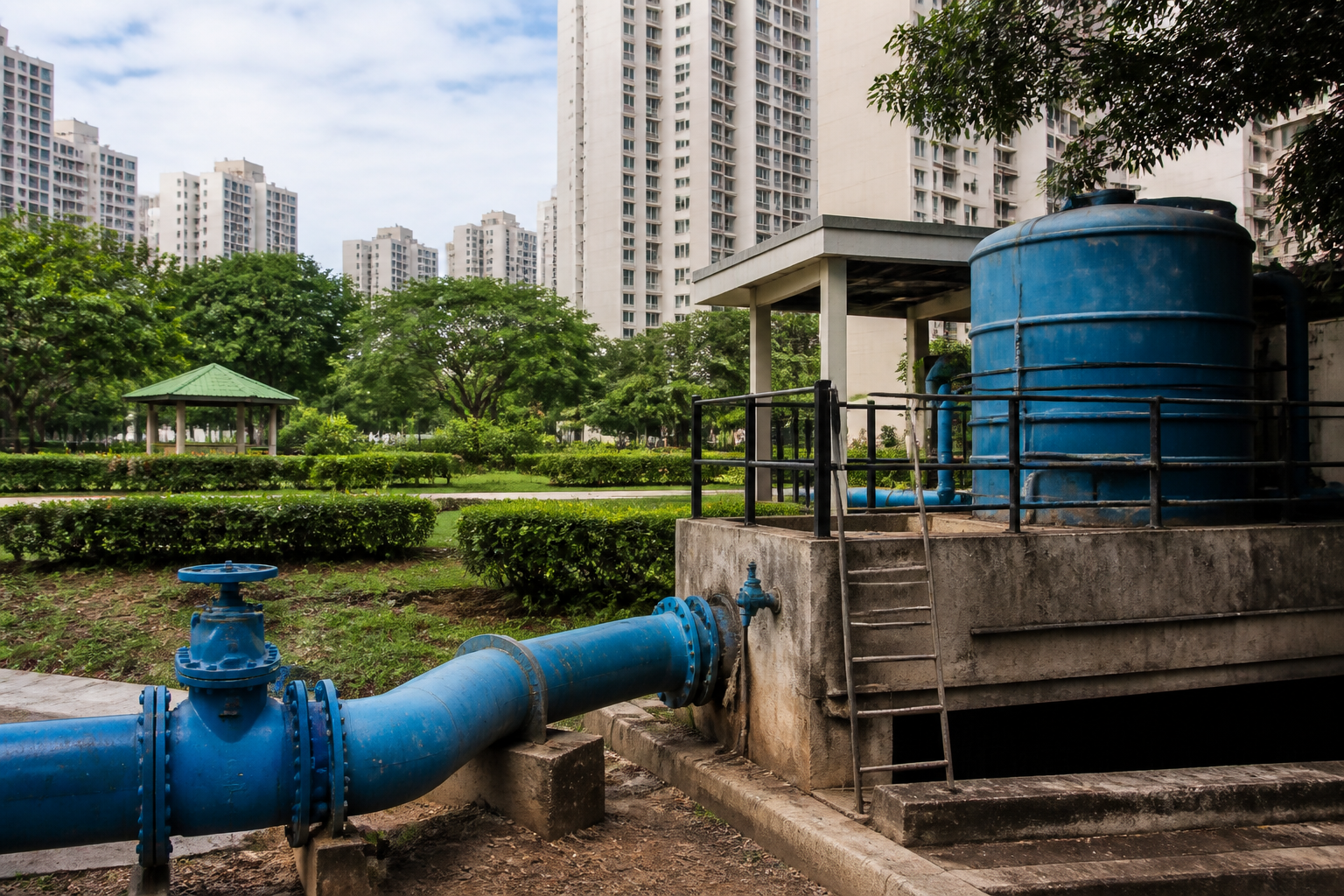
Bengaluru is preparing for future water stress with a strategy that reaches beyond securing more Cauvery water. The Bangalore Water Supply and Sewerage Board (BWSSB) is combining new supply projects with rainwater harvesting, wastewater reuse, leakage control and closer coordination among civic agencies. The approach reflects a central challenge for the city: water security depends not only on how much water can be brought into Bengaluru, but also on how efficiently it is distributed, treated, reused and governed.
The urgency comes from the city’s experience in 2024, when Bengaluru faced one of its worst summers in recent years. The crisis occurred despite continued Cauvery water supply. Poor monsoon rainfall in 2023 had depleted groundwater levels, worsening the shortage and exposing the limits of relying on a single source or on groundwater as a buffer. Although the monsoon has been better this year, BWSSB is pursuing both immediate and long-term measures to reduce the city’s vulnerability.
The board’s plans, outlined by chairperson Manjula N, begin with augmenting available supply. Cauvery Stage V has been rolled out, helping meet the needs of people on Bengaluru’s periphery and reducing dependence on groundwater. Cauvery Stage VI is also being pursued. In the longer term, water from Yettinahole is expected to add to the city’s supply. These projects represent the conventional infrastructure response to water scarcity: increase the volume of water available to a growing urban region.
Yet the interview also indicates that supply augmentation is only one part of the water-security equation. A larger and more reliable source does not automatically resolve problems within the city’s distribution system, nor does it address the pressure created by uncertain rainfall and declining groundwater. The BWSSB is therefore pairing new supply with efforts to improve how water is treated, moved and accounted for.
One of the most significant parts of this strategy is the proposed expansion of treated-water use. BWSSB is working to increase its capacity to treat wastewater and encourage industries to use treated water. Uptake has so far been limited, partly because of apprehension about using secondary-treated water. The board is exploring arrangements under which industries could undertake additional treatment themselves, or receive water treated to the required standard by BWSSB through dedicated pipelines.
This is more than a technical question. It is also a question of institutional design and cost-sharing. BWSSB is identifying industrial clusters where treated water could be supplied through co-investment or other models. It is also mapping sewage treatment plants (STPs) against industrial clusters and upgrading STPs to increase treatment capacity. The proposed system would require treatment facilities, users, pipelines and operating responsibilities to be aligned. Without that coordination, wastewater may continue to be treated without becoming a dependable substitute for freshwater in industrial use.
The limited uptake of treated water shows why urban water management cannot be judged only by the capacity installed. The city may have treatment plants, but their wider value depends on whether treated water reaches users who can use it safely and consistently. BWSSB’s focus on matching STPs with industrial clusters suggests an attempt to connect infrastructure supply with actual demand. The interview, however, does not establish the number of clusters involved, the volume of water that could be supplied or a completion timeline for the proposed arrangements.
The board’s short-term preparations for the next summer place rainwater harvesting at the centre. Around 1,000 rainwater harvesting structures have been installed, and BWSSB plans to expand the programme across government properties and community spaces, including parks, schools and hospitals. At the household level, it is promoting water conservation and the use of aerators. The board says a large number of aerators have already been installed.
Rainwater harvesting is being treated here as a distributed urban infrastructure measure rather than only a household obligation. Government properties and public spaces offer locations where collection systems can be installed at scale and potentially linked to local storage or groundwater recharge. The source material does not specify the capacities of the structures already installed, the volume they are expected to capture or how their performance will be monitored. Those details will matter in assessing whether the programme is reducing demand, improving local availability or mainly serving as a conservation measure.
The board has also penalised people found using water irresponsibly for cleaning and other purposes. This enforcement effort reflects the pressure that appears during periods of scarcity, when demand management becomes an immediate administrative concern. But the larger structural issue identified by BWSSB is the quantity of water that does not reach the billing system or intended users.
Unaccounted-for Water (UfW) remains close to 30%, according to the chairperson. BWSSB attributes the major share of these losses to leakages, particularly in the distribution network. It says there is almost no leakage at the transmission level, while losses are concentrated after water enters the distribution system. The distinction is important because it shifts the operational challenge from bringing water into the city to managing the networks that carry it through neighbourhoods.
BWSSB is evaluating ground-level reservoirs and pipelines, prioritising locations based on complaints and reported leaks, and using technology to identify failures. It is also expanding the District Metered Area (DMA) network. DMAs divide distribution systems into measurable zones, allowing authorities to compare water entering an area with consumption and identify places where losses are unusually high. The board’s stated objective is to use this information to locate problem areas and take corrective action.
The proposed crackdown on illegal connections is another part of the UfW strategy. BWSSB says it intends to reduce losses from such connections while bringing more households into the billing system. This links water accounting with administrative visibility: households outside the billing system may represent both a revenue gap and an incomplete picture of demand. The interview does not provide a breakdown of how much of the nearly 30% UfW is attributed to physical leakage, illegal connections, meter issues or other causes. That breakdown would be necessary to evaluate the expected impact of each intervention.
The distribution network also connects water management to road and infrastructure governance. Utility works have often created friction between BWSSB and city corporations, particularly when roads are not restored after pipelines or other works are completed. Under a new agreement described by the chairperson, BWSSB will reconstruct roads up to the wet-mix level so they are motorable, while the Greater Bengaluru Authority (GBA) will subsequently undertake complete restoration as part of its action plan.
The arrangement attempts to separate immediate reinstatement from final road restoration. Its success will depend on how responsibilities are recorded, funded and enforced across agencies. BWSSB also says all agencies will soon be brought onto a common portal being developed. Every work taken up in the city is expected to be mapped through the platform, allowing agencies to coordinate and avoid duplication or unnecessary works.
A common portal could address a recurring problem in dense cities: roads are repeatedly opened by different agencies because information about planned or completed works is fragmented. In Bengaluru’s case, the proposed system is being linked not only to road restoration but to the wider coordination of utility projects. The source material does not establish when the portal will become operational, which agencies will be included first or whether the mapped information will be publicly accessible.
Cauvery Stage VI remains the largest identified project in the board’s long-term supply plans. The project has received Cabinet approval and clearance from the Central Government, according to BWSSB. It is expected to cost around Rs 7,000 crore, and the board is expecting a Rs 5,000-crore loan from the Japan International Cooperation Agency (JICA). The difference between the expected project cost and the proposed loan indicates that the financing structure will be an important part of implementation, although the interview does not provide further details on the balance funding or project timeline.
Taken together, the measures point to a layered approach to Bengaluru’s water security. Cauvery Stage V and the proposed Stage VI address supply augmentation. Yettinahole is identified as a longer-term additional source. Rainwater harvesting and aerators target conservation and local demand. Wastewater treatment and industrial reuse seek to reduce pressure on freshwater supplies. Leakage detection, DMAs and action against illegal connections address distribution losses and billing gaps. The common portal is intended to improve coordination around the physical network in which these systems operate.
The evidence also shows that the city’s water challenge is distributed across multiple systems. Rainfall affects groundwater. Groundwater dependence is influenced by the reach and reliability of piped supply. The value of wastewater treatment depends on industrial demand and treatment standards. The impact of new supply depends on distribution capacity and network losses. Road restoration affects the ability to carry out utility works without leaving damaged public infrastructure behind. No single project can resolve all of these links.
What remains uncertain is the scale and measurable impact of each intervention. The material identifies approximately 1,000 rainwater harvesting structures and an UfW level close to 30%, but it does not provide targets for reducing losses or figures for treated-water reuse. It identifies the estimated cost of Cauvery Stage VI and the expected JICA loan, but not the implementation schedule. It records plans for a common agency portal, but not its launch date or operating framework.
For Bengaluru, the next phase of water planning will therefore be defined not only by project approvals but by execution across connected systems. The developments to monitor are the progress of Cauvery Stage VI, the financing arrangement for the project, the expansion and use of treated wastewater, the performance of rainwater harvesting structures, reductions in distribution losses and the operation of the proposed inter-agency portal. Together, these will show whether the city’s response is becoming a more integrated water-security system rather than a series of separate measures.
