


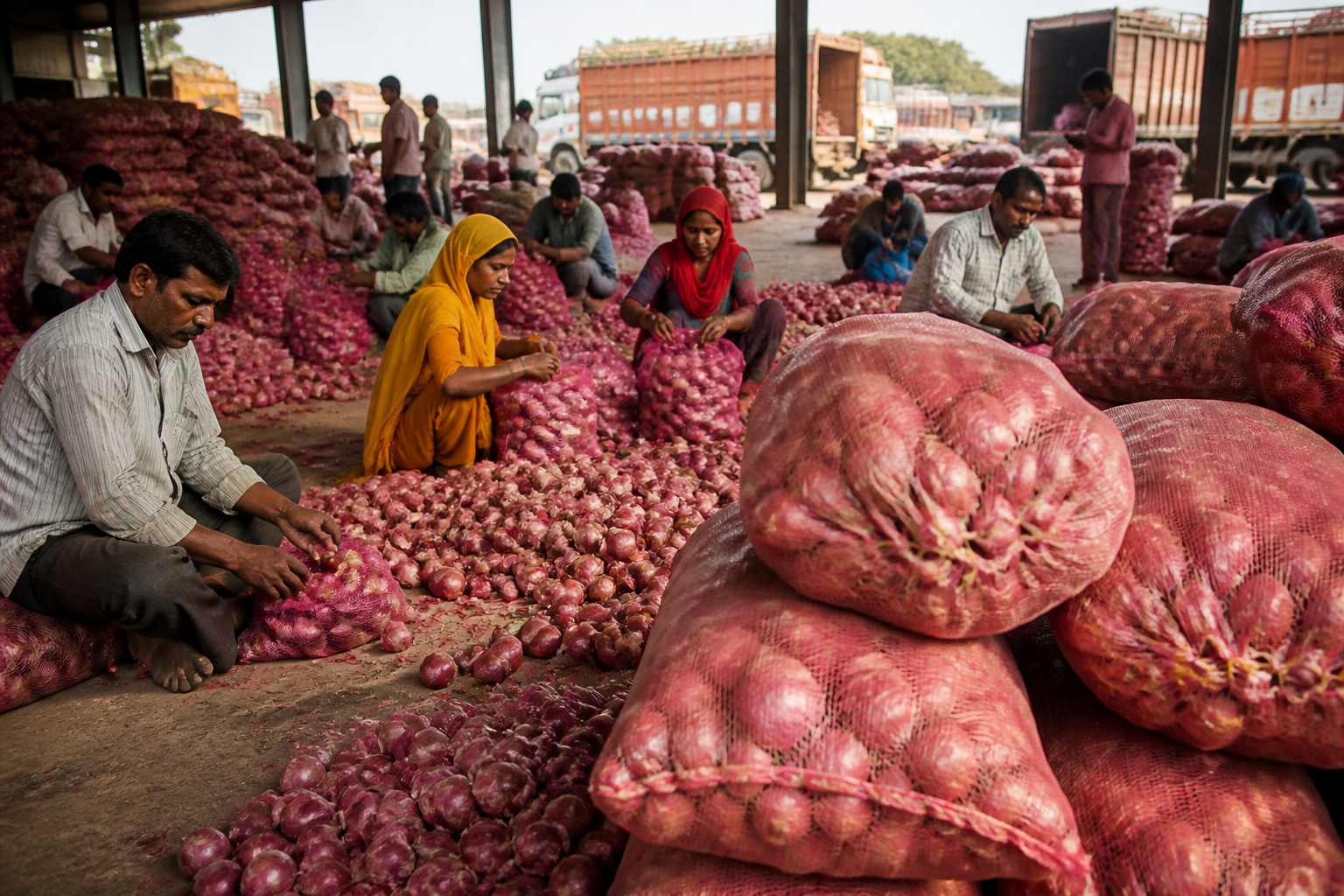
The Centre’s decision to release buffer onions at Rs 35 per kg was intended to moderate retail prices in urban markets. Yet, during the first 10 days of the intervention, the national average retail price rose from Rs 48.50 per kg on August 28 to Rs 50.79 per kg. The gap between the government’s subsidised sale price and the prices most consumers continue to encounter raises a broader question: how effectively can public stock release influence food prices when supply, storage and distribution remain uneven across cities?
The intervention is not small in administrative or logistical terms. The Centre is releasing onions from a 1.21 lakh-tonne buffer stock for 2026 through the National Cooperative Consumers’ Federation, or NCCF, and Nafed. The Central Warehousing Corporation is handling the sorting, grading and packing of the stock, as well as its movement to states. The onions are then being distributed through stores, mobile vans, cooperative societies and other platforms identified by local administrations.
This arrangement shows that the price intervention depends on more than the existence of a government reserve. Onions must be moved from producing regions to consuming centres, prepared for sale and inserted into retail networks that can reach households. The government has used trucks as well as a dedicated railway rake, named “Kanda Express”, to move the stock. Bulk consignments have already been sent to Delhi and Chennai, while a third rake is being loaded for dispatch to Guwahati.
The reported city-level prices illustrate the uneven geography of the problem. On September 5, onions were selling at Rs 58 per kg in Delhi, Rs 53 per kg in Mumbai, Rs 63 per kg in Chennai and Rs 40 per kg in Ranchi. The average wholesale price was Rs 42.79 per kg. These figures indicate that a national average can conceal significant differences in the prices faced by consumers in individual markets. They also show why a uniform subsidised price at selected outlets does not immediately translate into a uniform city-wide retail price.
According to Department of Consumer Affairs data cited in the report, around 4,000 tonnes of buffer onions had been sold across 17 cities during the first 10 days. Nidhi Khare, the consumer affairs secretary, said the stock was being sold at Rs 35 per kg in selected price-sensitive cities. She also said the distribution had brought some relief and that prices had fallen slightly, while noting that the government’s stock was comparable in size and quality to onions sold by private traders.
NCCF accounted for 1,500 tonnes of the reported sales. Its managing director, Anice Joseph Chandra, said the federation was focusing on retail sales at Rs 35 per kg. NCCF’s intervention was underway in Delhi-NCR, Tamil Nadu, Uttar Pradesh, Kerala, Rajasthan, Punjab, Odisha and a few other states. Several state governments had also expressed interest in participating, according to the report.
The numbers point to a central limitation of the intervention: the quantity released is meaningful, but its distribution remains selective. Four thousand tonnes sold across 17 cities is not the same as four thousand tonnes reaching every neighbourhood or every retail channel in those cities. The scheme’s effect depends on where the outlets are located, how frequently they are supplied and whether consumers can access them without travelling beyond their usual markets. The supplied information does not establish the number of outlets, the volume available in each city or the share of total urban demand covered by the programme.
The difference between the government’s sale price and the prevailing market price is therefore not simply a question of subsidy size. It is also a question of transmission. Public stock must pass through multiple operational stages before it reaches consumers: storage, sorting, grading, packing, transport, local distribution and retail sale. The CWC’s role in the chain is significant because the condition and movement of the stock can affect how quickly it becomes available for sale. The use of trucks and rail indicates an effort to connect producing states with large consuming centres, but the city-level price variation suggests that the intervention has not yet produced a consistent market response.
The episode also highlights the importance of timing in agricultural supply management. The rabi onion crop, which is generally stored for release later in the year, suffered some damage during harvesting because of untimely rains, according to Khare. That disruption reduced the effectiveness of the stock normally available for later release. The government is now looking towards the new kharif crop, whose arrival is expected to begin in mid-October. Officials have described the outlook for that crop as promising, and its arrival could ease supply pressure.
The distinction between current buffer release and the expected kharif arrival matters. The reserve intervention is an immediate administrative response to elevated prices, while the new crop represents a potential change in market supply. The first can expand availability in selected locations, but it cannot by itself replace a broader harvest entering markets. The supplied material does not establish how much of the kharif crop will arrive, how prices will respond or whether weather conditions will affect it before reaching markets. Those remain developments to monitor rather than conclusions that can be drawn now.
The government’s approach also brings several institutions into one supply chain. The Department of Consumer Affairs is overseeing the intervention, NCCF and Nafed are involved in releasing and selling the stock, CWC is handling storage-related operations and movement, railways are being used for dedicated consignments, and state governments are helping identify distribution platforms. This institutional structure allows the Centre to move supplies across state boundaries, but it also means that implementation depends on coordination between national agencies and local administrations.
That coordination is particularly important in cities. Urban consumers are largely dependent on continuous flows of food from outside the city, while retail markets are fragmented across formal stores, wholesale yards, neighbourhood vendors and mobile distribution points. A government sale at a selected location can provide relief to the consumers who reach it, but the effect on the wider market depends on the scale and regularity of the release. In the material available, officials report some price relief, but the national average and city-level prices show that the intervention has not yet brought prices down uniformly.
The use of the “Kanda Express” adds a transport dimension to what is often treated as a simple commodity-price story. Rail movement can carry bulk consignments between producing and consuming regions, while trucks can support final distribution. But transport capacity alone does not determine retail prices. The stock must be available at the right time, stored adequately, moved to the right markets and sold through channels that consumers can access. The reported prices in Delhi, Mumbai, Chennai and Ranchi suggest that location remains a decisive factor in how public intervention is experienced.
There is also a difference between relieving consumers and resetting the market. NCCF’s reported sales of 1,500 tonnes and the wider figure of around 4,000 tonnes indicate that public distribution has begun at scale across the selected cities. Officials say the intervention has reduced prices by Rs 2-3 per kg in some locations. Yet the average all-India retail price was higher after the intervention began, and prices remained above the subsidised rate in the major cities cited. The evidence therefore supports a measured conclusion: the scheme is providing targeted relief, but its early effect has been uneven and insufficient to lower the national average.
The next test will be whether the intervention expands its reach while maintaining the quality and regularity of supply. A third railway rake is expected to move towards Guwahati, and more states have shown interest in participating. The arrival of the kharif crop from mid-October is another important milestone. Together, these developments will indicate whether the current pressure reflects a temporary gap that can be managed through reserve release or a wider supply and distribution problem requiring sustained intervention.
For now, the evidence points to a familiar urban food-system challenge: a government can hold stocks and announce a subsidised price, but consumers feel the benefit only when the entire chain from warehouse to neighbourhood retail works effectively. The buffer sale has created additional supply and delivered some local relief. It has not yet overcome the differences between cities, retail channels and the national market. The durability of any price reduction will depend on the movement of the new crop, the scale of future releases and the ability of agencies and state administrations to deliver onions consistently where urban demand is highest.
