


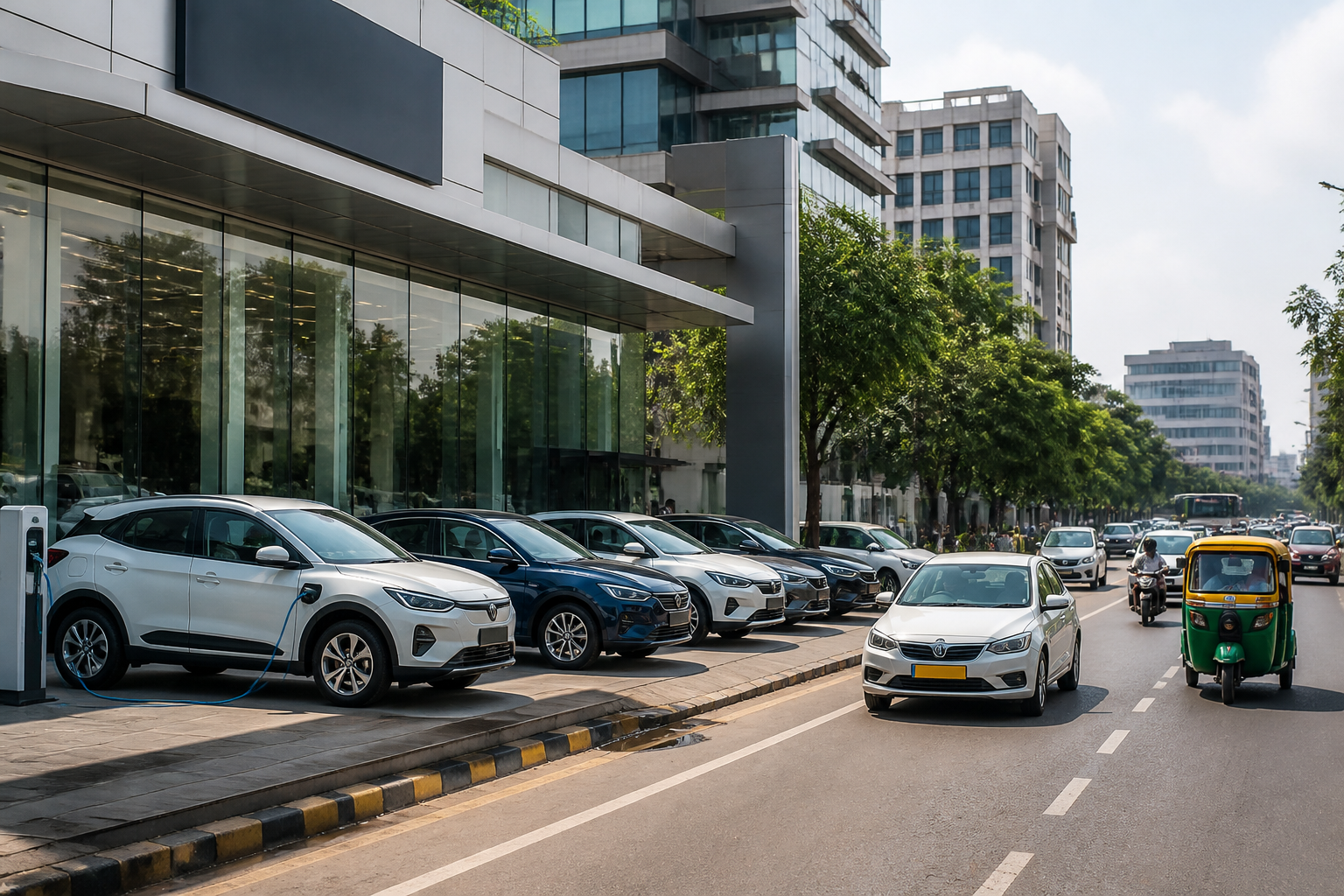
Subheadline: CNG, hybrids and electric vehicles together accounted for 42 per cent of passenger vehicle sales in August, according to an Equirus Securities report.
Standfirst: India’s passenger vehicle market is showing a measurable shift away from petrol, but the transition is not being led by one technology or one type of buyer. CNG, hybrids and electric vehicles collectively exceeded petrol’s share of sales in August 2026, while electric car sales rose sharply year on year. The pattern reflects changing consumer preferences, the availability of multiple cleaner-fuel options and uncertainty around the transition to E20 petrol. It also reveals how uneven the shift remains across manufacturers and cities. Delhi recorded the country’s highest electric-car penetration, although fleet registrations significantly influenced the figure. The available data points to a market in transition rather than a settled replacement of petrol by electric vehicles.
India’s passenger vehicle market reached a notable inflection point in August 2026. CNG, hybrid and electric vehicles together accounted for 42 per cent of passenger vehicle sales, exceeding petrol’s 41 per cent share for the first time, according to a report by Equirus Securities cited by The Hindu BusinessLine. The change was accompanied by a 16 per cent year-on-year increase in passenger vehicle retail sales, which the report linked to improved affordability following GST rate cuts.
The significance of the August numbers lies less in a single month’s ranking than in the direction of the fuel mix. Petrol’s share fell from 46 per cent in August 2025 to a record-low 41 per cent in August 2026. Over the same period, CNG’s share rose from 21 per cent to 25 per cent. Electric vehicles also expanded their presence, although their share remains much smaller than that of petrol or CNG. Together, the figures show consumers distributing demand across several alternatives rather than moving uniformly towards one replacement fuel.
The shift complicates the way India’s vehicle transition is usually described. A market moving beyond petrol is not necessarily a market that has become predominantly electric. In August, CNG was the largest contributor among the alternatives identified in the report, with a 25 per cent share. Electric cars accounted for 7.7 per cent of passenger vehicle sales, while hybrids formed part of the combined 42 per cent figure. The available data therefore describes a diversified transition in which buyers are choosing different technologies for different reasons.
The report attributed part of the movement towards CNG, hybrids and electric vehicles to buyer hesitation around the E20 transition. E20 refers to petrol blended with 20 per cent ethanol. The material supplied with the report does not establish the precise scale or causes of that hesitation, but it identifies the transition as a factor that may have influenced consumer decisions in August. That attribution matters because it distinguishes a reported market signal from a confirmed explanation of every purchase.
The broader affordability context also shaped the month. Passenger vehicle retail sales grew 16 per cent year on year, with the Equirus report linking the increase to improved affordability after GST rate cuts. A growing market can make changes in the fuel mix more consequential: the alternatives are not merely gaining share in a shrinking pool of sales but are expanding within a month when total retail demand also increased. However, the supplied data does not establish how much of the growth came from individual buyers, fleet purchases, replacement demand or particular vehicle segments.
Electric vehicles recorded the sharpest specific growth rate in the report. Electric car sales rose 52 per cent year on year to 30,700 units in August 2026. EV penetration increased from 5.9 per cent in August 2025 to 7.7 per cent in August 2026. The monthly movement was not entirely linear: penetration eased from 8.1 per cent in July 2026 to 7.7 per cent in August. That decline does not erase the year-on-year increase, but it shows why a single month should not be treated as proof of a continuous upward path.
The combination of annual growth and month-on-month easing illustrates the evidence problem facing any assessment of India’s vehicle transition. The long-term direction in the supplied figures is favourable to electric vehicles, but the month-to-month pattern remains variable. EV sales are growing from a smaller base, and their national penetration is still below the combined share of CNG, hybrids and EVs. The market is therefore changing quickly without yet settling into an electric-only trajectory.
The manufacturer-level data reinforces this unevenness. Tata Motors’ electric vehicle share recovered to around 43 per cent in August, its highest level since December 2025. The figure compared with around 42 per cent in July 2026 and 41 per cent in August 2025. The report associated the recovery with Tata’s broad electric vehicle portfolio and the recent launch of the Tiago EV. These figures describe the company’s share of the electric vehicle market, not the share of its total passenger vehicle sales that was electric; that distinction is important when comparing manufacturer performance.
JSW MG Motor’s share of the electric vehicle market declined to around 15 per cent in August from 28 per cent in August 2025, according to the report. Mahindra & Mahindra’s share eased to around 21 per cent in August from 23 per cent in July. Maruti Suzuki, following its entry into the electric vehicle segment, captured around 5 per cent of the electric vehicle market. The figures point to intensifying competition as more manufacturers enter the segment, but they do not by themselves establish whether the changes resulted from product availability, pricing, new launches, fleet sales or consumer preferences.
The city-level picture is equally important for understanding how the transition is taking place. Delhi recorded the highest electric-car penetration in the country during August, at about 19 per cent. The report cautioned that the number was inflated by registrations of a VinFast-supplied taxi fleet. Excluding those registrations, Equirus estimated underlying penetration at approximately 12 to 14 per cent, still above the national penetration of 7.7 per cent.
Delhi’s adjusted figure demonstrates why headline adoption rates need to be read alongside the composition of registrations. Fleet purchases can raise a city’s electric vehicle share without indicating that private household adoption has reached the same level. At the same time, the report’s adjusted estimate remains higher than the national figure, suggesting that the capital’s market had a stronger electric component even after the fleet effect was removed. The supplied material does not explain whether this difference reflects policy, charging access, fleet economics, consumer income, vehicle availability or other factors.
For urban transport planning, the data signals a transition involving several systems at once. CNG demand, hybrid adoption and electric vehicle sales each carry different implications for vehicle supply, refuelling or charging interfaces and fleet operations. The report does not provide infrastructure figures, emissions comparisons or total-cost calculations, so it cannot establish which option delivers the greatest urban benefit. It does show that consumers are already moving across multiple alternatives, making a single-technology account of cleaner mobility incomplete.
The policy landscape is also visible in the figures, though only indirectly. GST rate cuts are identified as a factor supporting improved affordability, while the E20 transition appears in the report as a source of buyer hesitation. These two developments point to the importance of how tax policy, fuel policy and vehicle technology changes reach consumers. The supplied material does not specify the GST measures, their duration, the affected vehicle categories or the policy response to E20-related concerns. Those details would be needed for a fuller assessment of policy impact.
What the August data confirms is a decisive change in the composition of passenger vehicle sales. Petrol no longer held the largest combined position when CNG, hybrids and EVs were counted together. What it does not confirm is that India has crossed into an electric vehicle market, or that the August pattern will repeat at the same level. EV penetration rose year on year but slipped from July; CNG was the largest individual alternative in the reported mix; and fleet registrations influenced Delhi’s leading position.
The most defensible reading is that India’s passenger vehicle market is entering a more contested phase of fuel transition. Petrol’s declining share, CNG’s rise, faster electric sales and the presence of hybrids show that the market is responding to affordability, technology choices and transition-related uncertainty in combination. The next developments to monitor are whether the alternatives retain their combined lead over petrol, whether electric penetration recovers from its monthly easing, and whether city-level growth remains strong after fleet registrations are separated from private demand.
