


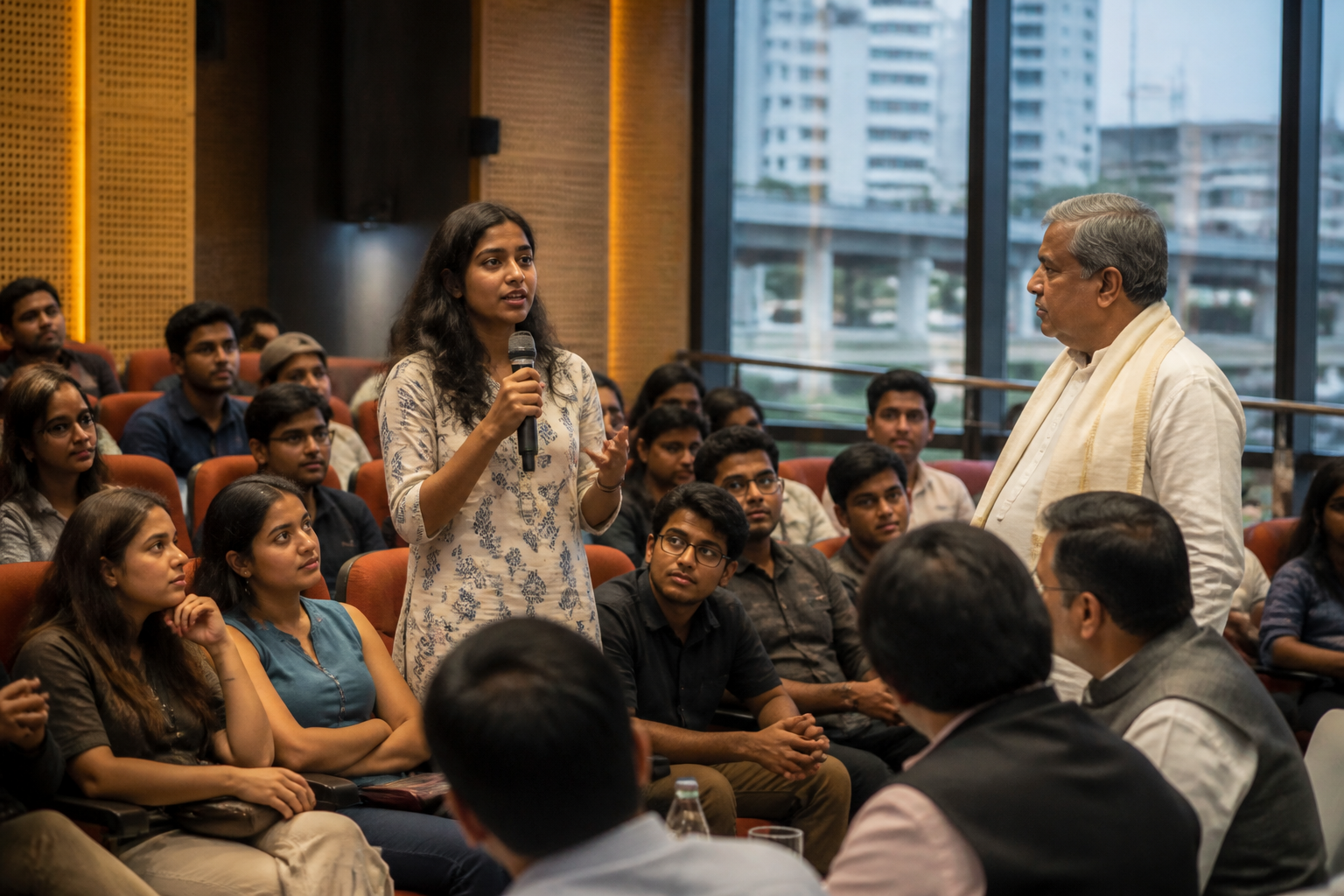
Bengaluru Gen Z is entering public life through questions that traditional political forums often struggle to absorb: how young people find work, how cities remain liveable, how public health is protected, how misinformation spreads and whether citizens can press institutions to respond. Those concerns shaped The GenZ Reckoning, a dialogue held in Bengaluru between young participants and political and public figures.
The event, initiated by Salmaan Ahmed, brought together participants to discuss education, careers, leadership, culture, urban development and the future. It also included conversations on social media, public health, civic concerns and grassroots environmental struggles. The range of subjects was significant because it placed youth participation within the everyday systems that determine how a city functions, rather than treating young people only as voters or beneficiaries of government programmes.
The central argument advanced at the event was that a politically aware generation is creating new forms of public participation. Dinesh Gundu Rao described citizen movements, youth-led non-governmental organisations and public participation as an emerging “fifth estate” that could help address shortcomings in traditional democratic institutions. The phrase is not a formal institutional designation. In this context, it describes a possible civic role for organised citizens operating through movements, associations, public campaigns and digital networks.
That framing shifts attention from whether young people are politically aware to how their awareness is converted into sustained engagement. A dialogue can give citizens access to political leaders, but it does not by itself create accountability. The more difficult question is what happens after the discussion: whether concerns are documented, whether officials respond, whether institutions accept responsibility and whether participants can continue to engage without being reduced to symbolic representatives of their generation.
The event’s urban dimension was visible in the issues raised by participants. Bengaluru’s growth, infrastructure and liveability were discussed alongside the needs of its young population. The supplied account does not provide project-level details, infrastructure performance data or a policy response to specific city problems. It therefore cannot establish whether the dialogue produced commitments on transport, housing, water, public space or municipal services. What it does show is that young participants connect the quality of urban life to political participation and institutional performance.
That connection matters because civic concerns are rarely confined to one department. A young resident’s experience of the city may involve education and employment, but also commuting time, access to healthcare, water supply, environmental conditions and the reliability of public authorities. When these issues are discussed separately, the institutional structure can obscure how they overlap in daily life. The dialogue brought them into the same conversation, even though the report does not record a consolidated urban agenda or specific follow-up mechanism.
The strongest evidence of this connection came from a student activist from Kolar, who raised a 15-year struggle for clean drinking water. He said he had faced seven first information reports while campaigning on the issue and linked contaminated water to serious health concerns. These claims are reported as statements made during the event; the supplied material does not include official water-quality records, details of the FIRs, medical evidence or responses from the relevant authorities.
Even with those limitations, the account illustrates the distance that can exist between civic participation and institutional resolution. A resident may campaign for years, attract attention and raise a public-health concern, yet the underlying service problem can remain unresolved. The reported duration of the campaign—15 years—also underlines why one-off consultations cannot substitute for administrative follow-through. Participation becomes meaningful only when it is connected to records, responsibilities, timelines and remedies.
Kirthi Ganesh, NSUI Karnataka state president, acknowledged the seriousness of the water concerns and said sustained grassroots advocacy and institutional engagement were necessary for long-term solutions. That response points to a second challenge: public participation can identify problems, but institutions must still investigate, budget for and implement solutions. The account does not specify which authority was responsible for the Kolar water issue, what action had been taken or whether a formal resolution process was initiated after the discussion.
The event also exposed a tension at the heart of digital-age participation. Rao rejected the perception that young people lacked political awareness, arguing that today’s youth were better informed and more conscious than previous generations. At the same time, he warned that unregulated social-media echo chambers could spread misinformation and extreme narratives. His stated response was not reliance on regulation alone, but the development of scientific temper and the habit of questioning information before reacting to it.
This places the problem beyond a simple debate about social media use. Digital platforms can widen access to political speech and help local campaigns find supporters. They can also compress complex civic questions into highly shareable claims before evidence is available. For urban governance, that distinction is important. Public-health warnings, infrastructure failures and environmental grievances require verification because inaccurate information can damage trust just as unresolved official failures can.
The report offers no data on the scale of misinformation discussed at the event, the platforms involved or the effectiveness of any proposed response. It also does not establish whether participants reached agreement on a media-literacy programme or institutional mechanism. The evidence supports a narrower conclusion: political participants recognised information quality as a condition of meaningful civic engagement, and they placed responsibility on citizens to question claims rather than simply react to them.
Public health formed another part of this wider discussion. Gundu Rao defended government interventions such as restrictions on hookah bars and measures against carcinogenic food additives, arguing that young people needed protection from harmful and unmonitored chemical exposure. The supplied account does not provide the relevant regulations, enforcement figures, scientific assessments or implementation outcomes. It therefore cannot determine how effective those measures have been.
What the discussion does reveal is a recurring governance problem. Health protections often depend on a chain that runs from regulation to enforcement and public communication. Young residents may encounter the issue through commercial spaces, food products or online claims, while responsibility is distributed among government departments, local authorities, businesses and consumers. Without details of enforcement or monitoring, the event’s public-health discussion remains a statement of concern rather than evidence of policy performance.
The participation of political figures from different parties and public backgrounds gave the event a broad platform. Those named in the report included N A Haris, Dinesh Gundu Rao, C N Ashwath Narayan, Ramya, Pawan Khera, Rizwan Arshad, Revathi Kamath, S R Vishwanath and Mohammed Haris Nalapad. Their presence indicates an effort to place youth concerns before a cross-section of political and public voices. It does not, however, demonstrate consensus among them or establish that the event produced shared commitments.
Ashwath Narayan addressed Karnataka’s economic and innovation ecosystem, with emphasis on research, entrepreneurship and opportunities for young people. Ramya discussed career choices, social media and the expectations placed on young people around success and adulthood. These themes extend the idea of civic participation beyond protest or electoral politics. They suggest that young people also understand public life through access to opportunity, social pressure and the ability to make informed choices.
The distinction is important for cities. A young population’s relationship with urban institutions is shaped not only by formal political participation but also by whether education connects to careers, whether innovation systems create opportunities and whether public services support a secure daily life. The source account does not provide employment, education or demographic data, so it cannot measure the size of these pressures or compare Bengaluru with other cities. It does show that participants and speakers treated them as connected elements of the urban experience.
The phrase “fifth estate” is therefore best understood as a question rather than a settled description. Can citizen movements, youth-led organisations and public participation supplement institutions without becoming substitutes for them? Can digital mobilisation lead to verifiable claims and durable administrative action? Can public forums move from representation to resolution? The Bengaluru dialogue raised these questions, but the supplied report does not record institutional answers.
The available evidence confirms that young participants used the forum to raise concerns across education, public health, urban development, infrastructure, water and the information environment. It also records a specific example of long-running grassroots advocacy over drinking water in Kolar. What remains uncertain is whether the dialogue will generate formal follow-up, measurable commitments or responses from the authorities responsible for the issues raised. Those outcomes not the event alone will determine whether the emerging civic role described as a “fifth estate” can influence how Bengaluru and Karnataka address public problems.

