


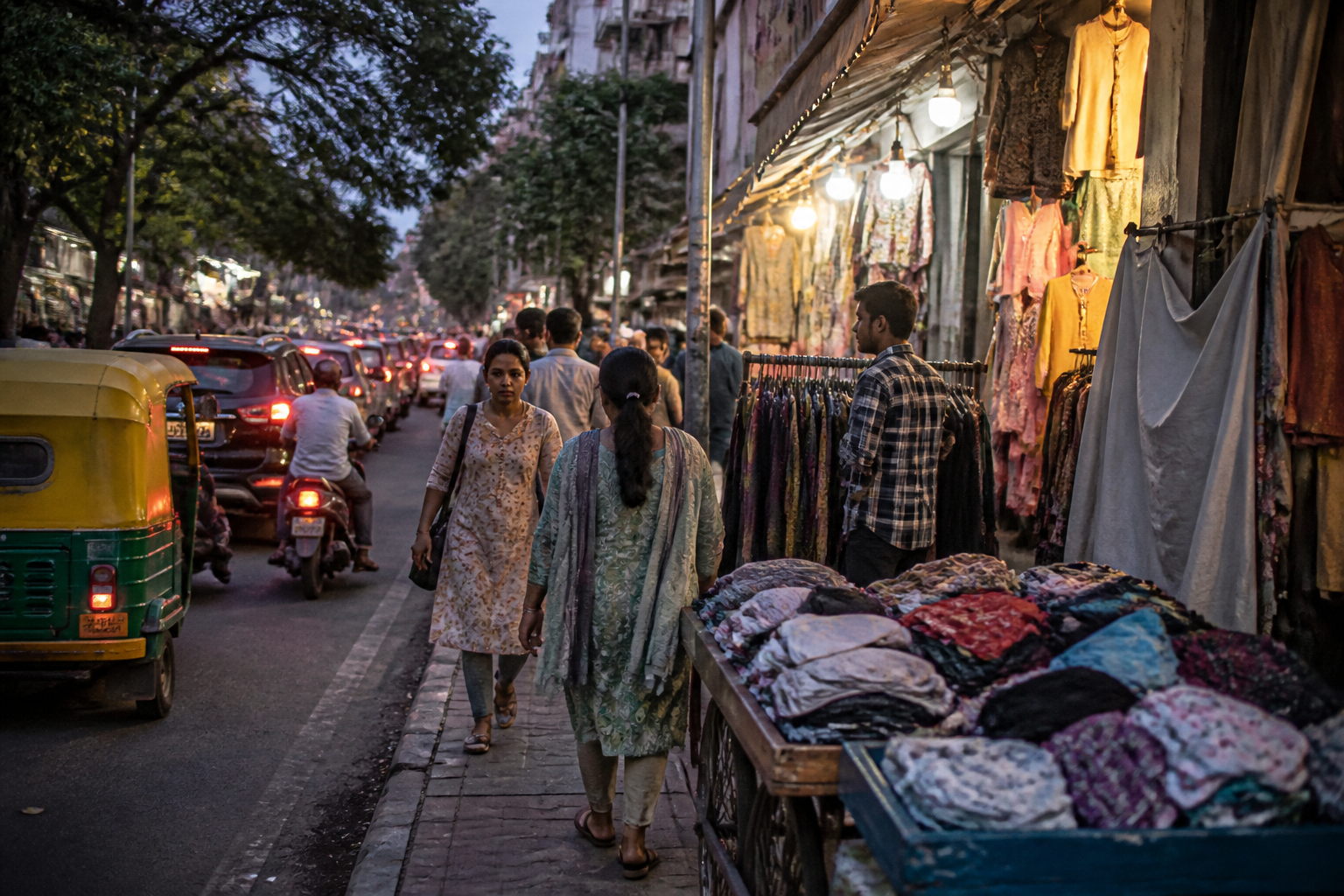
Bengaluru’s recurring footpath encroachment problem is once again visible on some of the city’s busiest shopping streets. Residents and shoppers say eviction drives on Church Street and Commercial Street clear pavements only briefly, with vendors and shopkeepers returning within days or even the following day. The cycle has left pedestrians sharing narrow road space with carts, merchandise, vehicles and temporary stalls.
The immediate problem is physical: footpaths intended for walking are being used for selling, displaying goods and placing commercial material. The larger issue is administrative. When enforcement produces only a short pause before the same activity resumes, the city is not simply facing isolated encroachments. It is facing a system in which removal, monitoring, livelihoods and the allocation of vending space remain disconnected.
On Church Street, Sanjay Kumar, president of the Church Street Residents Welfare Association, wrote to Bengaluru Development Minister Krishna Byre Gowda and the Greater Bengaluru Authority over the continuing encroachments. He said the drives initially cleared the area, but vendors returned within two days. According to Kumar, residents complain to the GBA, officials ask vendors to free the footpath, and the vendors return after leaving temporarily.
The residents’ association has also sought an inquiry into alleged leaks about enforcement operations. Its claim is that vendors remove their carts before officials arrive and return after the teams leave. The supplied report does not establish whether such leaks occurred or whether any inquiry has been ordered. It does, however, show the difficulty of sustaining enforcement when action is episodic and the people affected can quickly reoccupy the space.
Church Street is a particularly visible example because it attracts shoppers and visitors to jewellery, clothing, cap shops and eateries. The footpaths are part of the street’s public movement network, but residents say they are frequently occupied by commercial activity. When that happens, pedestrians are pushed closer to moving traffic or forced to navigate around carts and stalls.
A similar pattern has been reported on Commercial Street. Enforcement drives cleared parts of the pavements, but pushcarts, clothes and other merchandise soon returned. The problem also extends to connecting stretches such as Ibrahim Sub Street, where pedestrians face additional difficulty when vehicles pass through the narrow roads.
The effect is not limited to inconvenience. A shopper quoted in the report said that when the footpaths were clear, people could walk comfortably and view shops without repeatedly moving aside for carts or vehicles. After the vendors returned, the available walking space became severely restricted. The shopper also said autos and cabs sometimes avoid entering the smaller roads and drop passengers farther away.
That account points to the way footpath encroachment can alter the functioning of an entire commercial district. A blocked pavement does not only affect a person walking past one shop. It can change where vehicles stop, how pedestrians transfer between streets and how easily people reach businesses on adjoining roads. On streets with high visitor and shopping activity, the loss of walking space can spread pressure into the carriageway and side roads.
At the same time, the report makes clear that the conflict is not simply between pedestrians and vendors. Shoppers and residents acknowledge that vendors depend on the streets for their livelihoods. Their demand is for designated vending zones where selling can continue without occupying pedestrian space or obstructing traffic movement.
This distinction matters because repeated eviction without a clear alternative does not resolve the underlying use-of-space conflict. It may remove a cart or stall for a few hours, but it does not answer where that livelihood can legally continue. The return of vendors after each drive therefore reflects both weak enforcement and the absence, at least in the account supplied, of a durable arrangement that separates vending activity from walking space.
The report also identifies shopkeepers as a significant part of the problem. An Infantry Road resident said commercial establishments place goods, stands, carts and billboards outside their shops, extending private commercial activity into roads and footpaths. The resident called for confiscation of such goods, penalties and, after repeated warnings, sealing of establishments.
This expands the policy question beyond hawker removal. If enforcement focuses mainly on mobile vendors while overlooking goods and advertising material placed by formal shops, the administration risks applying an uneven standard to the same public space. A footpath occupied by a shop display is no more available to pedestrians than one occupied by a pushcart. The supplied material does not indicate how frequently either category is penalised or whether the GBA has a common enforcement protocol for them.
The repeated return of encroachments also raises questions about responsibility. Residents have approached the GBA, while the association has called for traffic police monitoring. The complaints therefore involve more than one public authority. The GBA is named in relation to action against encroachments, and residents have specifically sought traffic police involvement to ensure that enforcement is strict and monitored. The report does not provide a formal response from either authority.
That absence is significant for understanding what happens after an eviction drive. A drive is a visible intervention, but maintaining a clear footpath requires continuing inspection, a process for complaints, action against repeat violations and coordination where vehicles also obstruct movement. Without information on these steps, residents are left judging enforcement by its most visible outcome: whether the carts and displays are back after officials leave.
The Church Street and Commercial Street accounts show why footpath encroachment is a governance problem rather than a one-time clearance exercise. The city’s commercial streets must accommodate walking, access for deliveries and vehicles, retail activity, informal vending and visitor movement. When these demands are managed through periodic removal alone, the same conflict reappears as soon as enforcement ends.
The proposed vending zones offer one possible administrative separation between livelihood activity and pedestrian movement, but the supplied report does not identify any approved locations, implementation plan or timeline. That uncertainty is central. Residents are asking for footpaths to remain clear, while also recognising that vendors need a place to work. Authorities would need to establish how such spaces are identified, who may use them and how compliance is maintained; none of those details is provided in the report.
What the evidence confirms is narrower but important. Eviction drives have produced temporary clearance on the streets described by residents, but the encroachments have returned. Pedestrians continue to face restricted movement on Church Street, Commercial Street and connecting stretches such as Ibrahim Sub Street. The dispute includes both vendors and shopkeepers, and residents are calling for designated vending areas alongside stronger penalties and monitoring.
What remains uncertain is whether the alleged leaks about enforcement operations occurred, whether the authorities have ordered an inquiry, how many vendors or establishments have been penalised, and whether any designated vending zones are under consideration. Those are the facts that will determine whether Bengaluru’s next response is another short-lived drive or a sustained system for managing public space. For now, the city’s footpaths remain caught between enforcement that does not last and commercial activity that has nowhere else to go.
