


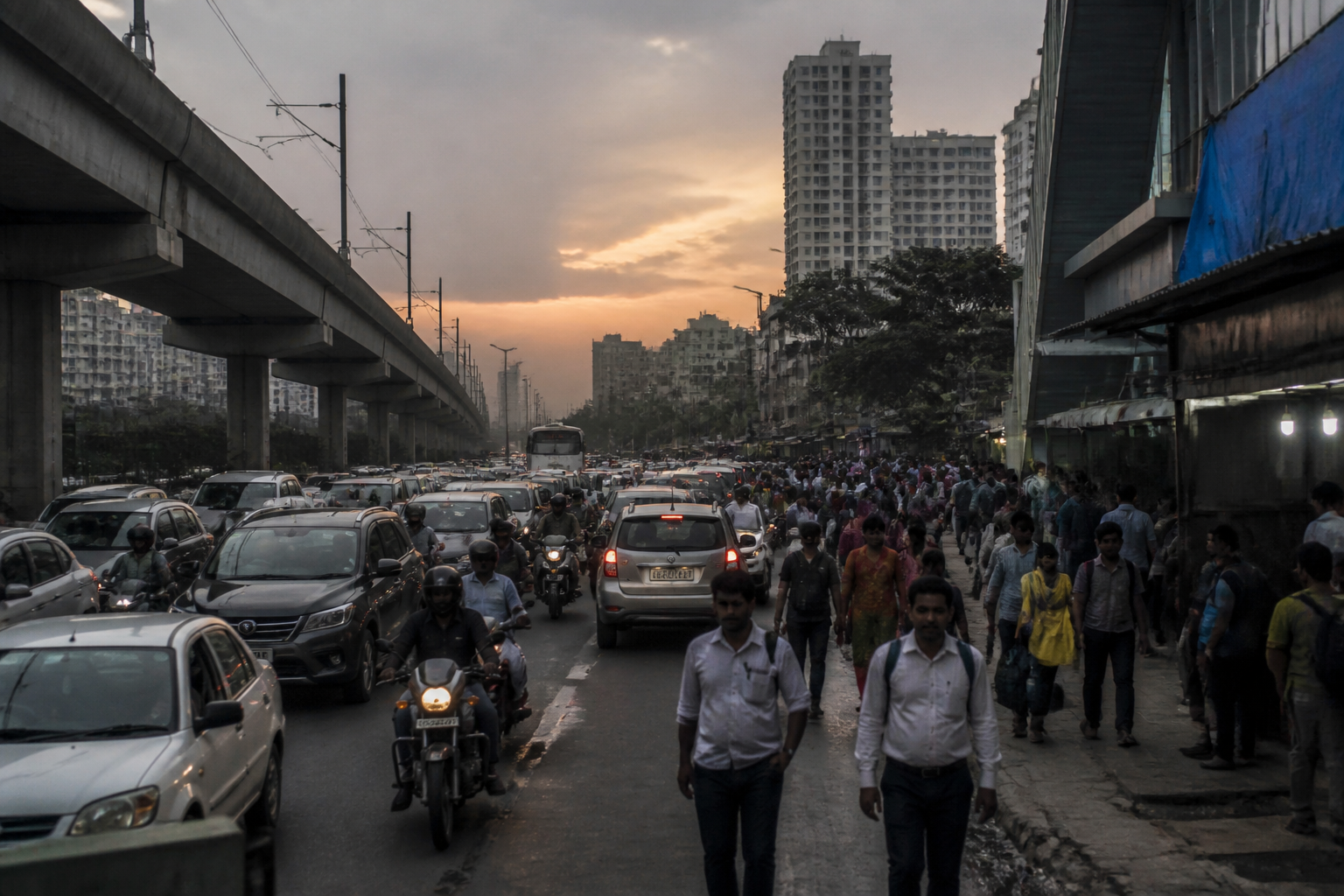
India GDP growth has reached 7.8% in the first quarter of FY27, but a debate sparked by stock market veteran Shankar Sharma asks whether headline expansion is translating into better urban lives. His argument is not that the official number is necessarily false. It is that economic performance can look very different when judged through traffic, public environments, stress, employment and everyday access to prosperity.
Writing on X after the latest GDP figures were released, Sharma said he was no longer interested in being drawn into the conventional growth debate. Instead, he proposed what he called “Real Feel” GDP growth: an informal measure of how the economy appears and feels to people on the ground. On that basis, he estimated India’s growth at only 2-3%, despite the reported 7.8% quarterly expansion.
The distinction matters for cities because urban residents encounter the economy through physical systems. They experience growth in the form of roads that move or fail to move traffic, public spaces that are clean or neglected, neighbourhoods that support social life or isolate residents, and services that reduce or add to daily stress. Sharma’s comments point to these visible conditions, describing people as stressed and traffic as chaotic. He also argued that India’s cities and villages appear more like those of a $100 billion economy than a $4 trillion one.
That comparison is a perception, not an alternative national-accounts measure. The supplied report does not establish a methodology for calculating “Real Feel” GDP, nor does it provide an index that can be tested against the official growth rate. Its significance is therefore less statistical than diagnostic. It identifies a question that headline GDP alone cannot answer: whether the benefits and capacities associated with a growing economy are becoming legible in ordinary urban life.
The official figure remains central to the economic debate. India reported 7.8% GDP growth in the first quarter of FY27, accelerating from a revised 6.9% in the same quarter of the previous year, according to the report. Commerce and Industry Minister Piyush Goyal defended the number after opposition leaders and former finance secretary Subhash Garg criticised the growth data. Goyal said critics were comparing figures from different GDP series and attempting to misguide the public.
“The naysayers can say what they want, but 7.8 per cent growth is a reality,” Goyal said, as quoted in the report. His response treats GDP growth as an established statistical fact and places the dispute within a broader argument about how the data should be compared. Sharma’s intervention addresses a different layer of the economy: what residents see, feel and experience, even when aggregate output is rising.
These two positions are not necessarily mutually exclusive. A country can record strong GDP growth while its urban systems remain under pressure. Output can expand faster than the capacity of roads, drainage, housing, public transport, waste management and civic administration to absorb the consequences of that expansion. The source material does not provide data on any of these systems, so it cannot establish whether infrastructure capacity has fallen behind growth. It does, however, show how urban conditions have become part of the public interpretation of economic performance.
Traffic is one of the clearest examples of this gap. For an economic statistic, traffic congestion is not a direct measure of national output. For a city resident, it affects the time required to reach work, school, healthcare and commercial areas. It can also shape how people assess whether their city is becoming more efficient or merely busier. Sharma’s reference to chaotic traffic converts an abstract debate over GDP into a question about the daily cost of urban movement.
The same is true of the quality of public surroundings. Sharma contrasted India’s urban and rural environments with his description of Europe, where headline growth is around 2-3% but the lived experience, in his view, appears stronger. He pointed to organised and clean surroundings, busy cafes and restaurants, street music and attractive villages as signs of what he called “Khushhali”, or prosperity. He consequently assigned Europe a “Real Feel” growth rate of 7.8%, reversing the relationship between the reported and perceived numbers.
This comparison is also a subjective reading rather than a verified cross-country benchmark. The report does not provide comparable measures of European quality of life, cleanliness, public space, cultural activity or household prosperity. Nor does it identify the countries or cities Sharma had in mind. The value of the comparison lies in the contrast it creates: economic growth can be judged not only by how much an economy produces, but also by whether its physical and social environments communicate security, order and opportunity.
For urban policy, that distinction is important. GDP records the value of economic activity, but it does not by itself describe how effectively cities convert resources into liveable environments. A growing economy may generate more construction, consumption and investment while still leaving residents dissatisfied with mobility, housing affordability, public services or the condition of neighbourhoods. None of these outcomes can be inferred conclusively from the supplied GDP figure. They are the kinds of questions that need separate evidence.
The report offers no employment data, household income figures, housing-cost measures, transport performance indicators or municipal-service benchmarks. It also does not provide a formal quality-of-life index. As a result, the “Real Feel” concept should not be treated as a replacement for GDP or as a quantified finding about India’s cities. It is better understood as a prompt to examine the distribution and visibility of growth through urban conditions.
That prompt is especially relevant because cities are where national economic performance becomes tangible. A new business, factory, office or housing project may contribute to output, but residents encounter the wider economic system through the services and infrastructure surrounding those activities. If roads are congested, public areas are poorly maintained or neighbourhoods lack the social and commercial amenities associated with prosperity, the official growth figure may not match the public mood.
The disagreement over the first-quarter number also highlights the importance of measurement. Goyal’s criticism, as reported by Economic Times, was that some critics were comparing data from different GDP series. That is a technical issue with public consequences: disagreements over the base, series or comparison period can change how growth is interpreted. But even an uncontested GDP number would not settle the question Sharma is raising, because the two arguments measure different things.
One measures aggregate economic expansion. The other asks whether expansion is visible in lived experience. The first is a national indicator; the second is an impression formed through streets, workplaces, public spaces, commercial activity and social surroundings. Treating either as a complete account would narrow the debate. GDP cannot explain every feature of urban life, while a visual impression of a city cannot establish the size or direction of an economy.
The policy landscape described in the supplied material is limited. It identifies the central government’s defence of the GDP figure through the Commerce and Industry Minister, but it does not specify any urban programme, municipal reform, infrastructure initiative or funding framework linked to the concerns raised by Sharma. That absence is significant in editorial terms: the report opens an urban question without supplying the administrative evidence needed to answer it.
Further reporting would therefore need to examine whether the concerns about traffic, stress and urban disorder are reflected in measurable trends. It would also need to separate differences between cities and villages, between regions and between income groups. The source does not show whether Sharma’s observations are based on a systematic survey, a defined set of locations or personal observation. Without that information, the claim cannot be generalised across the country.
What the current evidence confirms is narrower but still relevant. India recorded 7.8% GDP growth in the first quarter of FY27, according to the report. A prominent market participant publicly challenged the assumption that this figure captures the country’s economic reality, using urban conditions as part of his argument. The government defended the growth figure and disputed criticism based on comparisons across GDP series.
What remains unresolved is whether the reported growth is being converted into better urban outcomes, and how those outcomes should be measured. The next stage of the debate cannot be settled by competing impressions alone. It requires evidence connecting economic expansion with mobility, public environments, employment, household security and access to urban opportunity. Until that evidence is assembled, “Real Feel” GDP remains a compelling phrase for a real policy question, but not a substitute for the official measure it challenges.
