


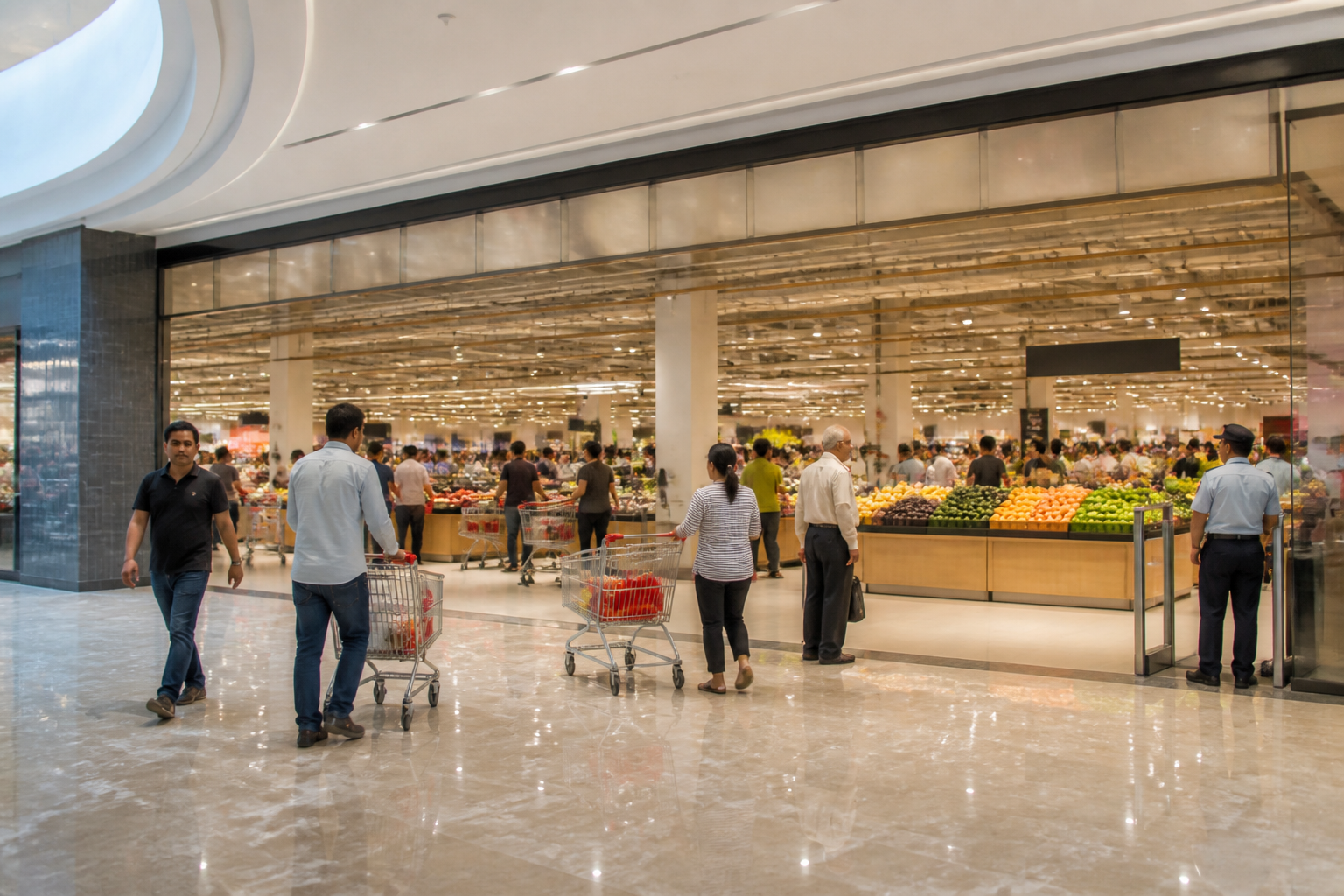
Carrefour’s return to India is being built around more than a new chain of hypermarkets. The French retailer plans to expand to 50 stores, enter neighbourhood clusters through acquisitions and use India as both a consumer market and a sourcing base. Its strategy arrives as malls reconsider the space given to hypermarkets and shoppers divide their spending among stores, e-commerce and quick-commerce platforms.
The company has opened its first store of its second India phase in Noida’s newly opened H&S mall. The 50,000-square-foot outlet marks Carrefour’s re-entry after it exited the country in 2014. During its earlier presence, the chain operated five stores. According to the report, the earlier exit followed restrictions on foreign direct investment in multi-brand retail, financial difficulties and an inability to break even.
Carrefour is now working with Apparel Group in India. Patrick Lasfargues, Carrefour’s executive director for international partnerships, said the company had returned to markets where it had previously operated by working with local partners. He described India as a long-term strategic market, citing its young population, rising discretionary incomes, expanding economy and the development of e-commerce and quick-commerce.
The local-partner model is central to the company’s revised approach. Lasfargues said a partner could help Carrefour enter smaller cities, while also creating sourcing opportunities. The company plans to replace some Chinese sourcing with products and food made in India. It also expects the recently actioned free trade agreement with the European Union to support the movement of products between Europe and India, although the report does not provide details of the agreement, product categories or projected trade volumes.
This makes Carrefour’s second India attempt different in structure from a simple store rollout. The business is linking retail presence with procurement, imports and exports. A store network would provide consumer access, while local sourcing could connect Indian manufacturers and food producers to the retailer’s international system. The report does not establish how much of Carrefour’s future assortment will be sourced domestically or how the company will divide its supply chain between Indian production and European products.
The format strategy is also broader than the 50,000-square-foot Noida store. Nilesh Ved, chairman of APPCORP Holding, which owns Apparel Group, and founder of KORA Properties, said the partnership would use a hybrid model that includes home delivery and private-label products. He also referred to several formats: hypermarkets, supermarkets, gourmet stores and an express format. The company is discussing the acquisition of local players to expand into neighbourhoods, but no names, valuations or transaction timelines have been disclosed.
That proposed portfolio reflects a major change in the way large retailers approach Indian cities. The hypermarket depends on customers travelling to a large store and completing a substantial share of their shopping in one visit. Neighbourhood and express formats bring the retailer closer to residential areas, while home delivery reduces the need for customers to make a physical trip. Private-label products can give the operator greater control over assortment and pricing, though the supplied material does not provide details of planned brands, margins or price points.
The shift is taking place as the economics of large retail spaces become more contested. The report says established mall operators are reducing the space allotted to hypermarkets because of competition from emerging channels, including quick commerce. This creates a tension for Carrefour’s expansion: its first new store is a large-format outlet, but its stated growth plan also depends on smaller neighbourhood formats and digital fulfilment.
The Noida store therefore functions as both a retail outlet and a test of the mall-based model. At 50,000 square feet, it requires a location with enough catchment demand, customer traffic and operating capacity to support a large assortment. The supplied material does not disclose the store’s sales, footfall, staffing, delivery radius or financial performance. Without those indicators, it is too early to assess whether the new format can achieve the break-even threshold that eluded Carrefour during its previous India presence.
The wider hypermarket category is already consolidating. The report cites Reliance Retail’s acquisition of Metro Cash & Carry India for Rs 2,850 crore in 2022, after Reliance had taken over Future Retail earlier that year. These transactions indicate that scale, distribution networks and established store or business formats have become strategic assets in Indian retail. They also show that expansion can occur through acquisition rather than only through new construction and organic store openings.
For urban real estate, that distinction matters. A retailer entering neighbourhood clusters through acquisitions may use existing commercial premises rather than waiting for new malls or building a fresh network of large outlets. It could also create demand for different kinds of spaces: smaller stores close to residential communities, fulfilment capacity for home delivery and larger stores that combine shopping with an in-person experience. The report does not specify whether Carrefour’s potential acquisitions would involve stores, operating companies, properties or a combination of these.
The pressure on large-format retail is visible in the performance data cited by the report. Avenue Supermarts, which operates D-Mart, has more than 500 stores across India. Its like-for-like growth slowed to 5.5 percent in the June quarter from 10.8 percent in the preceding quarter, while the share of food revenue also declined. The figures do not establish the reasons for the change, and they should not be treated as a direct measure of Carrefour’s prospects. They do, however, place the proposed expansion in a market where an established operator has reported slower comparable-store growth.
The same data also complicates the idea that Indian consumers are simply moving from physical stores to digital channels. Ved said e-commerce and quick commerce had expanded the market, but that customers continued to seek reasonable prices, a decent environment and an experience in the store. Carrefour’s proposed hybrid model is a response to that combination of preferences. It seeks to retain the physical retail experience while adding delivery, multiple store formats and private-label products.
This model places new demands on the urban systems around retail. A large store requires accessible commercial space and customer movement through a mall or other destination. A neighbourhood network requires locations embedded in everyday travel patterns. Home delivery requires inventory visibility, order processing and last-mile distribution. The source material does not provide operational details on how Carrefour or Apparel Group will organise these functions, but the proposed formats show that retail expansion is increasingly tied to the design and functioning of the city beyond the store itself.
The sourcing plan adds another layer. Carrefour wants to buy more products and food made in India instead of sourcing from China, while also moving products between India and Europe under the newly actioned trade agreement. If implemented at scale, this would connect Indian retail demand with domestic production and international trade. The report does not identify the Indian supplier base, the states or cities involved, the categories to be prioritised or the infrastructure that would handle the movement of goods. Those details will determine whether the sourcing ambition becomes a material industrial and logistics opportunity or remains a broad corporate objective.
The institutional context is also important. Carrefour’s first India exit was linked in the report to foreign direct investment restrictions in multi-brand retail, as well as financial difficulties and an inability to break even. Its return through a local partnership shows how regulatory conditions and operating structures shape the entry of international retailers. The current report does not set out the legal terms of the partnership or describe the regulatory approvals involved, so the exact framework for the expansion remains unclear.
The proposed 50-store target should therefore be read as an expansion ambition rather than a completed network. Only the first 50,000-square-foot Noida store is identified in the supplied material. The company has not disclosed the locations of the remaining stores, the implementation schedule, capital expenditure, expected acquisitions or the share of stores planned for smaller cities. These omissions are significant because location, format and timing will determine how the strategy affects malls, local retail streets and neighbourhood commercial clusters.
Carrefour’s return brings together several changes in India’s urban economy: the continuing importance of physical retail, the growth of quick commerce, the consolidation of large retail businesses, the search for more flexible store formats and the use of local partnerships to reach smaller cities. None of these trends alone determines whether the company will succeed. Together, they show why a national retail expansion is also a question about land use, commercial real estate, logistics and the changing geography of everyday consumption.
What the evidence confirms is that Carrefour is attempting a broader and more flexible India strategy than the one associated with its earlier five-store presence. It has opened a 50,000-square-foot Noida store, partnered with Apparel Group, set a 50-store expansion goal and identified sourcing, home delivery, private labels and neighbourhood acquisitions as parts of its plan. What remains uncertain is the pace of execution, the economics of the formats and the identity of the businesses it may acquire. The next milestones are the disclosure of additional store locations, acquisition details, operating performance and the structure of its India-Europe sourcing plans.
