


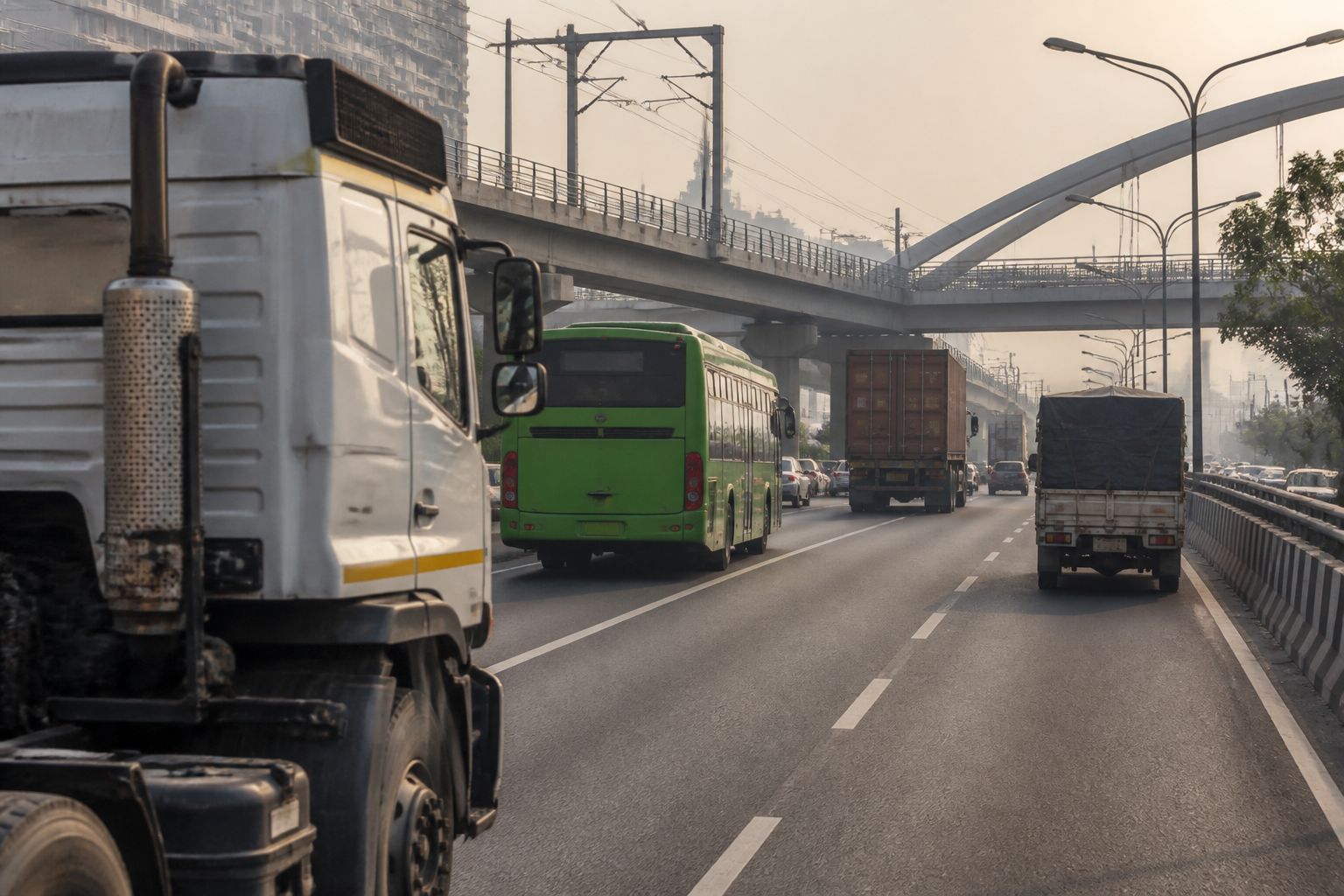
A new retrofit standard for older heavy vehicles, combined with a renewed push to scrap ageing trucks and buses, signals a two-track approach to transport emissions in Delhi-NCR: reduce pollution from vehicles that remain in service while accelerating their replacement.
Road Transport and Highways Minister Nitin Gadkari said on Thursday that the government had approved AIS 228 standards for retrofitting rear emission-control devices on pre-BS6 heavy vehicles. According to Gadkari, the device, developed by an IIT Delhi-led team, costs around Rs 4,000-5,000 and can reduce particulate matter emissions by 90 per cent and nitrogen oxides by 60 per cent. He also said emissions from a retrofitted BS4 vehicle had been demonstrated to be comparable to those of a BS6 vehicle.
The announcement matters because it places an emissions-control intervention between two established positions in vehicle policy. Older commercial vehicles can be replaced through scrappage, but replacement takes time and depends on owners being able to finance newer vehicles. Retrofitting, by contrast, is presented as a lower-cost measure for vehicles that continue to operate. The supplied announcement does not specify the rollout timetable, enforcement mechanism, certification process for individual devices or the number of vehicles that could eventually be covered under AIS 228.
That missing implementation detail will determine how much of the standard’s potential reaches the road. A technical standard can define what a retrofit device must achieve, but its urban effect also depends on installation quality, maintenance, inspection and compliance. The announcement establishes the performance claims cited by the minister, but it does not provide details on testing sites, operating conditions, monitoring arrangements or how authorities will verify that a device continues to deliver the stated reductions after installation.
The retrofit proposal has been announced alongside the government’s Parivartan scheme for Delhi-NCR. Launched in July, the scheme targets the scrapping of more than 2 lakh older trucks and buses and offers incentives for the purchase of newer BS6 and electric vehicles. Gadkari urged original equipment manufacturers to provide additional discounts to customers who surrender scrappage certificates and buy new vehicles.
This links air-quality policy to the economics of fleet renewal. The minister asked automakers to treat scrappage as a commercial opportunity that could support vehicle sales and production, rather than only as a government recommendation. In this model, the state provides the policy direction and incentives, vehicle owners replace older assets, and manufacturers are encouraged to reduce the cost gap through concessions. The supplied material does not establish whether OEMs have committed to such discounts or how large they would be.
The two measures address different constraints. Retrofitting is intended to reduce emissions from pre-BS6 heavy vehicles that remain operational. Scrappage is intended to remove older vehicles from the fleet and replace them with BS6 or electric vehicles. The distinction is important for urban transport planning because a device fitted to an existing vehicle does not by itself reduce the age, condition or operating intensity of that vehicle. Conversely, scrappage can deliver a more complete fleet transition but may be slower or more expensive for operators.
The policy therefore appears to be designed around transition rather than a single intervention. Older vehicles can be brought closer to newer emissions performance through approved equipment, while the Parivartan scheme seeks to reduce the stock of older trucks and buses over time. The announcement does not say whether retrofitted vehicles will receive any change in operating eligibility, access permissions or compliance status, nor does it clarify how retrofit approval will interact with existing pollution-control checks.
Those questions are particularly relevant in a region where commercial vehicles operate across administrative boundaries. Delhi-NCR is not a single municipal fleet. Trucks and buses may be registered in one jurisdiction, travel through another and serve markets across the wider region. The supplied report does not outline the role of individual state transport departments, pollution-control authorities or local enforcement agencies in applying AIS 228. Without that institutional detail, the announcement describes the direction of policy more clearly than the machinery needed to implement it.
The numbers announced by the minister show the scale of the government’s stated ambition. The Parivartan scheme targets the scrapping of more than 200,000 older trucks and buses. The retrofit device is priced at roughly Rs 4,000-5,000, while the claimed reductions are 90 per cent for particulate matter and 60 per cent for nitrogen oxides. These figures are not directly comparable: one describes a device cost, another a fleet target and the others pollutant reductions. Together, however, they indicate that the policy is trying to combine a relatively low-cost intervention with a large-scale replacement programme.
The evidence supplied does not include an estimate of the total number of pre-BS6 heavy vehicles in Delhi-NCR, the expected number of retrofit installations, the projected emissions reduction across the region or the cost of implementing the scrappage target. It also does not establish whether the reported BS4-to-BS6 comparison applies to all vehicle types, all operating conditions or the specific vehicle tested by the IIT Delhi-led team. Those limits matter when assessing the difference between demonstrated device performance and region-wide outcomes.
Gadkari’s remarks also placed the retrofit and scrappage measures within a broader automobile-policy agenda. He cited Bharat NCAP, saying that more than 30 models from 11 companies had already been certified. He said testing under the programme costs around Rs 60 lakh per model, compared with about Rs 2.5 crore under Global NCAP, and argued that the lower cost had encouraged foreign automakers to send vehicles to India for testing.
The minister further said the government plans to introduce Bharat NCAP 2 from October 2027. The proposed expansion would move beyond crashworthiness to cover crash avoidance, passenger protection, pedestrian safety and post-crash evacuation and care. He invited the automobile industry to submit suggestions and technologies, including innovations developed by Indian startups, for consideration in the expanded programme.
The connection between emissions retrofits and vehicle safety is institutional rather than technical. Both initiatives seek to establish standards that shape the performance of vehicles already on the road or entering the market. In the emissions case, the immediate policy question is how older commercial vehicles can be controlled during a transition to newer fleets. In the safety case, the stated direction is to broaden testing from the result of a crash to the wider chain of prevention, protection and response.
What remains unresolved is how the emissions policy will be measured in practice. The announcement confirms approval of AIS 228 standards and presents performance figures for the device, but it does not specify a public dashboard, inspection frequency, penalties for non-compliance or a timetable for the Parivartan target. Nor does it say how authorities will prevent a retrofit programme from becoming a substitute for replacing vehicles that are beyond economical or safe operation.
The larger urban question is whether Delhi-NCR can manage fleet transition without treating pollution control and vehicle replacement as separate programmes. The government’s stated approach combines an immediate intervention for some existing vehicles with incentives for longer-term renewal. Its success will depend on the relationship between the standard, enforcement, financing, manufacturer participation and the actual pace of scrappage.
For now, the announcement confirms a policy framework built around both vehicle emissions retrofit and fleet replacement. The next developments to watch are the operational rules under AIS 228, the response of automakers to proposed scrappage discounts, the implementation of the Parivartan target and the evidence generated when retrofitted vehicles are tested under regular road conditions.
