


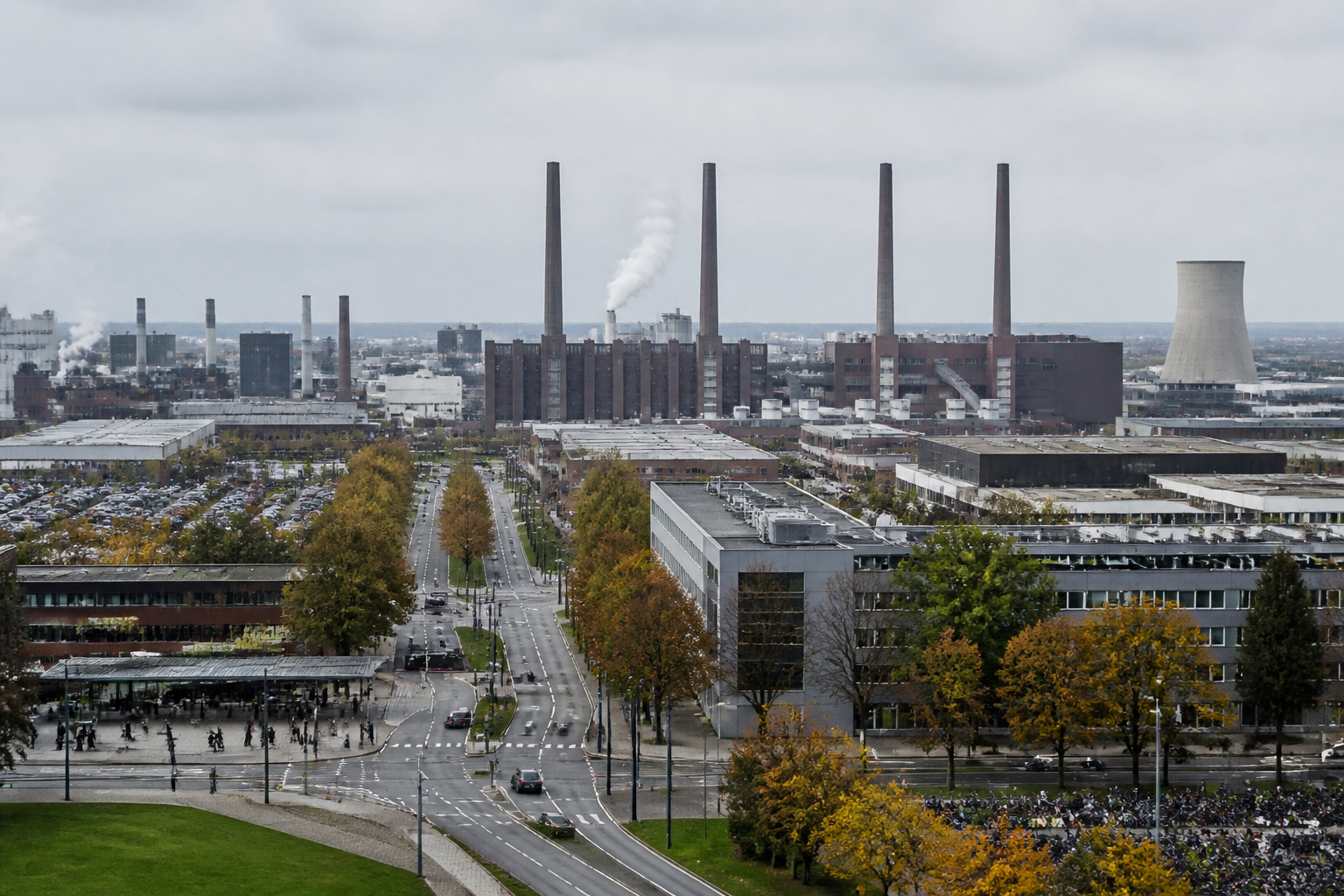
Volkswagen’s restructuring fight is no longer only a dispute over costs, models or factory capacity. It is a test of how Germany’s industrial cities function when the company that built their economies must reduce its workforce, decentralise production and respond to competitors that move faster in electric vehicles.
Chief Executive Oliver Blume is seeking a major overhaul of Volkswagen’s global business, including a possible additional 50,000 job reductions, a substantially smaller model portfolio and lower overheads. The plan has met resistance from the company’s works council and from the government of Lower Saxony, which holds 20% of Volkswagen’s voting shares. If the factions fail to agree, Blume could take contentious elements of the plan directly to shareholders, according to people familiar with the discussions cited in the report.
That possibility would be an extraordinary escalation at a company where decisions have traditionally been shaped by negotiation between shareholders, employees and the state. It also exposes the dependence of places such as Wolfsburg, Emden and Zwickau on a manufacturing system that once appeared to offer both corporate scale and regional stability.
The immediate dispute centres on Volkswagen’s cost structure. Blume has argued that the company has accumulated too many layers, interfaces and duplicated functions. Volkswagen operates roughly 150 vehicle models across its brands, including Audi and Porsche, and has a portfolio of about 2,000 investments. The proposed response includes halving the number of models, reducing administrative costs and shifting more decision-making power towards regional markets.
The company’s workforce is unusually concentrated in Germany. More than two in five employees worked there, a larger domestic share than at Toyota in Japan, according to the report. Volkswagen employed about 680,000 people globally at the end of 2024. Earlier agreements negotiated by Blume’s team at Volkswagen, Audi and Porsche had already covered around 50,000 German job reductions, largely through voluntary buyouts and early retirement over five years.
The new proposal would move the dispute beyond negotiated workforce adjustments. Around half of the targeted cost reduction would need to come from Germany, with management, central functions, development and sales among the areas under scrutiny. At the Wolfsburg headquarters, roughly four in five of the company’s approximately 60,000 employees work in office-based roles rather than directly on production lines.
This concentration makes Wolfsburg different from a conventional factory location. The city grew around Volkswagen and remains deeply connected to it. The company owns the local football club, helped establish the city’s art museum and contributes significantly to the tax base that supports public services. Volkswagen also employs local residents in service functions that other companies have more commonly outsourced.
A reduction in headquarters employment would therefore affect more than the company’s payroll. It could alter demand for offices, housing, retail, services and local transport, although the supplied report does not quantify the potential effect. In a company town, corporate restructuring becomes a question of municipal resilience because the employer, the tax base and the social infrastructure are closely connected.
The resistance to Blume’s proposal reflects that relationship. Daniela Cavallo, head of Volkswagen’s group works council, has argued that the company cannot be governed solely according to capitalist rules and that employees have a claim on the company’s returns through domestic factories, secure jobs, training and strong industrial regions. Trade unionists at a Wolfsburg meeting reportedly carried signs opposing the use of job cuts as a balance-sheet measure.
Lower Saxony’s role adds another layer of institutional complexity. The state owns 20% of Volkswagen’s voting shares and has representatives on the supervisory board. Premier Olaf Lies, who voted against Blume’s plan, visited factories that could be affected and described Lower Saxony as automotive country. His position links a shareholder decision to the future of several towns whose economic identity is tied to Volkswagen production.
The structure of the supervisory board makes rapid change difficult. Worker representatives hold half of its seats, while Lower Saxony and the Porsche-Piëch family are among the other major centres of influence. In the reported July vote, union-linked members and representatives of Lower Saxony opposed the plan, while representatives of the Porsche-Piëch family and Qatar’s sovereign wealth fund supported it.
Volkswagen’s ownership and governance arrangements were designed to prevent decisions about the company’s future from being separated entirely from its workforce and home state. The Porsche-Piëch family controls just over half of Volkswagen’s voting shares through Porsche SE, but shareholder control does not eliminate the need to bargain with employee and government representatives at the supervisory-board level.
The Volkswagen law creates a further constraint. Important shareholder decisions normally require 75% approval, while the special law raises the threshold to 80% for certain measures. That could give Lower Saxony a blocking minority. The legal mechanisms have not been tested in this particular confrontation, leaving the path from boardroom disagreement to shareholder vote uncertain.
The governance dispute has become more urgent because the company’s previous growth model has weakened. Volkswagen expanded rapidly over two decades, especially in China, which had been its strongest overseas market. Chinese automakers, including BYD, are now competing directly with German brands in their home market. At the same time, the shift towards electric vehicles and hybrids has required large investments while tariffs and geopolitical tensions have increased uncertainty.
Volkswagen has said higher US auto tariffs could cost it almost $6 billion a year. Unlike some rivals, it does not have a large US manufacturing base to limit the effect of those tariffs. Its US operation includes a small factory in Tennessee, while luxury brands such as Audi and Porsche have not established the kind of large-scale US SUV production presence created by BMW and Mercedes-Benz.
The company’s response has been to give regional operations a greater role. Blume has supported the revival of Scout Motors as an American electric-vehicle brand, including a planned $2 billion factory in South Carolina. Volkswagen has also reduced the size of Cariad, its Berlin-based software subsidiary, and created a California joint venture with Rivian after Cariad struggled with some of the software tasks required for modern vehicles.
In China, the company has pursued a local-for-local approach through investment in Chinese partners and a vehicle-development hub. The strategy reflects a broader shift in the automotive industry: products and decisions are increasingly expected to match regional markets instead of being designed primarily in Germany and exported around the world.
That shift has direct implications for Germany’s industrial geography. Volkswagen’s older model placed high-value design, administration and production capacity close to its home base, while the company grew through overseas sales. The new model would distribute more authority internationally and reduce the amount of corporate activity performed in Germany. For the company, this may be a response to cost and market pressures. For industrial cities, it raises questions about what remains when the headquarters functions that supported local prosperity are reduced.
The conflict also shows why workforce reductions are difficult to separate from urban planning. Factory towns are built around employment concentrations that shape housing demand, commuting patterns, public revenues and local institutions. When a large employer changes its footprint, the effects may emerge gradually through lower investment, reduced service demand or pressure on municipal budgets rather than through a single plant closure.
Volkswagen has already warned employees in Emden and Zwickau that their plants are not competitive enough, despite a roughly 20% reduction in costs at the sites last year. Blume has said closing a plant would be the last and most expensive solution. That position leaves the immediate implementation path unresolved, while the company weighs production costs against the political and social consequences of withdrawing from established locations.
The evidence in the supplied report confirms a company under pressure from several directions at once: Chinese competition, US tariffs, electric-vehicle investment, software difficulties, a large model range and a workforce structure that management considers too costly. It also confirms that Volkswagen’s home-market challenge is institutional as much as financial. The company cannot change its German footprint without negotiating with the workers and public authorities that helped define it.
What remains uncertain is whether Blume can secure agreement through the supervisory board, return to negotiations or call an extraordinary shareholder meeting. The decisive question is not only how many jobs Volkswagen can remove, but how much of the economic and organisational system surrounding its German plants the company intends to preserve. The next supervisory-board meeting and any subsequent shareholder process will determine whether Volkswagen’s restructuring remains a negotiated adjustment or becomes a direct challenge to Germany’s stakeholder model.
