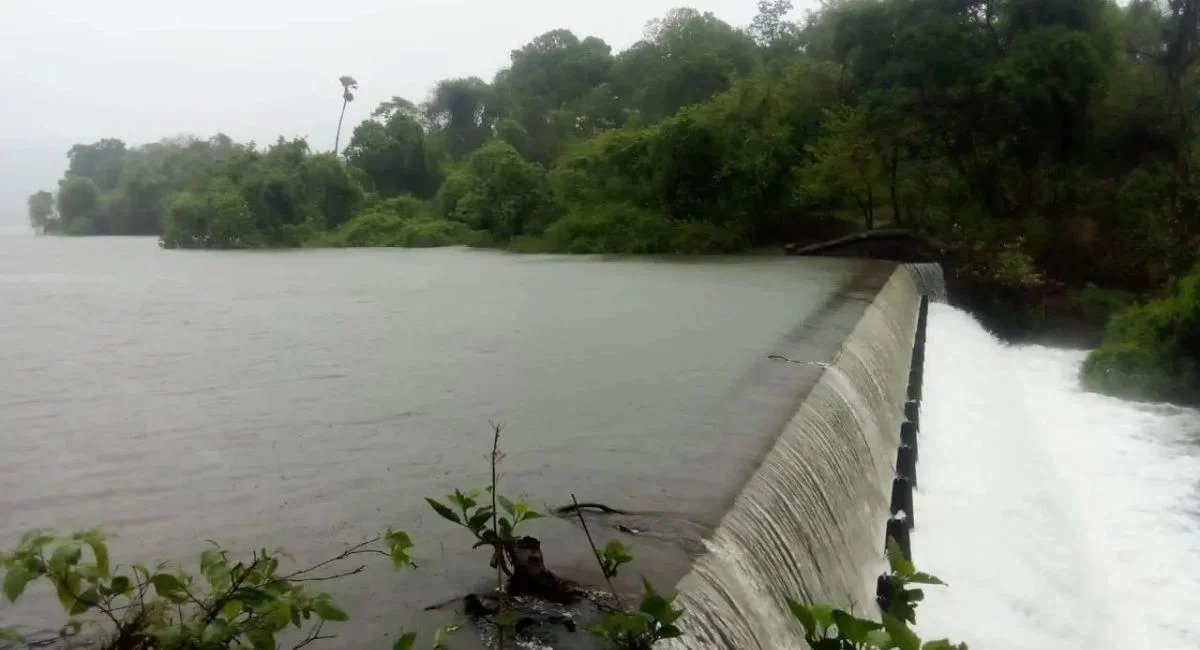
Mumbai’s seven drinking-water reservoirs are holding close to full capacity as the monsoon enters its final stretch, giving the city a strong water buffer for the months ahead. The combined stock stood at 13,86,969 million litres (ML), or 95.83 per cent, at 6am on September 2. The high reserve improves short-term supply security, but also highlights the importance of managing storage through a less predictable rainfall cycle. The latest figures from the Hydraulic Engineer’s Department show that the overall position changed only marginally over 24 hours. Upper Vaitarna, Tansa, Bhatsa and Vihar recorded no significant movement, while Modak Sagar, Middle Vaitarna and Tulsi saw small declines.
The distribution of water across the system remains uneven. Upper Vaitarna was the least full at 89.76 per cent, with 2,03,789 ML in storage. By contrast, Modak Sagar was at 99.27 per cent, Tansa at 98.29 per cent and Middle Vaitarna at 98.15 per cent. Vihar remained at full useful storage, while Tulsi held 97.30 per cent. Bhatsa remains particularly important because of its large storage capacity. It contained 6,87,132 ML, or 95.83 per cent of its useful capacity of 7,17,037 ML. The reservoir therefore represents a substantial share of the water available to Mumbai, making its level a key indicator of the city’s overall supply position. The numbers also show why rainfall alone is not enough to assess Mumbai’s water security. Reservoir catchments continued to receive rain, but most lakes recorded little change in levels. This suggests that the system is now moving from rapid monsoon accumulation towards a period in which stored water will increasingly determine supply resilience.
For households and businesses, the immediate picture is reassuring. A reserve above 95 per cent gives the civic administration considerable room to manage demand if rainfall weakens during the later monsoon or the winter months. However, urban planners note that high storage should not reduce attention on leakage control, efficient distribution and long-term demand management. The comparison with recent years adds another layer. The September 2 stock is below the corresponding levels reported for both 2025 and 2024, when storage was above 96 per cent. The difference is not large enough to indicate immediate stress, but it reinforces the need to judge Mumbai’s water position over several seasons rather than through a single strong monsoon.
With several reservoirs already having crossed overflow levels earlier in the season, the priority now shifts towards preserving this reserve efficiently. Mumbai lake levels will remain an important measure of the city’s resilience as rainfall patterns become harder to predict and demand continues to rise.