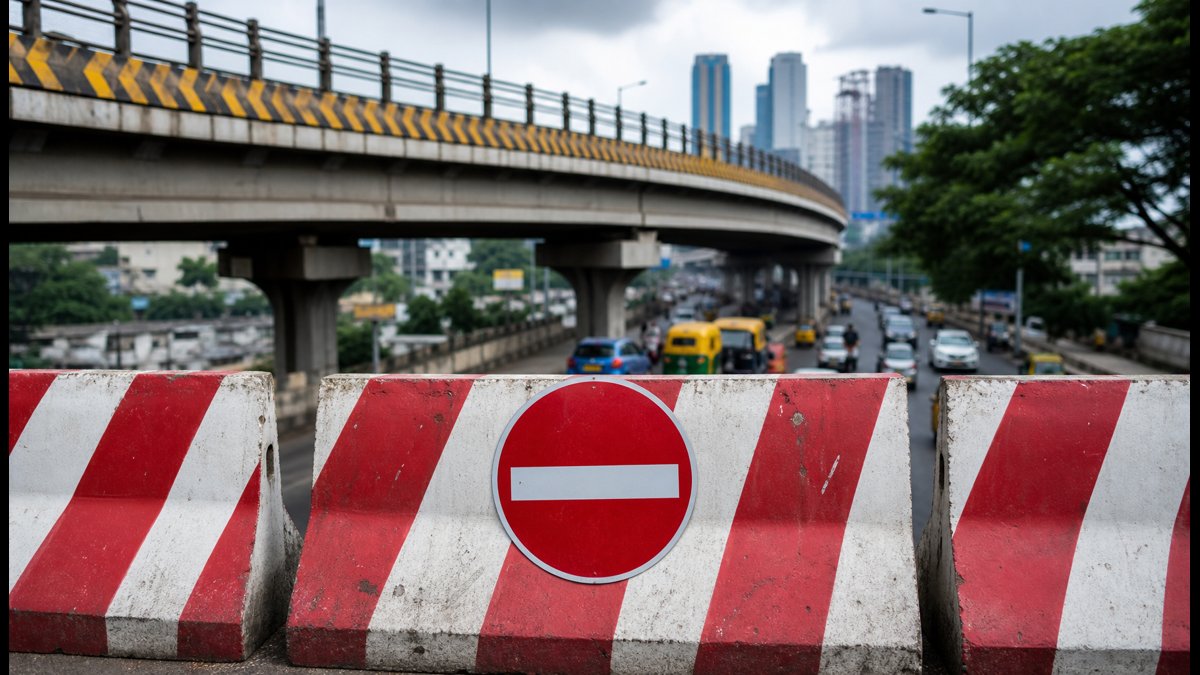
Bengaluru Flyovers Restrict Two Wheelers And Autos
Bengaluru is set to restrict two-wheelers and autorickshaws on five flyovers as traffic authorities seek to reduce conflicts and improve road safety on elevated corridors. The restrictions will alter routes for a large number of daily commuters, making the availability of safe alternatives and efficient surface-road traffic management critical to preventing congestion from simply shifting elsewhere.
The new Bengaluru flyover restrictions are being introduced on selected structures where authorities have identified safety and traffic-management concerns. The move forms part of a broader effort to regulate vehicle movement on roads where different vehicle types interact at high speeds and where emergency response can be more difficult. For two-wheeler and autorickshaw users, however, the policy could mean longer journeys. These modes are widely used for relatively short trips and last-mile connectivity, particularly where bus or Metro services do not provide direct connections. Diverting them to surface roads could therefore have an immediate impact on travel times. Urban mobility experts say the effectiveness of the restrictions will depend on what happens below the flyovers. If diverted traffic enters already crowded junctions without signal optimisation or lane management, congestion could increase rather than decline. The policy also highlights a longstanding issue in Bengaluru’s road planning. Flyovers can separate traffic streams and improve vehicle movement at specific junctions, but they do not necessarily address the broader causes of congestion. Rising vehicle ownership and limited alternatives can continue to put pressure on the surrounding road network.
The Bengaluru flyover restrictions also need to be considered alongside the city’s public transport expansion. Metro corridors can absorb longer-distance passenger demand, while buses and shared mobility can provide connections between neighbourhoods and transit stations. Improving these links would make traffic restrictions easier for commuters to absorb. Safety is another important consideration. Two-wheelers are more vulnerable in collisions than occupants of enclosed vehicles, while autorickshaws serve an important role for passengers who need flexible point-to-point travel. Any restriction should therefore be accompanied by clear diversion routes, adequate signage and predictable enforcement.There is also an environmental dimension. Longer diversions can increase fuel consumption and emissions if they result in additional kilometres travelled or prolonged congestion. Traffic restrictions work best when they are integrated with measures that encourage efficient public transport and shorter, safer journeys. Authorities will need to monitor traffic volumes on both the affected flyovers and alternative routes after implementation. Data on journey times, congestion, crashes and pedestrian conditions can help determine whether the intervention is delivering its intended outcome.
For Bengaluru, the immediate challenge is to balance safety with mobility. Restricting selected vehicles may address specific risks, but lasting improvements will depend on a wider transport system in which public transport, walking and cycling provide credible alternatives to private vehicle travel.