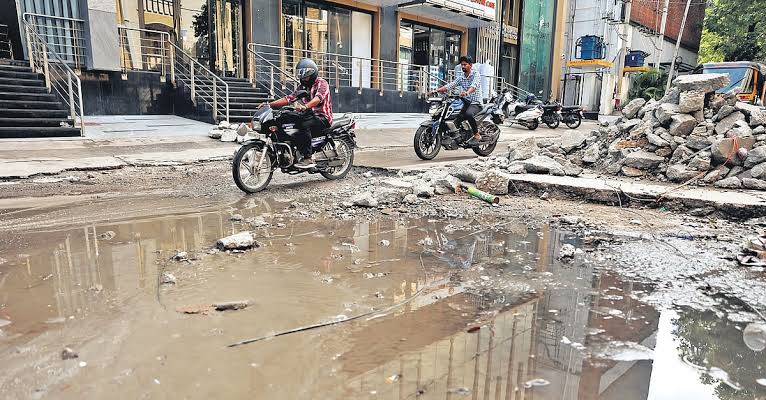
Hyderabad Roads And Drainage Face Political Scrutiny
Hyderabad’s roads, drainage network and wider civic infrastructure have become a fresh point of political contention, with Telangana BJP president N Ramchander Rao criticising successive BRS and Congress administrations over the city’s development. His remarks come as political parties prepare for upcoming municipal elections, placing everyday urban services at the centre of the civic debate.
Speaking at a party-joining programme in Tarnaka, Rao argued that Hyderabad had fallen short of its ambitions to emerge as a global city. He pointed to deteriorating roads, inadequate infrastructure and weaknesses in drainage as problems affecting residents across Greater Hyderabad. The criticism comes against a backdrop of rapid urban expansion. Hyderabad has added large residential and commercial developments across its peripheral and established areas, increasing pressure on roads, stormwater systems, public transport and other municipal services. The challenge for city authorities is to ensure that infrastructure capacity grows alongside construction and population. Drainage has become particularly important as the city experiences periods of intense rainfall. Flooding and waterlogging can disrupt commuting, damage property and affect businesses, while poorly maintained drainage infrastructure can amplify the impact of heavy rain. Improving resilience therefore requires more than isolated drain construction; it also involves protecting natural water channels, managing catchments and coordinating land development with stormwater planning.
Road quality presents a similar issue. As vehicle ownership and daily travel increase, inadequate road capacity and maintenance can raise travel times and operating costs. For lower-income workers and residents dependent on buses, two-wheelers and walking, unreliable infrastructure can also create wider economic and safety consequences. The Hyderabad infrastructure debate is likely to gain greater prominence as municipal elections approach. Political parties are expected to frame roads, drainage, waste management, public transport and neighbourhood-level services as indicators of governance. The effectiveness of those promises, however, will ultimately depend on funding, implementation capacity and measurable service improvements. Rao also expressed confidence that the BJP would perform strongly in elections to Hyderabad’s three municipal corporations. He linked a possible victory to improved delivery of central government welfare and development programmes.
Beyond the political contest, the Hyderabad infrastructure debate reflects a larger question facing the city: how can rapid real estate and commercial growth be matched with reliable public infrastructure? New development can generate jobs, investment and economic activity, but its benefits can be weakened when basic civic systems fail to keep pace. For Hyderabad’s residents, the coming electoral debate offers an opportunity to focus on measurable outcomes rather than competing claims. Road conditions, drainage performance, flood risk, public transport reliability and neighbourhood-level infrastructure are issues that can be assessed directly—and are likely to remain central to the city’s development trajectory.