


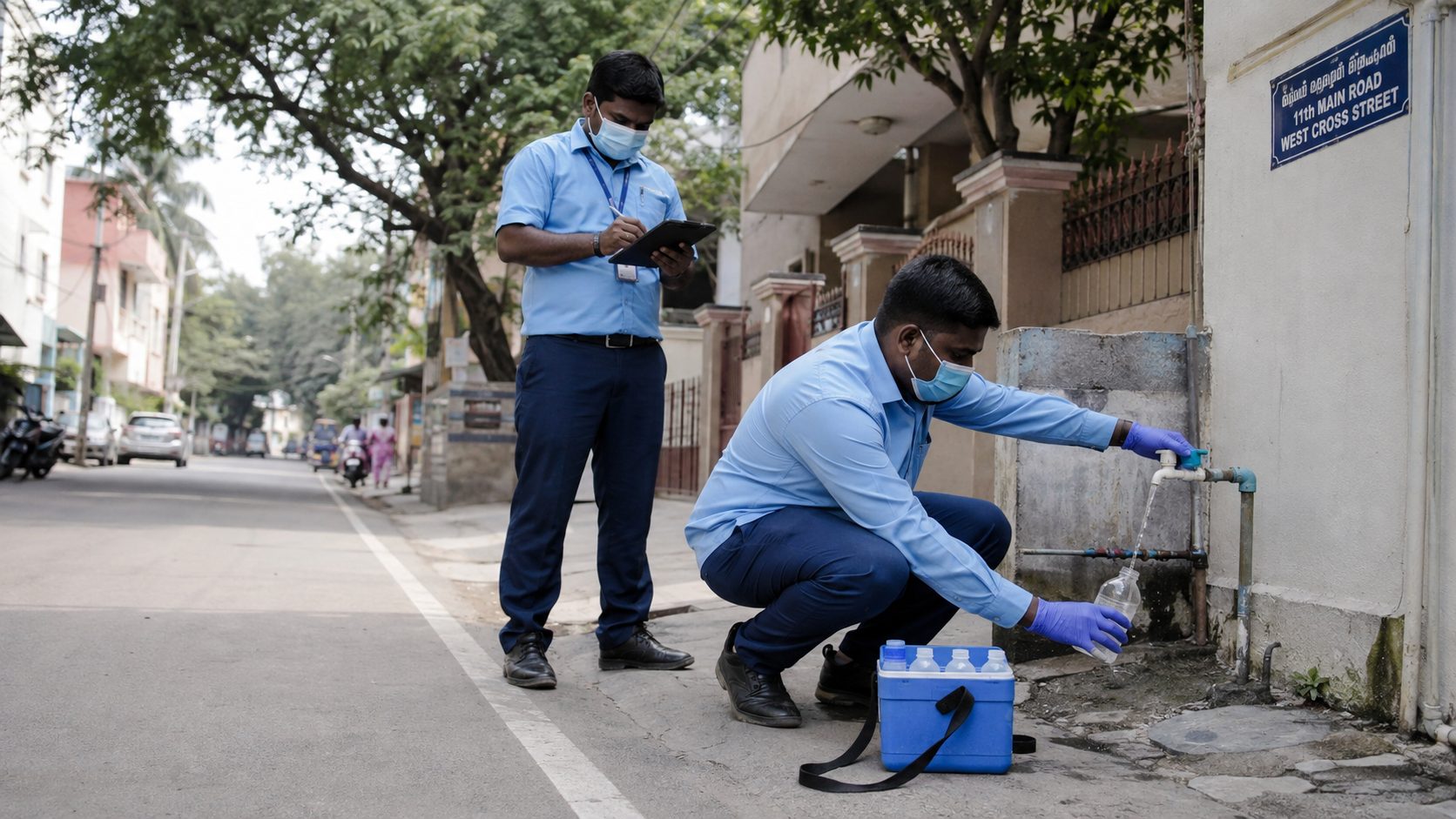
A health department report tabled before the Greater Chennai Corporation council has recorded 43 E. coli-positive water samples in Valasaravakkam Zone 11, with 46 samples classified as bacteriologically unsatisfactory. The findings cover locations including Valasaravakkam, Porur, Ramapuram, Mogappair West, Maduravoyal and Nolambur, while Chennai Metro Water has separately said its own testing found no deficiencies.
A dispute over drinking-water quality has emerged in west Chennai after laboratory findings presented at the Greater Chennai Corporation council indicated E. coli contamination across multiple locations in Zone 11, Valasaravakkam.
According to a health department report tabled at Friday’s council meeting, 43 samples collected between May 26 and August 12 were recorded as E. coli-positive, while 46 were classified as “bacteriologically not satisfactory”. Of the 43 positive samples, 36 were reportedly collected from Metro Water facilities.
The affected sample locations included households, tanks and public facilities. Ward 145 recorded 10 E. coli-positive samples, Ward 148 recorded nine and Ward 147 six. Wards 143, 152 and 153 recorded four each, while Wards 151, 150 and 155 also recorded positive samples. Two samples linked to the Chinna Porur Urban Community Health Centre, a tank at an Amma Unavagam in Ward 148 and two tanks in Nerkundram were among locations listed in the report.
Valasaravakkam Zonal Committee Chairman V. Rajan raised the issue during the council meeting and sought wider testing across Chennai. DT Next reported him as saying samples had been collected from 48 locations and that 46 were substandard, including locations in Nolambur, Valasaravakkam, Mogappair West, Porur, Ramapuram and Maduravoyal. Corporation Commissioner G.S. Sameeran assured the council that an investigation and detailed testing would be undertaken.
There is, however, an important institutional contradiction. Times of India reported that Metro Water officials subsequently said they had tested water in the zone and found no deficiencies. The available reporting does not yet establish why the corporation-linked health results and Metro Water’s testing differ.
The distinction is significant because Indian drinking-water standards require E. coli to be undetectable in any 100 ml sample and call for immediate investigation when it is detected.
The report tabled at the council also does not disclose the total number of Zone 11 samples tested between May and August, so the percentage of all samples that failed cannot presently be calculated.
Urban Acres Commentary
The most serious issue here is not simply that one set of samples tested positive. It is that two parts of Chennai’s public system appear to be producing different answers to the same fundamental question: is the water safe?
That is an accountability problem before it becomes a communications problem.
E. coli is not a parameter where an urban utility can rely on broad averages. Drinking-water standards require zero detection in a 100 ml sample, precisely because contamination may be highly localised—a leaking pipe joint, cross-connection, contaminated service reservoir or negative pressure event can affect one pocket while samples elsewhere remain compliant.
The next useful investigation therefore cannot simply consist of Metro Water producing another zone-wide assurance. Chennai needs paired sampling: the same locations, at the same time, tested using documented collection protocols and preferably independently verified laboratories. Authorities should then trace each positive result backwards through the distribution system—from household or tank to local pipe, reservoir and source.
The unanswered question is infrastructural: where, between treatment and the consumer’s tap, is water quality being lost?
Until the conflicting test results are reconciled location by location, neither a blanket claim of contamination nor a blanket declaration that the system is satisfactory is adequate public-health governance.
Key Facts
| Indicator | Verified position |
|---|---|
| Location | GCC Zone 11, Valasaravakkam |
| Council discussion | August 28, 2026 |
| E. coli-positive samples in health report | 43 |
| Bacteriologically unsatisfactory samples | 46 |
| E. coli-positive samples reportedly linked to Metro Water facilities | 36 |
| Highest ward count | Ward 145 — 10 |
| Ward 148 | 9 |
| Ward 147 | 6 |
| Areas referenced | Valasaravakkam, Porur, Ramapuram, Mogappair West, Maduravoyal, Nolambur and others |
| GCC response | Commissioner assured investigation and further testing |
| Metro Water position | Reportedly says its testing found no deficiencies |
| Drinking-water standard | E. coli must not be detectable in any 100 ml sample |
| Critical data gap | Total number of samples tested not disclosed |
