


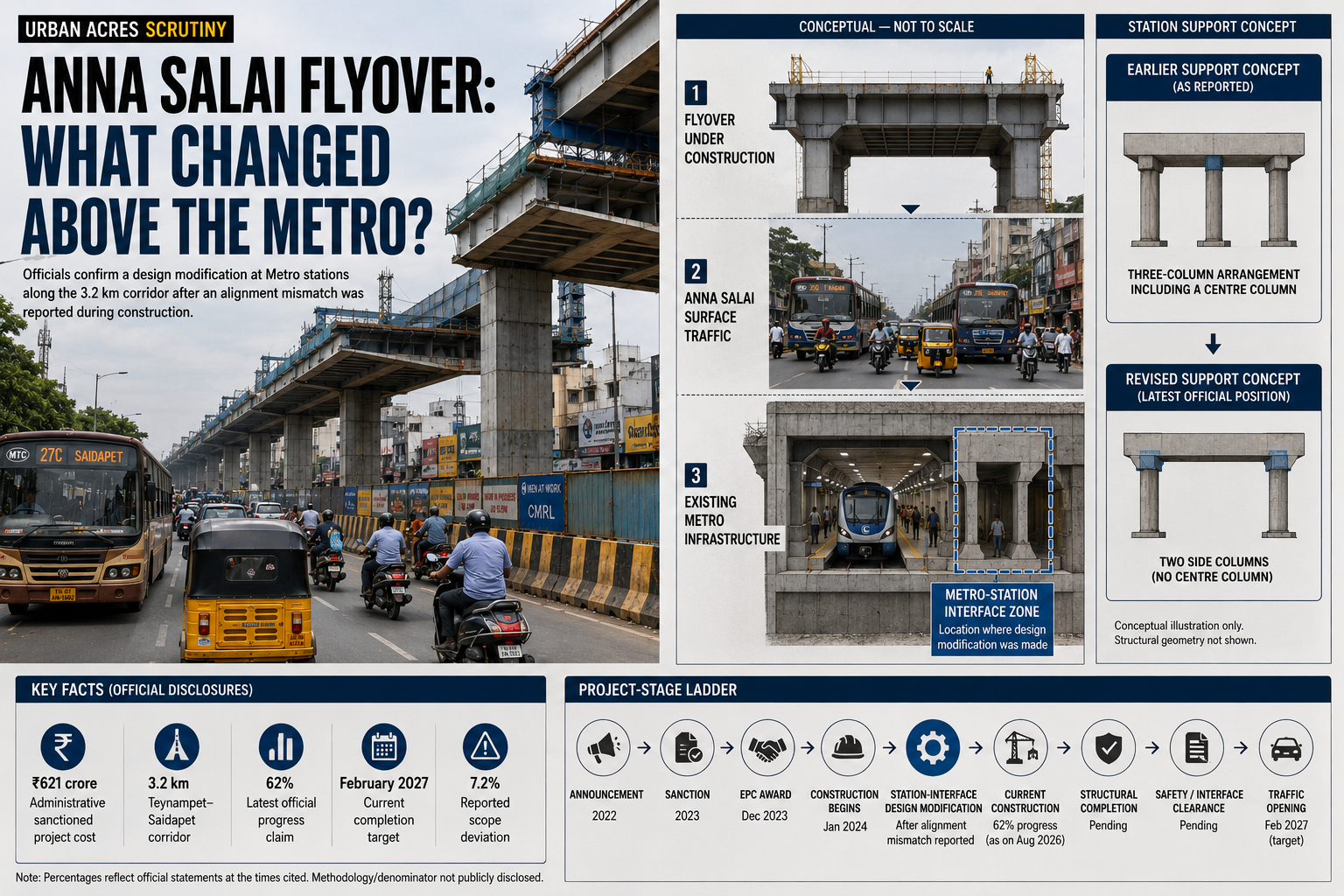
Chennai’s ₹621-crore Teynampet–Saidapet elevated corridor is still under construction after engineers modified its support arrangement around two existing Metro stations. The redesign may be legitimate engineering change control; the unresolved issue is why the critical Metro interface was not fully reconciled earlier — and why the original and revised design record remains outside public view.
CHENNAI — The design change slowing Chennai’s 3.2-km elevated corridor on Anna Salai is not merely another construction delay.
It is a test of how two major pieces of urban infrastructure — an operating underground Metro and a new four-lane flyover above it — were coordinated before steel and concrete reached the site.
Engineers associated with the project have now said the flyover geometry did not match the relevant Metro-station alignment when construction reached Teynampet and Nandanam. The support configuration has consequently been altered from three columns, including one in the centre, to two columns positioned on either side. State approval has been obtained, officials say, and they maintain that the revision will not increase the project’s cost. The two affected station sections account for around 426 metres.
The project is now described as 62% complete, with February 2027 as the completion target.
But neither the redesign nor the February deadline first emerged this week.
On August 18, another report said Highways had submitted a change-of-scope proposal earlier in 2026 after identifying differences in the station-area geometry, with the modification approved the previous month. That report had already moved the expected completion date from September 2026 to February 2027.
The journalistic value of the latest disclosure is therefore different: it provides more detail about the engineering change and creates a clearer accountability trail.
The Metro interface was never an incidental constraint
The underground railway beneath Anna Salai has shaped this flyover from the project’s inception.
Tamil Nadu’s June 2023 approval expressly involved CMRL. The government sanctioned ₹621 crore for the corridor, said the supervisory consultant would be appointed in consultation with CMRL, and recorded CMRL’s in-principle concurrence subject to safety conditions for the underground structures and passengers.
This was therefore never an ordinary flyover whose designers unexpectedly encountered a Metro line during excavation.
Its foundations, structural loads, instrumentation, supervision and construction techniques were devised around that constraint.
By March 2025, an official project update was already describing three distinct construction situations. A 655-metre non-Metro section was to use 22 pillars; a 1,955-metre section over Metro tunnels was associated with 69 pillars and specialist foundation techniques; and approximately 460 metres around the Teynampet and Nandanam Metro stations was to use 41 portal frames.
That history matters because it changes the question Urban Acres should ask.
The question is not why engineers eventually decided that station locations required a special structural solution. A special solution was publicly part of the project at least by early 2025.
The unanswered question is what specifically changed within that station-support design, what survey or construction-stage information revealed the incompatibility, and when the relevant parties first knew.
A redesign is not automatically evidence of failure
The fairest interpretation must acknowledge the project’s engineering difficulty.
This is construction inside an intensely constrained brownfield corridor, above operational Metro infrastructure and amid utilities and live city traffic. Earlier Highways explanations identified ground improvement, specialised foundations, utilities and Metro monitoring as significant components of the project.
Site conditions can differ from design-stage assumptions. EPC contracts are intended in part to accommodate engineering development, and controlled changes are not unusual.
The latest account says the scope deviation is approximately 7.2%, within the 10% allowance officials cite for infrastructure projects.
That may be entirely defensible.
What is missing is the documentation required to establish it.
Highways should therefore release the applicable original station-interface drawings, the survey information used during design, the revised configuration, the engineering justification, CMRL’s concurrence, the formal change-of-scope approval and the programme impact.
Without that record, outsiders cannot determine whether this was an unavoidable field refinement or a design-interface problem that could reasonably have been identified earlier.
Progress reporting has become another issue
There is also an unresolved numerical problem.
On August 3, a senior Highways official was reported as saying the corridor was about 70% complete and could be finished by the end of November. Labour shortages and the restricted nighttime construction window were cited among the causes of delay.
Less than four weeks later, officials are quoted putting completion at 62%, with February 2027 as the target.
That does not necessarily mean either figure is false. Physical progress can be calculated using weighted quantities, structural components, financial milestones or revised scope baselines.
But a public percentage without its denominator has little accountability value.
If the change of scope altered the project baseline, Highways should say so and publish a revised work-breakdown structure.
₹621 crore is also not one interchangeable number
The project’s finances require similar discipline.
The ₹621 crore figure is the administratively sanctioned project cost. The government’s 2023 order initially provided ₹100 crore for FY2023-24, demonstrating why sanctioned project value must not be described as money spent in one year.
J. Kumar Infraprojects subsequently disclosed an EPC order worth ₹582.684 crore including GST.
A later Highways explanation showed that the ₹621-crore sanctioned estimate included multiple cost heads beyond the basic structure — including utility relocation, ground improvement, supervision, Metro instrumentation, 10-year maintenance, escalation, contingencies and GST.
Officials now say the redesign produces no additional cost. That is possible, particularly if quantities are rebalanced within an EPC/change-of-scope mechanism.
But “no additional cost” should be demonstrated through the revised bill of quantities or change order, rather than treated as a sufficient disclosure by itself.
The real milestone is not structural completion
Even February 2027 should be described carefully.
It is currently a completion target, not passenger or traffic service already delivered.
The corridor remains in construction. Structural work has to be completed, followed by the remaining deck and road works, safety and monitoring requirements around Metro assets, finishing and traffic restoration before motorists receive the intended benefit.
And the outcome cannot ultimately be measured simply by announcing that 3.2 km of flyover is complete.
Tamil Nadu originally justified the project partly through severe traffic pressure on the corridor. The 2023 government record cited peak-hour traffic of about 18,000 passenger-car units against an existing capacity of 10,000 and average daily traffic of 237,686 vehicles.
Once opened, the real questions are whether junction delay falls, whether surface traffic improves rather than merely relocating congestion, whether buses and pedestrians experience deterioration or improvement, and whether the corridor’s maintenance obligations are actually performed.
Publish the engineering trail
There is no basis at present to allege structural danger, contractor misconduct or administrative negligence.
There is, however, a strong case for transparency.
This is precisely the kind of project where coordination between two infrastructure systems must be auditable: the road authority builds above an operating Metro system; CMRL controls critical underground assets; an EPC contractor carries construction responsibility; specialist supervision and third-party review exist; and hundreds of crores of public expenditure are involved.
The next meaningful disclosure is therefore not another percentage-complete announcement.
It is the change-control record showing how Chennai moved from the original design to the structure now being built.
