


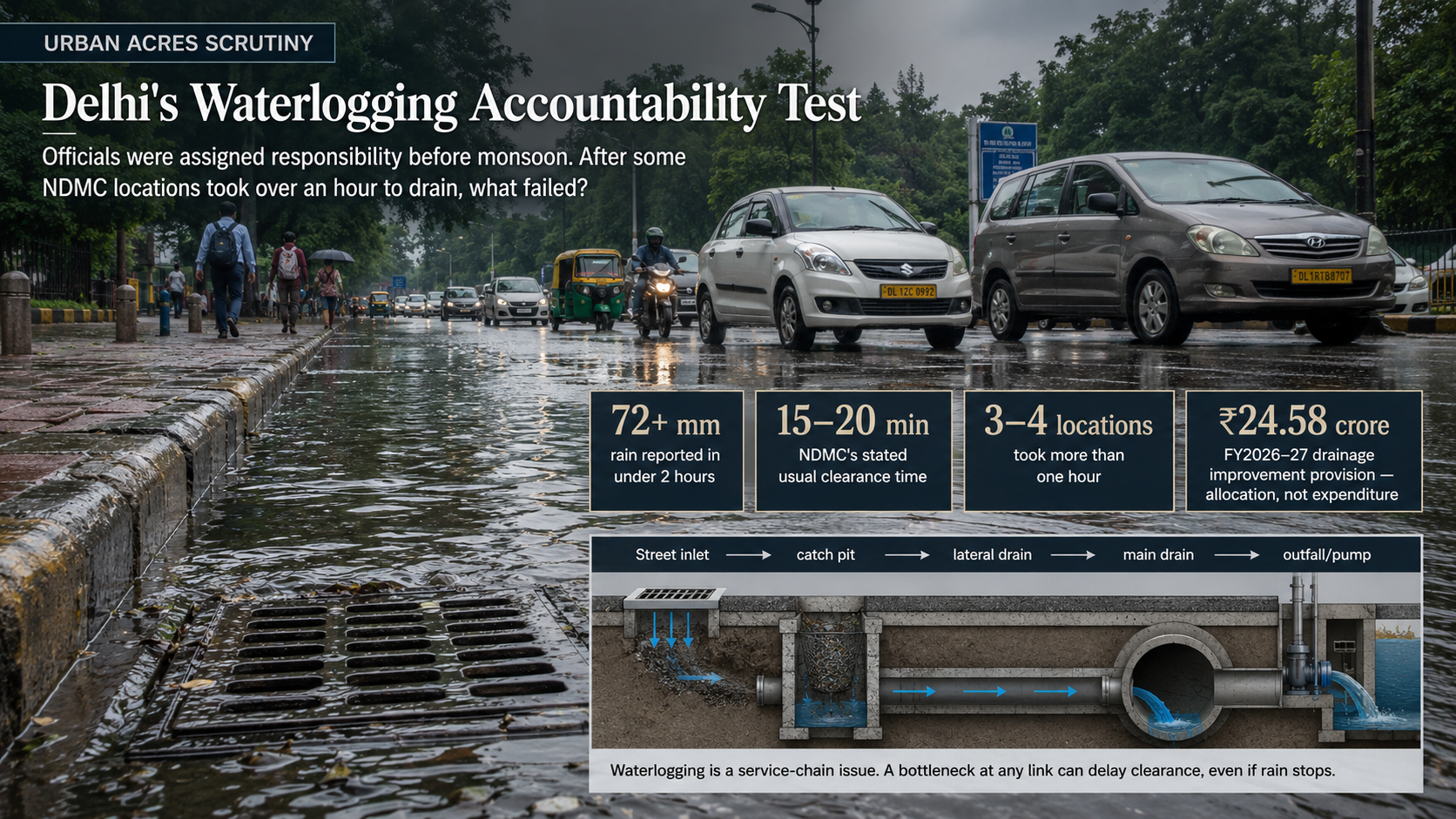
More than an hour of waterlogging at several New Delhi locations has turned this week’s rainfall into a test of Delhi’s pre-monsoon accountability system. The next meaningful milestone is not another warning, but a public explanation of what failed at each location and how recurrence will be measured.
NEW DELHI — Delhi’s latest response to monsoon waterlogging has escalated from an apology to another warning.
PWD, Water and Irrigation & Flood Control Minister Pravesh Sahib Singh reviewed the New Delhi Municipal Council’s response on Thursday, August 27, after heavy rain left parts of its jurisdiction waterlogged earlier in the week. Singh said waterlogging caused by negligence would not be tolerated and warned that responsible officials could face action if it happened again.
The immediate administrative intervention is fresh. The principle behind it is not.
Two months before this week’s flooding, the Delhi government issued its Flood Control Order 2026 and said nodal officers would be assigned to identified waterlogging locations, with responsibilities clearly defined and accountability attached to failures.
That makes the August incident an important test of an accountability system that was supposed to be operational before the rain arrived.
More than an hour against a 15–20 minute benchmark
NDMC Chairperson Manoj Kumar Dwivedi publicly apologised following Tuesday’s disruption and supplied a useful service metric.
The council, he said, generally clears waterlogging within about 15–20 minutes. At at least three or four locations on August 25, however, complete drainage took more than an hour.
That is more significant than the rhetoric surrounding the event because it creates a measurable operational benchmark.
The public can now ask not simply whether a road “waterlogged”, but how long it remained impaired.
Rainfall intensity must nevertheless form part of any fair assessment. Dwivedi said more than 72 mm fell in under two hours. Safdarjung recorded 99.1 mm during the 24 hours ending the following morning — Delhi’s highest 24-hour rainfall there in more than two years.
Heavy short-duration rain can overwhelm drainage even where maintenance has been performed. Without hydraulic-capacity information for the affected drains, Urban Acres cannot conclude that every instance resulted from official negligence.
The unresolved engineering test is therefore precise: what rainfall intensity was each drainage catchment designed to manage, what intensity occurred there, and which component failed first?
Drainage is a chain, not a desilting statistic
Urban waterlogging cannot be diagnosed from drain-cleaning numbers alone.
The service chain is:
Street inlet → catch pit → lateral drain → main drain → receiving drain/outfall → pumping or gravity discharge
A blocked gully inlet can leave a functioning trunk drain irrelevant. A clean local drain can fail if its downstream outfall is constrained. An operational pump can still be inadequate if incoming flow exceeds its capacity.
This is why a credible post-event review should disclose the failure mode at every location that exceeded NDMC’s normal clearance benchmark.
Was the inlet obstructed?
Did the local drain surcharge?
Was a pump unavailable or undersized?
Was there backflow?
Did a downstream drain constrain discharge?
Or did rainfall simply exceed the designed return-period capacity?
None of those location-specific answers has yet emerged publicly from the material reviewed.
NDMC has already acknowledged an ageing network
The current incident also sits within a longer infrastructure problem documented by NDMC itself.
Its budget papers describe 14 drainage systems, around 53 km of main drainage network and around 270 km of transfer underground drainage lines. They also state that some of the network is roughly 80 years old and acknowledge the need for rehabilitation.
More important is the project stage.
In its 2022-23 budget speech, NDMC said a consultant would be appointed for rehabilitation of all 14 drainage systems. By 2024-25, an estimate for rehabilitation was described as under process. The 2025-26 document said an estimate had been submitted for funding. The 2026-27 material described a consultant being appointed for condition assessment and CCTV survey, with the project at RFP stage.
The scope and financing arrangements may have evolved between those documents, so this sequence does not establish a simple uninterrupted project delay.
It does establish something narrower and important: the council’s own documents continued to describe systemwide rehabilitation as a preparatory rather than completed intervention across several budget cycles.
The 2026-27 budget provides ₹24.58 crore for drainage-system improvement, comprising ₹17.40 crore of capital provision and ₹7.18 crore of revenue provision. That number must be treated as an allocation, not expenditure or proof that rehabilitation has occurred.
Responsibility is institutionally more complex than one ministerial warning
NDMC is a statutory municipal council constituted under the New Delhi Municipal Council Act, 1994. The Central Government appoints its chairperson in consultation with Delhi’s chief minister, and the Act gives the Central Government significant supervisory powers over the council.
Singh, meanwhile, heads the Delhi government’s PWD, Water and Irrigation & Flood Control portfolios.
Those overlapping institutional interfaces matter because Delhi’s drainage does not respect administrative boundaries.
PWD roads, NDMC drains, Delhi Jal Board sewer infrastructure, Irrigation & Flood Control drains, traffic management and downstream outfalls can interact in a single waterlogging event.
A credible accountability exercise must therefore identify the responsible infrastructure interface, not merely an individual official standing nearest to the flooded road.
The real post-monsoon test starts with disclosure
Delhi had already moved toward hotspot-specific accountability before the monsoon.
The August 25 event now provides an opportunity to make that model measurable.
NDMC should publish, for every location where its normal clearance standard was missed:
rainfall intensity → maximum water depth → time first reported → pump/inlet status → drainage route → cause → responsible division → intervention → full-clearance time → permanent corrective work → target completion date
If negligence is found, the authority should say what evidence established it and what administrative action followed.
If the infrastructure was functioning as designed but the rainfall exceeded design capacity, the authority should disclose that capacity and the upgrade required.
That distinction is essential.
A city does not become flood-resilient because officials are repeatedly warned. It becomes more resilient when every failure produces engineering evidence, corrective investment and a measurable improvement at the next storm.
