


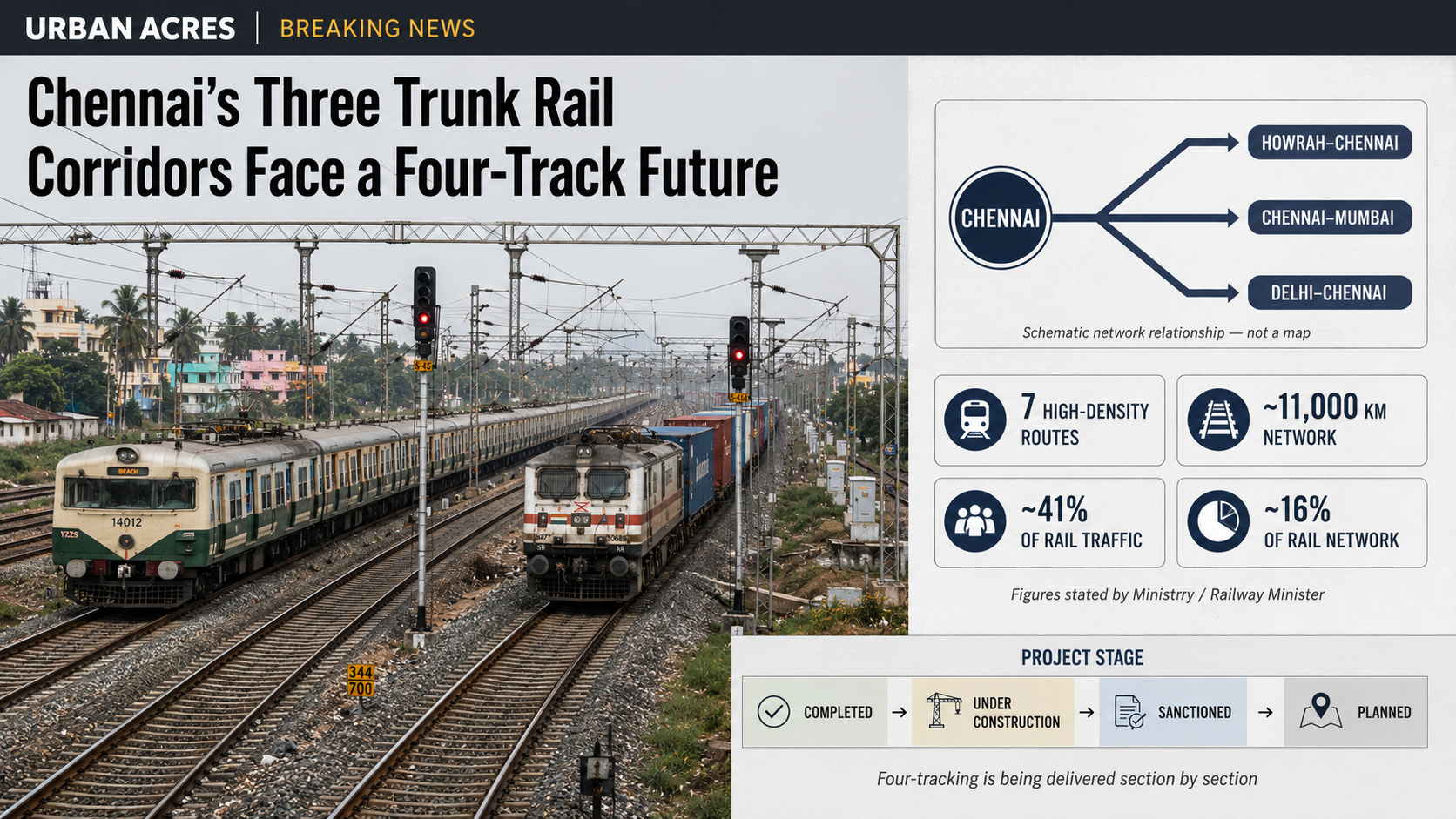
Indian Railways is pursuing a four-track capacity standard across the country’s busiest trunk rail network, bringing the Howrah–Chennai, Chennai–Mumbai and Delhi–Chennai routes into a much larger national multi-tracking programme. But the announcement should not be read as a single approval to immediately construct four tracks across all three corridors.
Railway Minister Ashwini Vaishnaw said on August 26 that Railways was moving towards four-laning seven High-Density Network routes covering roughly 11,000 km. According to the minister, these corridors account for around 41% of railway traffic while comprising about 16% of the network. Alongside the three Chennai-linked routes, the network includes Delhi–Howrah, Mumbai–Delhi, Mumbai–Howrah and Delhi–Guwahati.
The announcement is significant because it elevates four-tracking from a collection of individual capacity projects into an explicit network-wide objective.
But its project stage requires qualification.
There is no evidence in the primary material reviewed by Urban Acres of a single sanction covering the entire 11,000-km High-Density Network, nor has Railways disclosed a consolidated capital cost, common construction programme or completion date for every section.
Instead, the network is being expanded through individual projects at different stages — from surveys and planning to sanction, construction and completion.
Chennai already shows how that process works
On the northern approach to Chennai, Railways has been adding capacity progressively.
The Chennai Beach–Attipattu fourth line and the Tiruvallur–Arakkonam fourth line were already listed as completed by the Railway Ministry earlier this year. Meanwhile, the 23-km Attipattu–Gummidipundi third and fourth lines were listed as ongoing at a cost of ₹375 crore. The same official status report placed the 30-km Tambaram–Chengalpattu fourth line, costing ₹757 crore, among ongoing Tamil Nadu railway projects.
That sequencing is important. Chennai is not moving overnight from two tracks to four tracks because of a single August announcement. Its rail approaches have been undergoing multi-tracking through individual works for years.
The latest substantial approval came on August 19, when the Cabinet Committee on Economic Affairs cleared third and fourth lines between Gummidipundi and Gudur over approximately 90 km in Tamil Nadu and Andhra Pradesh. The project formed part of a four-project railway package with an aggregate estimated cost of ₹9,450 crore and a completion horizon up to 2030-31.
Railway planning documents had already identified Gummidipundi–Gudur as part of the Howrah–Chennai High-Density route and said the additional tracks were required for both freight and passenger capacity.
Further north on the same corridor, the Cabinet in April approved third and fourth lines across the 198-km Nidadavolu–Duvvada section in Andhra Pradesh at an estimated completion cost of ₹9,889 crore. Railways explicitly described that project as part of the Howrah–Chennai quadrupling initiative.
Chennai–Mumbai is also being built section by section
A similar pattern is visible towards Mumbai.
The Cabinet-approved Guntakal–Wadi third and fourth line project covers approximately 230 km and carries an estimated cost of ₹4,758 crore. An official Railways project brief identifies the section specifically as part of the Mumbai–Chennai High-Density Network.
Closer to Chennai, the Ministry has also taken the proposed Arakkonam–Renigunta third and fourth lines, measuring about 76.6 km, through planning evaluation under the High-Density Traffic programme. The source reviewed describes this as a proposal; Urban Acres has therefore not treated it as equivalent to a completed contract award or construction commencement.
That distinction is precisely why the national four-tracking announcement cannot be translated into a uniform project stage for every kilometre.
Delhi–Chennai is advancing through the same model
On the Delhi–Chennai corridor, one of the major capacity constraints is the central Indian rail spine through Maharashtra.
The Wardha–Balharshah corridor had previously been assessed for a fourth line because official planning documents recorded line utilisation above 150% in the relevant section.
By July 2026, the Railway Minister told Parliament that the approximately 135-km Wardha–Balharshah fourth line had been sanctioned at about ₹2,226 crore.
Again, the progression is visible:
capacity constraint → planning → sanction → construction → operational capacity.
The August 26 statement sits above this project pipeline as the overall network objective. It does not replace those individual stages.
What could four-tracking eventually change for Chennai?
Additional railway lines create operating paths.
That could matter considerably on approaches where suburban EMUs, long-distance passenger services and freight movements compete for capacity. Separating or increasing available paths can improve timetable flexibility, reduce conflicts and potentially accommodate more trains.
But those benefits are not automatic.
Urban Acres infers that physical four-tracking could create the infrastructure required for more reliable or more frequent passenger services. Actual improvements for Chennai commuters would still depend on signalling, terminal capacity, rolling stock, timetable planning, station capacity, maintenance blocks and how the new train paths are allocated between passenger and freight services.
No Chennai suburban frequency commitment accompanied the August 26 network announcement.
That is the outcome residents should ultimately measure.
Four railway lines are an infrastructure output.
More usable trains, shorter waits, fewer conflicts and better reliability are the mobility outcomes.
