


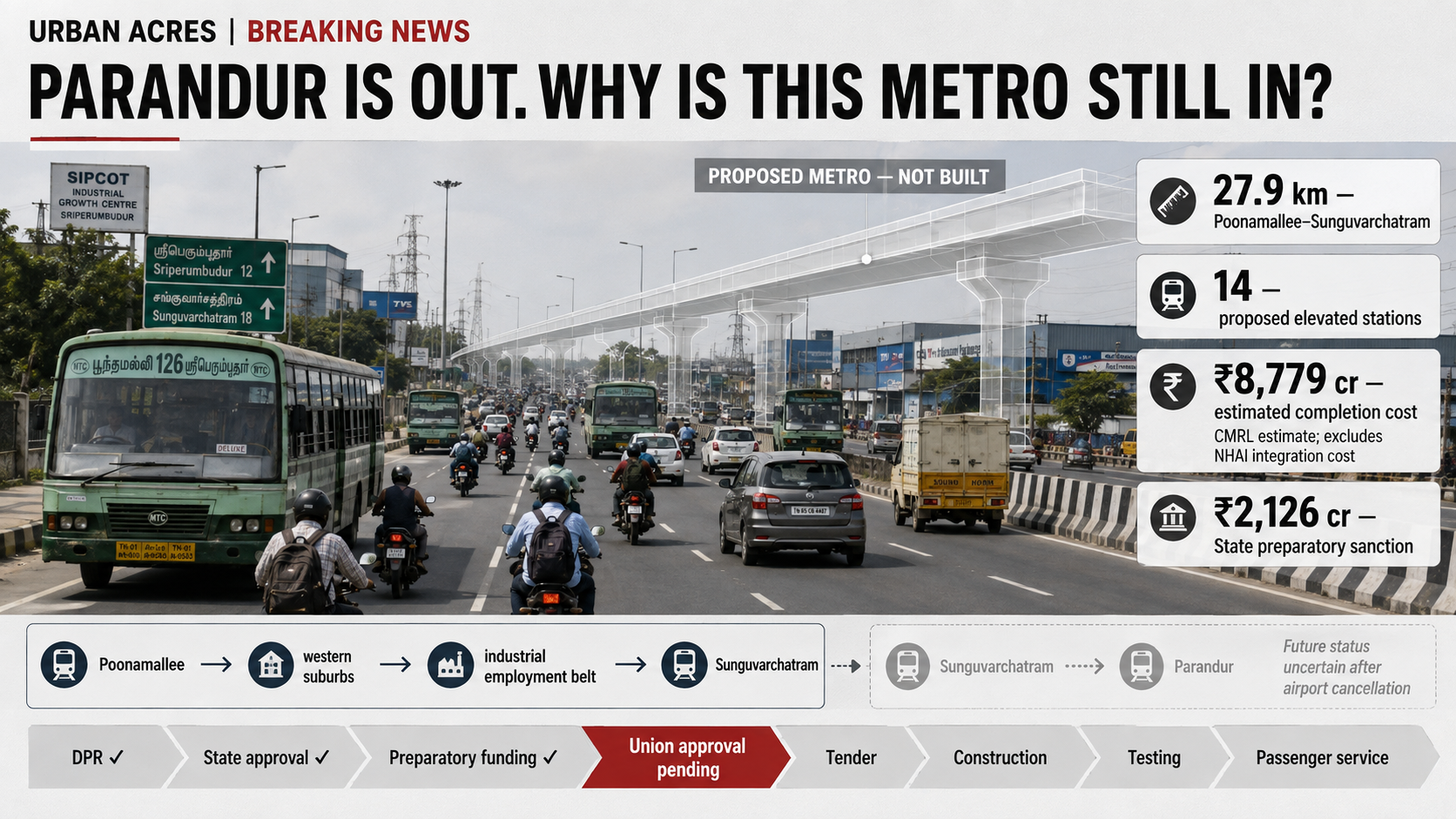
CMRL plans to continue pursuing the 27.9-km western extension despite Tamil Nadu abandoning the Parandur airport site. But the ₹8,779-crore figure is an estimated project cost, the line still awaits Union approval, and the airport-dependent second leg has effectively returned to the demand-testing stage.
CHENNAI: The cancellation of Chennai’s proposed greenfield airport at Parandur has broken one part of a much larger transport plan — but not, for now, the proposed Metro extension through Sriperumbudur.
Chennai Metro Rail Limited officials have said the proposed 27.9-km Poonamallee–Sunguvarchatram extension will continue to be pursued, arguing that the corridor has a transport case independent of the abandoned airport because it would serve Chennai’s western growth areas and the Sriperumbudur industrial belt.
That statement is significant because the Metro proposal was originally developed as part of a 52.94-km connection from Poonamallee to Parandur airport.
But it does not mean an ₹8,779-crore construction project has just been cleared.
CMRL’s own March 2025 DPR documentation describes ₹8,779 crore as the estimated completion cost of the Poonamallee–Sunguvarchatram portion. The proposed first phase comprises 14 elevated stations over 27.9 km. CMRL also says that cost excludes the expense associated with integration with NHAI’s planned elevated corridor between Poonamallee and Sriperumbudur.
The project was already being split before Parandur was cancelled
The distinction between the two Metro sections predates the latest airport decision.
CMRL’s consultant had already recommended that the full Poonamallee–Parandur project be developed in stages, with Poonamallee–Sunguvarchatram implemented first and the remainder towards Parandur following separately. Tamil Nadu granted in-principle approval to that structure in 2025.
The State then authorised ₹2,126 crore for preparatory activity on the first section, including land acquisition, surveys and road-related works. ₹1,836 crore — more than four-fifths of that sanction — was earmarked for acquiring land and compensating affected structures.
That ₹2,126 crore should not be confused with the ₹8,779-crore completion estimate.
Nor does the preparatory sanction establish that the main Metro civil works have been awarded.
What changed after Parandur
Until this week, the rationale for separating the first section from the airport extension was partly a risk-management decision: proceed with the industrial corridor while the airport’s future remained uncertain.
CMRL was already publicly maintaining this position in July, saying Poonamallee–Sunguvarchatram should move forward regardless of the uncertainty surrounding Parandur.
The context has now changed materially.
Tamil Nadu announced on August 24 that it would abandon the proposed Parandur airport and seek another site.
CMRL officials subsequently reaffirmed that the Metro would still be pursued to Sunguvarchatram. According to the latest reporting, the remaining Sunguvarchatram–Parandur section would instead be considered later depending on traffic demand.
That makes the new institutional position clearer:
Poonamallee → Sunguvarchatram: active proposal proceeding through approvals.
Sunguvarchatram → Parandur: no longer an immediately sequenced airport-connection project.
The real test is now the non-airport transport case
Removing Parandur changes how the first 27.9 km should be evaluated.
Its case can no longer rely primarily on future airport passengers. CMRL and the State now need to demonstrate the corridor’s value through existing and forecast travel demand generated by Sriperumbudur’s industrial workforce, western suburban growth, bus interchange demand and daily regional commuting.
That may ultimately strengthen the project if the numbers show that the corridor stands on its own. But it should be demonstrated through an updated appraisal rather than assumed because money has already been committed to preparatory work.
A revised public business case should disclose projected daily ridership without airport traffic, peak-hour demand, mode shift from buses and private vehicles, travel-time savings, station catchments and the proportion of expected passengers who are industrial workers.
The highway interface also matters
The extension is not an isolated viaduct proposal.
CMRL’s DPR envisages integration with an NHAI elevated corridor for 5.892 km between Poonamallee and Sriperumbudur, specifically to optimise project cost and implementation time.
That creates an institutional interface between Metro engineering and highway development that requires particular scrutiny. Changes to one programme could affect pier configuration, construction sequence, traffic management, structural responsibilities and ultimately cost.
The ₹8,779-crore estimate’s exclusion of the NHAI integration cost makes publication of the agreed cost-sharing and engineering arrangement especially important.
Union approval remains a hard gate
The strongest reason not to describe the project as being “under construction” is simple: Tamil Nadu is still seeking Union approval.
The State’s 2026-27 Budget position continued to list Poonamallee–Sunguvarchatram among the Metro extensions for which early central approval was being pursued.
Until that process is completed and the financing structure, procurement packages and construction programme are established, residents along the corridor do not yet have a passenger-opening date that Urban Acres can responsibly treat as committed.
The project’s survival after Parandur is therefore important.
But survival is only one project stage.
The next question is whether CMRL can convert a corridor originally embedded in an airport strategy into a fully justified metropolitan and industrial mobility project — and publish the evidence for doing so.
