


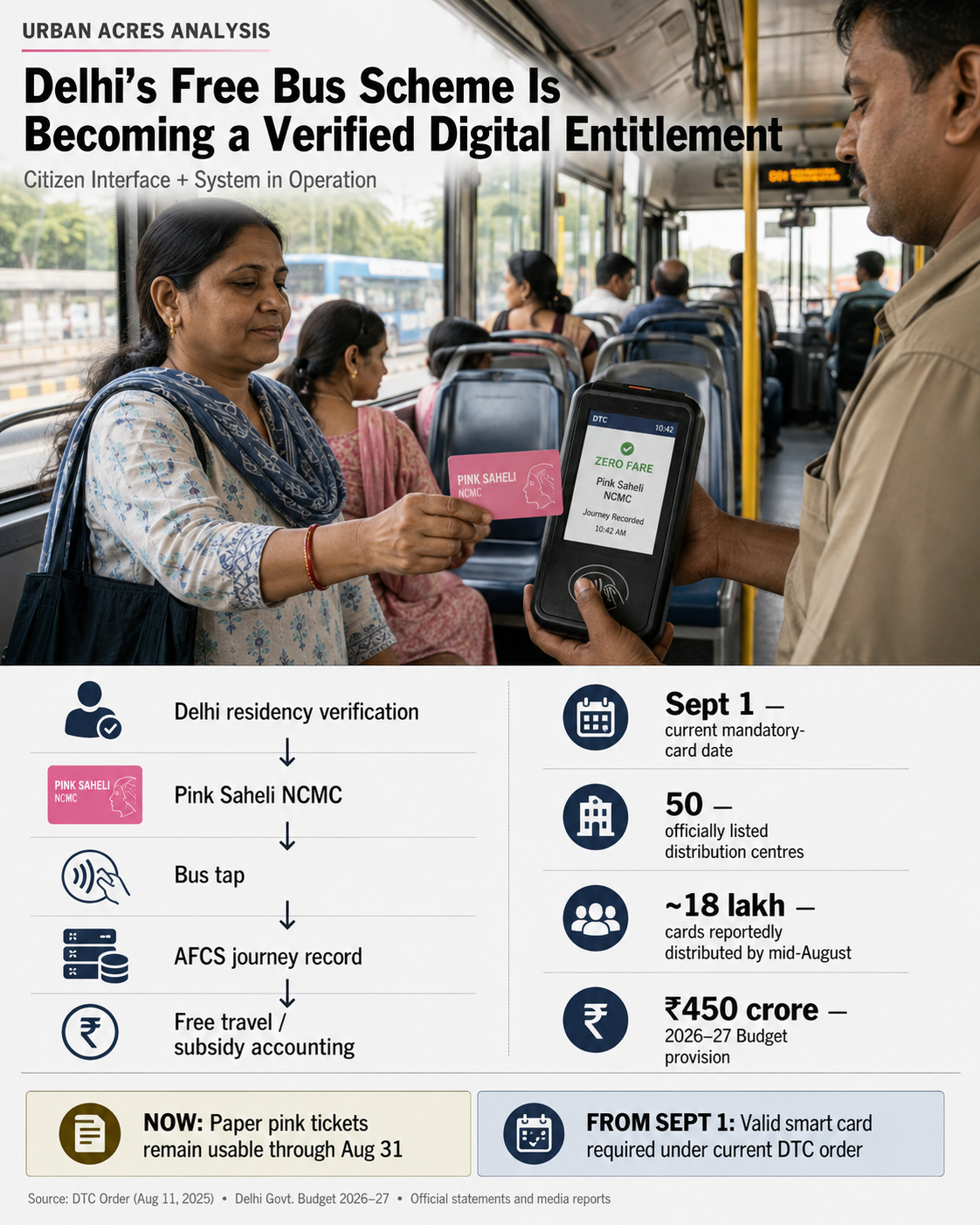
Delhi’s transition from pink paper tickets to the Pink Saheli Smart Card is being presented as a ticketing upgrade. It is more consequential than that.
From September 1, under the current Delhi Transport Corporation order, eligible women seeking free travel on DTC and Cluster buses will need to tap a valid Pink Saheli Smart Card. The paper tickets that have carried the subsidy since 2019 are scheduled to stop after August 31. A passenger without the required card will have to pay the applicable bus fare.
But technology is only half the change.
The entitlement itself has changed
When Delhi introduced free bus travel for women in October 2019, the regulatory amendment provided free travel to “female passengers” through a single-journey free pass. Contemporary reporting also recorded the scheme operating for women irrespective of whether they were Delhi residents.
Pink Saheli is different.
DTC’s own smart-card procurement documents define the target group as bona fide women and transgender residents of Delhi, aged 12 and above. For the zero-KYC Pink Smart Card, the documentation specifies mobile OTP and Delhi-based Aadhaar OTP verification; the full-KYC route likewise provides for verification of Delhi residency.
That means Delhi is implementing two changes simultaneously:
Paper → digital, and
category-based access → category-plus-residency access.
The second change matters more than the first.
Why digitise the scheme?
There is a credible administrative argument for doing so.
A paper ticket records a subsidised journey, but a smart-card system can create passenger-level and journey-level data, improve reconciliation and integrate free trips with Delhi’s automated fare-collection infrastructure. DTC has described the shift as a move toward a more transparent and digital system. Its procurement specification calls for real-time data exchange, activation/status synchronisation, weekly MIS and audit logs.
That potentially gives Delhi something the old pink-ticket arrangement could not: a clearer picture of when, where and how beneficiaries use the bus network.
If that data is used to change frequencies, identify routes with high female ridership, improve interchange planning or target safety interventions, Pink Saheli could become more than a subsidy-accounting mechanism.
But digitisation should be measured against access as well as auditability.
The residency gate is the real public-interest question
Delhi’s economy and transport system do not operate neatly around documentary categories.
A worker can live in Delhi while retaining identity documents registered elsewhere. A student can reside temporarily in the city. A renter can move frequently. A woman commuting through Delhi’s labour market can depend on the city’s buses without possessing the specific address documentation demanded by a digital eligibility system.
This does not establish that all such passengers are being excluded, and Urban Acres cannot yet quantify how many will lose the concession.
It does establish a question Delhi should answer before September 1:
How many women currently receiving free bus journeys will fail the new residency-verification test?
That number is currently more important than the headline card-distribution total.
Two deadline extensions reveal the implementation pressure
The card was initially supposed to become mandatory on August 1. DTC then allowed paper tickets through August 15. On August 14 it extended the transition again, this time through August 31, with mandatory smart-card use scheduled for September 1.
Around 18 lakh cards had been issued by mid-August, according to government-linked reporting, while DTC’s official distribution list identifies 50 designated centres across district offices, SDM offices and DTC locations.
The number of cards issued, however, is not sufficient to measure readiness.
Delhi needs a denominator: the number of regular women and transgender bus users who qualify for the programme and the share who have successfully activated cards.
Without that figure, “18 lakh cards issued” tells the public how much distribution has occurred, not whether the transition is complete.
The ₹450-crore question
The financial picture also deserves closer scrutiny.
Delhi’s 2026–27 Budget highlights contain a ₹450-crore provision for free travel for women and transgender passengers in DTC buses. That is a Budget allocation, not expenditure.
Separately, Delhi’s 2025–26 Economic Survey says 56.21 crore free journeys were recorded in DTC and DoT buses through February 2026 and ₹562.17 crore in subsidy was provided. The survey describes a ₹10 face value for the single-journey free pass.
The obvious numerical question is why a ₹450-crore provision follows a reported subsidy exceeding ₹562 crore before the previous financial year was even complete.
Urban Acres should not conclude from these numbers alone that the subsidy has been reduced. The Budget highlight specifically references DTC buses, while the Economic Survey reports DTC and DoT journeys together. Accounting treatment may also change under the new digital system.
The government should therefore publish the precise 2026–27 funding architecture: DTC subsidy, Cluster/DoT subsidy, smart-card technology cost, reimbursement formula and any supplementary provision.
What Delhi should measure after September 1
The most useful Pink Saheli dashboard would not merely display how many cards have been distributed.
It should report:
eligible applicants → cards issued → cards activated → successful free taps → failed taps → passengers charged because eligibility could not be established → complaints → resolution time.
It should also break outcomes down sufficiently to identify whether renters, students, lower-income workers or residents of particular parts of Delhi face disproportionate enrollment problems.
That is where the public-service test lies.
A digital card can make subsidy accounting cleaner. A residency test can make public expenditure more targeted. Both are legitimate policy objectives.
But the system succeeds only if Delhi can show that the administrative controls introduced to make the subsidy more accountable do not become larger barriers than the paper ticket they replaced.
