


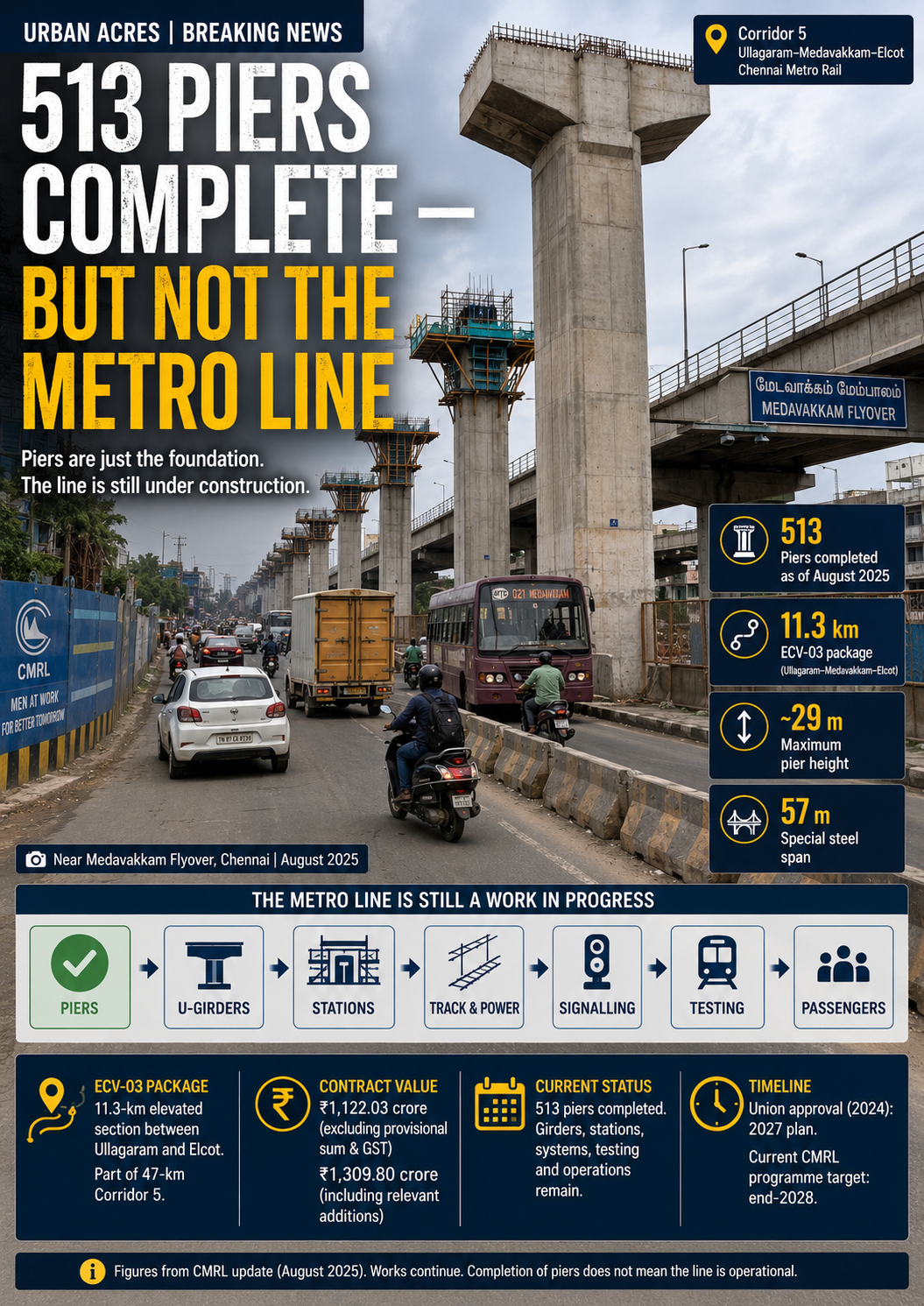
Chennai Metro Rail Limited has finished all pier construction on the ECV-03 elevated package between Ullagaram and Elcot, closing an important structural stage on Corridor 5. But the milestone covers only one 11.3-km package of the 47-km line, with U-girders, stations and multiple rail systems still separating civil progress from passenger operations.
CHENNAI — Chennai Metro Rail Limited has completed the casting of all 513 piers on the 11.3-km ECV-03 package of Phase II Corridor 5 between Ullagaram and Elcot, marking the completion of a major civil-construction stage on the southern elevated section of the line.
CMRL said Pier P814, approximately 25 metres high and located beside the under-construction Medavakkam-1 Metro station, was the final pier. The package’s 513 piers are supported by 2,351 piles.
The distinction in scale is important. The development does not mean that pier construction across the entire Corridor 5 is finished. Corridor 5 extends 47 km from Madhavaram to Sholinganallur and comprises 48 stations. The milestone is specific to ECV-03, one of several construction packages used to deliver the line.
A difficult elevated interface at Medavakkam
The Medavakkam section contains some of the package’s most technically demanding structures.
CMRL says several piers reach about 29 metres, while the Metro alignment passes over the existing Medavakkam flyover at a similar elevation. A 57-metre steel girder span has been constructed along a curve of approximately 125 metres radius. Medavakkam-1 and Medavakkam-2 stations are themselves being constructed roughly 29 metres above road level.
That combination matters because elevated Metro construction here has had to coexist with an operating urban road system and flyover rather than being executed on a cleared greenfield alignment.
CMRL has cited dense development, heavy traffic, traffic diversions and construction close to and above existing infrastructure as major execution constraints.
What the milestone does—and does not—complete
Pier completion removes one significant dependency from the package: every principal vertical support required for the elevated structure has now been cast.
It does not, however, create a continuous passenger-ready Metro railway.
CMRL says balance U-girder erection and station-building work are still progressing. Beyond those civil works, Metro service depends on a much longer delivery chain involving track, traction power, overhead electrification, signalling, telecommunications, station electrical and mechanical systems, fare collection and safety systems before integrated testing and statutory certification can occur.
For Urban Acres, therefore, the correct project stage is:
structural civil milestone — not civil completion, commissioning or passenger opening.
The contract context deserves closer disclosure
The ECV-03 construction package was awarded to the HCC-KEC Consortium. CMRL’s records give an awarded value of approximately ₹1,309.80 crore including provisional sum and GST. An AIIB contract-award notice reports ₹1,122.03 crore on a basis excluding provisional sum and GST.
The AIIB documentation specifies an original contract duration of 1,095 days. Earlier procurement records place the award in November 2021.
That makes one missing number especially important: the current approved contractual completion date after any extensions of time.
Urban Acres has not found sufficient public evidence in the material reviewed to establish the latest EOT for ECV-03. It would therefore be inappropriate to calculate a contractor delay from the original duration alone. CMRL should publish the present contractual baseline alongside its milestone updates.
Corridor 5 sits inside a much larger Phase II programme
The complete Chennai Metro Phase II programme spans 118.9 km with 128 stations, covering Madhavaram–SIPCOT Corridor 3, Lighthouse–Poonamallee Bypass Corridor 4 and Madhavaram–Sholinganallur Corridor 5.
The approved project completion cost is ₹63,246 crore including interest during construction.
The Union Cabinet’s October 2024 approval referred to a 2027 completion plan. CMRL’s current public project-status page now gives end-2028 as the completion target. The later CMRL timetable should be treated as the current programme baseline unless the agency publishes another revision.
Recent reporting based on a Lok Sabha response put Phase II’s aggregate physical progress at 54.62%. That figure is useful as a programme metric but should not be interpreted as passenger availability: different packages and disciplines can reach very different stages while contributing to the same aggregate progress percentage.
The next useful measure is no longer the number of piers
With every pier in ECV-03 cast, future progress reporting should move to more consequential indicators.
CMRL should disclose the number of remaining U-girders to be launched, station-by-station structural and architectural progress, track completion, traction and signalling readiness, road-restoration status and the current integrated-testing programme.
The service outcome will eventually be measured differently again: journey time, frequency, interchange quality, feeder access, reliability and whether passengers can conveniently reach destinations along the southern Corridor 5 catchment.
Completing 513 piers is a real engineering milestone.
It is also the point at which counting columns becomes progressively less useful than measuring how quickly an integrated railway emerges on top of them.
