


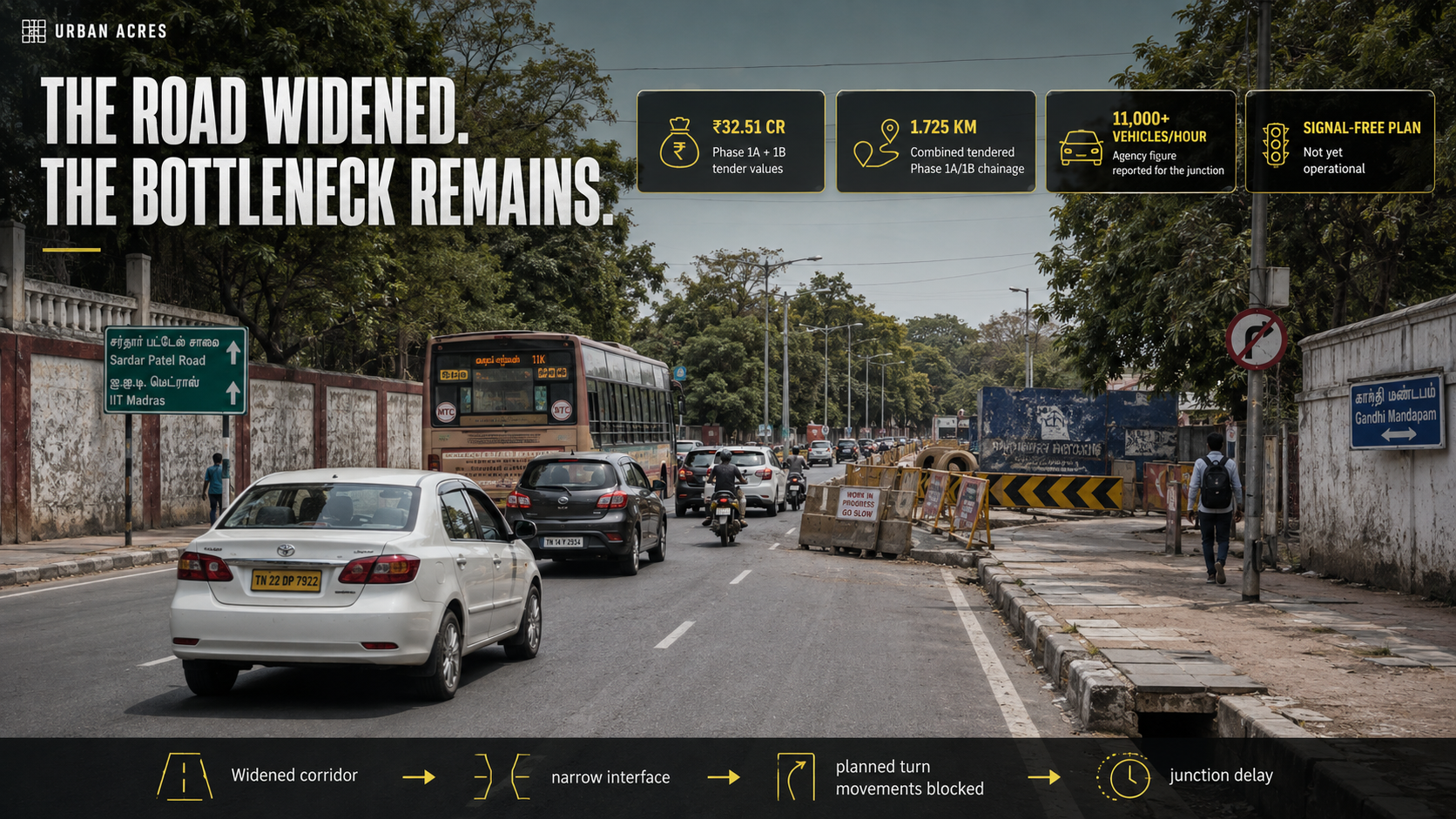
Four months after officials said the Gandhi Mandapam junction near IIT Madras could become signal-free once widening was completed, crucial road sections remain unfinished. The consequence is larger than a delayed strip of asphalt: the free-left, free-right and U-turn arrangement designed around Sardar Patel Road and Kotturpuram Road cannot yet operate as intended.
CHENNAI — The unfinished widening of Sardar Patel Road has exposed a basic weakness in how urban road projects are measured: additional carriageway does not become useful network capacity until every critical junction interface works with it.
A fresh field report on August 25 found widening incomplete at several locations around the Gandhi Mandapam–IIT Madras corridor, including portions near government and institutional properties. Kotturpuram Road widening required for a planned free-left movement also remains incomplete. Traffic police told the newspaper that three unwidened spots prevent the planned junction arrangement from being introduced safely.
That matters because the road project and traffic-management plan were conceived as one operating system.
Vehicles travelling from Guindy towards Kotturpuram are intended eventually to take a free left. Adyar- and OMR-originating traffic heading towards Kotturpuram is intended to receive a free right. Kotturpuram-to-Guindy vehicles would instead join Sardar Patel Road and turn beneath the Madhya Kailash L-flyover.
But those movements require sufficient width at every merge, turn and U-turn point.
A single constrained segment can therefore control the capacity of a much longer widened corridor.
The project is under construction, not delivered
The strongest primary documents located by Urban Acres are two Tamil Nadu Highways procurement records issued in November 2025.
Phase 1A covers chainage km 0.550 to 1.300 and carries a tender value of ₹18.47 crore. Phase 1B covers km 1.300 to 2.275 at ₹14.04 crore. Both include widening from four lanes to six, slip roads, drain-cum-footpaths, compound-wall works and land alienation. Their stated work periods were 300 days and 240 days respectively.
Those records are important because they show that the scheme is not merely a resurfacing exercise. Delivery depends on road construction + land transfer + utility coordination + pedestrian/drainage reconstruction + junction geometry.
That is also why describing the project simply as “₹48 crore of road widening” conceals useful information.
Contemporaneous reports placed the broader 2.5-km programme at roughly ₹45-48 crore. The two Phase 1 tenders reviewed by Urban Acres cover 1.725 km and total about ₹32.51 crore. A November report described roughly 1.7 km as the first phase and another 0.8 km as a subsequent phase.
That provides a plausible scope distinction, but it does not establish the sanctioned cost of the entire scheme. Urban Acres did not find a primary administrative-sanction document reconciling the ₹45-48 crore programme figure with the package values.
The completion narrative has repeatedly moved
In April, the project was being presented as nearing completion.
A Times of India report on April 28 said the Guindy-to-Adyar side had been widened, land had been acquired on the opposite side and widening there remained pending. Officials described how completing that work would allow the Gandhi Mandapam junction to operate without its existing signal arrangement. A completion expectation of roughly one month was publicly cited.
That operating change did not follow.
By May 30, Highways officials acknowledged another stoppage, telling DT Next that high-voltage cable relocation had interrupted construction. They said the electricity work would finish within two or three days and widening could then resume.
The latest report, almost three months later, says major gaps remain.
More importantly, the explanations have become inconsistent.
The May Highways response explicitly rejected reports that higher bitumen prices were responsible. In August, another departmental official cited bitumen-price increases among the causes, together with election-related constraints around Anna University. At the same time, a senior official maintained that construction had not been delayed.
All three propositions cannot be treated as a single verified explanation.
The Highways Department should therefore publish a package-level chronology identifying when each work front stopped, why it stopped, when possession or utility clearance was obtained, and whether the interruptions qualify for extensions of time under the contracts.
But a missed media deadline is not automatically a contractual breach
There is an important counterpoint.
The tender documents allow 300 days for Phase 1A and 240 days for Phase 1B. Urban Acres has not verified the contracts’ actual award dates or commencement dates.
That means the widely reported May completion expectation cannot automatically be treated as the contractor’s legal completion date.
A rigorous scrutiny story must distinguish:
public completion assurance → contractual completion date → revised completion date.
Only the first is presently clear.
Citizens are waiting for an outcome, not six lanes
The latest report says some Adyar commuters estimate that crossing the junction can take about 20 minutes, while traffic officials say more than 11,000 vehicles pass through the stretch each hour.
But even those figures should not become the final measurement of project success.
The relevant outcome indicators are:
- peak and off-peak junction travel time before and after commissioning;
- average queue length by approach;
- bus travel-time reliability;
- crashes and pedestrian conflicts;
- time lost at the Gandhi Mandapam signal;
- functioning of the planned free movements;
- continuous accessible footpath width;
- and whether congestion merely migrates to the next downstream junction.
The last point is particularly important. A six-lane corridor does not guarantee durable congestion reduction if increased capacity feeds another constrained intersection.
Walking and tree cover are part of the same project
The road expansion has already produced another set of public-interest questions.
In January, pedestrians raised concerns about narrowing pavements; Highways officials said completed footpaths would generally measure approximately one to 1.5 metres.
In February, The New Indian Express reported that around 100 trees were being removed. Highways officials said most would be transplanted and that District Green Committee approval had been obtained, but the eventual transplantation outcome was not specified publicly in the report.
The official tenders themselves explicitly contain drain-cum-footpath reconstruction.
So completion cannot be defined only as opening all six vehicular lanes.
For a corridor serving IIT Madras, Anna University, the Cancer Institute, government offices and major public-transport connections, pedestrian continuity is part of the infrastructure outcome.
The real commissioning test
The Highways official quoted on August 25 now says the project will be finished by September.
Urban Acres should treat that as a reported departmental target, not yet a verified revised contractual deadline.
September will matter only if it produces an operating result:
all required road segments widened → utilities cleared → slip movements completed → safe pedestrian works restored → traffic plan implemented → measurable reduction in junction delay.
Until then, Chennai has constructed portions of a wider road but has not yet delivered the complete junction system that was supposed to make that widening useful.
