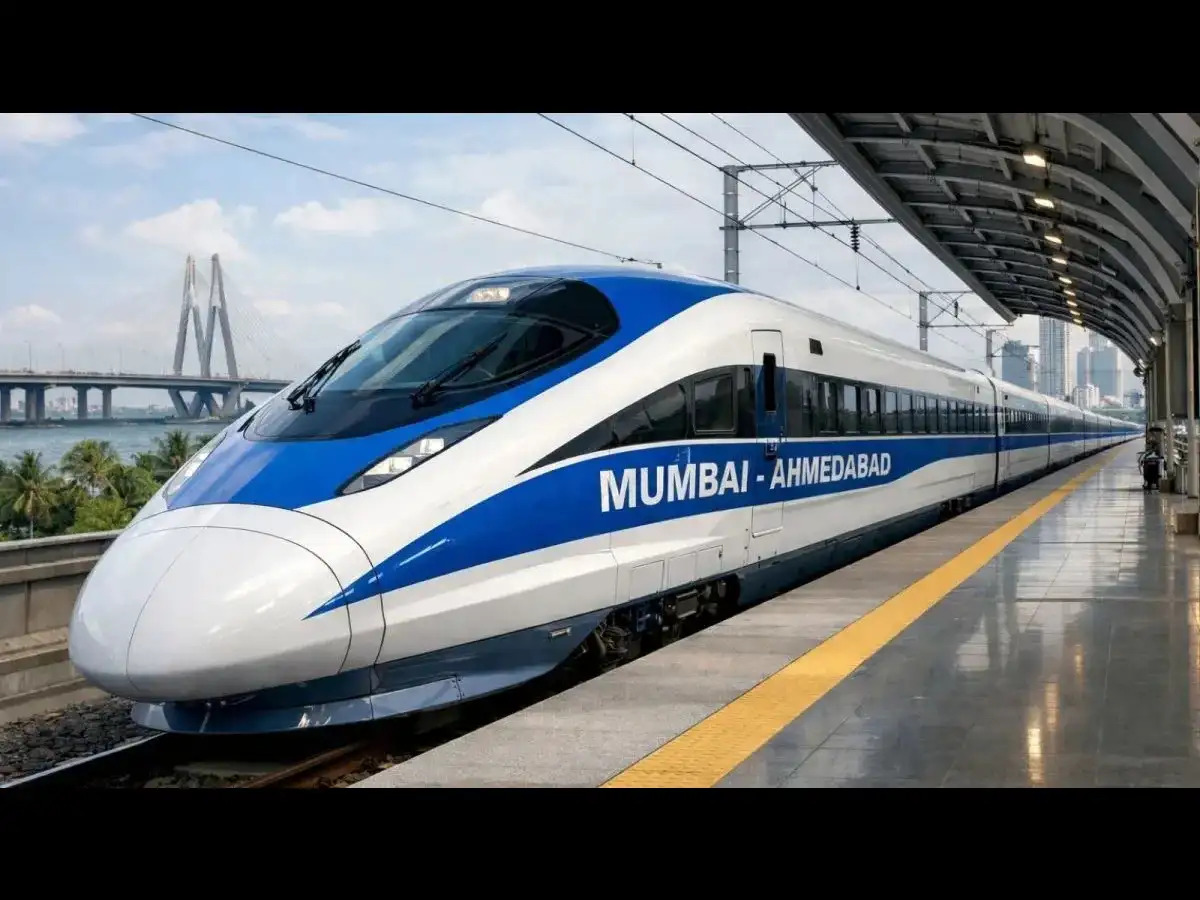
Mumbai Bullet Train Cost Review Moves Closer To Approval
The Mumbai–Ahmedabad High Speed Rail project is approaching a key financial decision, with revised cost estimates expected to come before the Cabinet Committee on Economic Affairs (CCEA) on August 25. The review comes as construction advances on the 508-km corridor, putting renewed focus on how rising land, construction and technology costs will shape the economics of India’s first dedicated high-speed rail project. The Mumbai bullet train project was originally sanctioned at ₹1.08 lakh crore. Government monitoring data released earlier this year still listed the sanctioned revised cost at the original level, while the project’s physical progress had reached about 58%. The official project schedule has also moved from its original 2027 completion target towards December 2029.
The latest cost review reflects a broader challenge facing large transport projects: the financial assumptions made at the planning stage can change substantially during a long construction cycle. Parliamentary and government records have indicated that the Mumbai bullet train project has faced additional expenditure linked to land acquisition, inflation, taxes, utility relocation, station approaches, power systems and other project requirements. Land has been particularly significant in the Mumbai region, where high urban land values and complex acquisition requirements can increase the cost of major infrastructure. The government has previously stated that the entire 1,389.5 hectares required for the corridor has now been acquired and that all identified utilities have been shifted. Construction, meanwhile, has moved well beyond the initial civil works stage. As of March 2026, official updates showed around 430 km of pier construction, 341 km of girders and 174 km of track bed completed. Work on the underground station at Mumbai’s BKC is also progressing, alongside construction at stations across Maharashtra and Gujarat.
For Mumbai, the financial decision has implications beyond the project balance sheet. The corridor is designed to connect the city with Thane, Virar, Boisar, Surat, Vadodara and Ahmedabad, creating a faster inter-city link across one of India’s most economically active regions. Its eventual impact will depend not only on journey times but also on station access, integration with suburban rail and metro networks, and the ability of surrounding areas to accommodate additional development without worsening congestion or land pressure. Urban transport specialists say the revised estimate should therefore be assessed alongside the project’s wider economic and environmental outcomes. High-speed rail can shift some long-distance travel from road and air to rail, but the benefits depend on efficient last-mile connectivity and strong utilisation.
The CCEA decision could establish the next financial baseline for the Mumbai bullet train project. The immediate priority will be completing construction while maintaining cost discipline, transparent funding and integrated urban planning around the stations.