Hyderabad Gachibowli Traffic Plan Targets Key Junctions
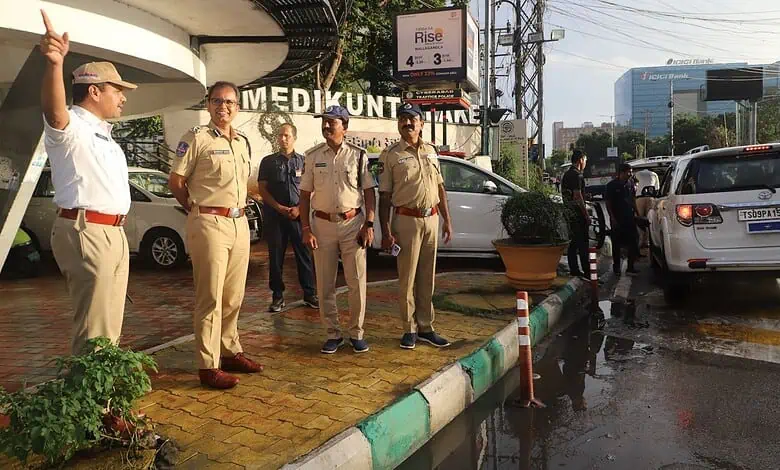
HYDERABAD: Traffic authorities have reviewed mobility conditions across the Gachibowli-Raidurgam corridor, identifying road widening, junction redesign, pedestrian facilities and alternative routes as immediate priorities. The inspection comes as the western IT corridor continues to absorb intense commuter movement, raising pressure on roads connecting Gowlidoddi, Nanakramguda, IIIT and other major employment areas.
The review covered several busy junctions and road stretches where congestion is linked to turning movements, incomplete infrastructure and limited pedestrian facilities. Officials have proposed opening a U-turn at Journalists Colony Kaman and widening or repairing the road between Aparna Shangri La and Gowlidoddi. At Wipro Junction, authorities have sought a foot overbridge and vegetation trimming. Widening free-left lanes at selected junctions is also being considered to improve vehicle movement without requiring major new road structures. The wider Gachibowli corridor faces a difficult mobility equation. Roads serving the western technology district carry large volumes of private vehicles, while construction activity and monsoon-related waterlogging can further reduce effective road capacity. Earlier disruptions in the Gachibowli-Raidurg corridor have shown how road works and drainage problems can quickly translate into longer peak-hour journeys.
Officials also examined the Gowlidoddi-Nanakramguda-IIIT-ICICI stretch, with attention on separating conflicting traffic movements and reducing unnecessary U-turns. An alternative road connecting Vamshi Ram BSR Towers with Mantri Constructions Road through the Medikunta edge has also been proposed. Work near ITC Kohenur was reviewed as part of the inspection, with directions to accelerate pending activity. Officials have also been asked to install clearer pedestrian crossing signs and guide people towards designated foot overbridge facilities. The pedestrian focus is significant for a business district where short-distance travel often competes with heavy vehicular movement. Better crossings and continuous pedestrian access can reduce unsafe road crossings while improving connections between offices, public transport stops and surrounding neighbourhoods.
The review also points to a broader issue in Hyderabad’s infrastructure planning: traffic relief cannot depend only on adding road space. Junction management, pedestrian design, parking discipline, drainage and better use of existing corridors can often deliver quicker gains. For the Gachibowli-Raidurgam belt, the next test will be implementation. Measures such as road repairs and junction improvements can provide near-term relief, but long-term mobility will depend on whether new development is matched by safe pedestrian infrastructure, efficient public transport links and coordinated road planning.