


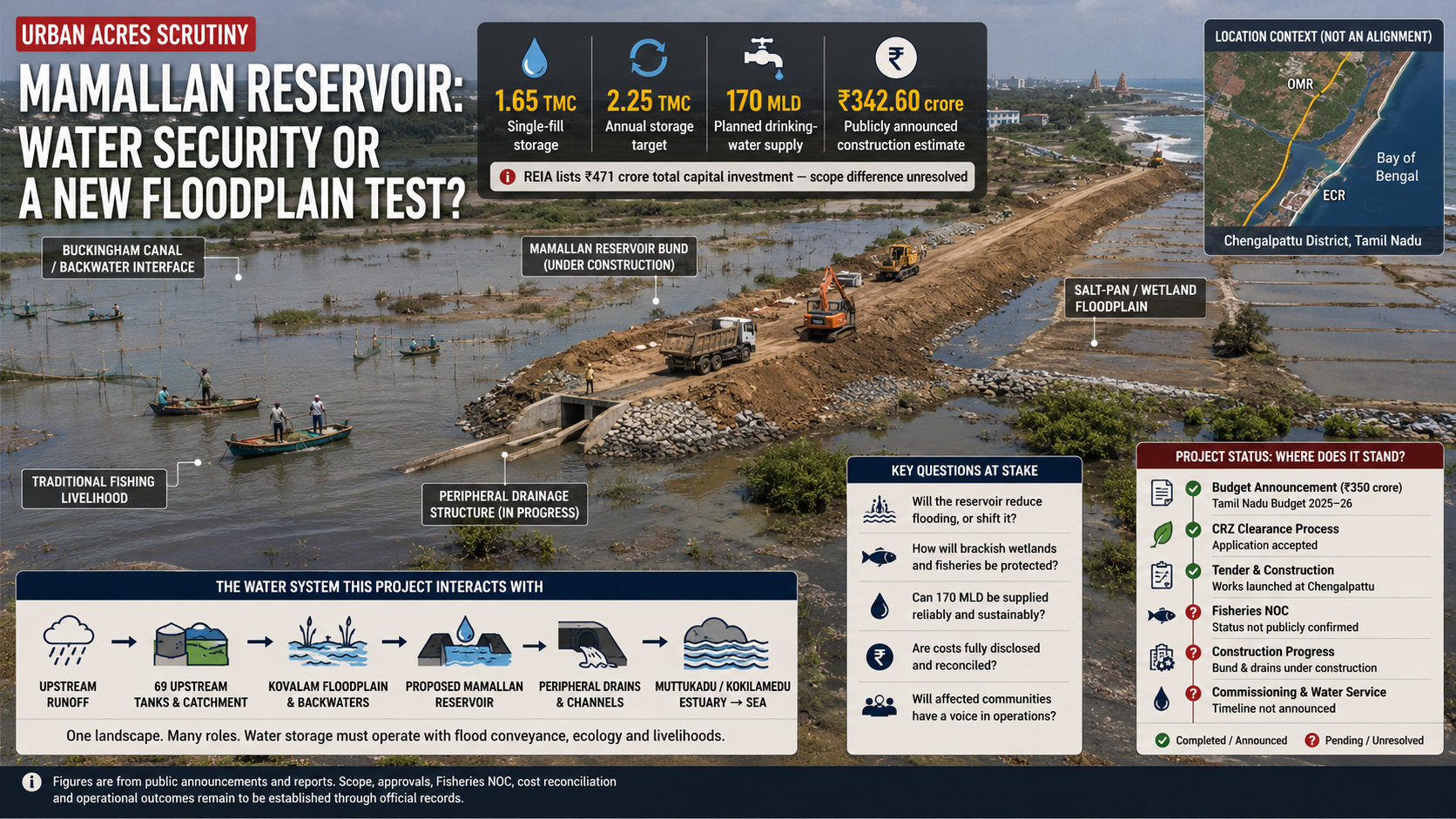
A new petition from OMR residents has renewed opposition to Chennai’s Mamallan Reservoir. But the harder question is no longer whether the project should be proposed: construction is already underway, while flood modelling, ecological mitigation, fisheries clearance and even the published project cost still require clearer public accounting.
CHENNAI — More than 50 organisations and over 1,100 citizens have asked the Tamil Nadu government to scrap the Mamallan Reservoir, arguing that a project intended to strengthen Chennai’s drinking-water security could instead damage a coastal wetland, disrupt fishing livelihoods and worsen flooding along the city’s rapidly urbanising southern edge.
Those are serious claims. They are not yet established outcomes.
But neither can the government’s position be reduced to a simple assurance that the reservoir will simultaneously provide water and reduce flooding.
The documents reviewed by Urban Acres reveal a more complicated project: one being constructed inside a coastal hydrological system whose ecological alteration is acknowledged in the project’s own environmental assessment, and whose flood performance still requires additional modelling recommended by IIT Madras.
The project has moved beyond the proposal stage
Tamil Nadu announced the reservoir in the 2025-26 Budget as a new surface-water source for Chennai’s expanding metropolitan region. The Budget described a project across 4,375 acres of government land between OMR and ECR, with approximately 1.6 TMC of storage, annual harvesting capacity of 2.25 TMC and a planned 170 MLD contribution to drinking-water supply.
On January 19, construction was formally flagged off at Nemmeli. Contemporary reporting put the implementation estimate at ₹342.60 crore.
That matters because repeatedly calling Mamallan merely a “proposed” reservoir obscures the accountability stage.
The project must now be judged through construction sequencing, approvals, environmental conditions, contract delivery and eventual service outcomes.
A reservoir inside a functioning floodplain
The government’s environmental study describes the area between OMR and ECR as a natural flood bowl receiving flows from a network of upstream tanks before water passes through the Buckingham Canal/backwater system and eventually reaches the Bay of Bengal through coastal outlets.
The report attributes existing flooding partly to raised embankments and insufficient waterways and proposes the reservoir, peripheral drainage and improved outlets as a solution.
Residents argue the opposite: that modifying this floodplain and its drainage pathways could increase flood levels in settlements along OMR and neighbouring catchments.
There is therefore a testable engineering disagreement.
IIT Madras’ assessment strengthens the government’s argument on water availability: its modelling indicates sufficient dependable runoff to support 1.655 TMC of storage. But its recommendations are equally important. The institute called for better flood-estimation methods, calibration against observed field data, validation against major Chennai floods, hydraulic simulations comparing with-reservoir and without-reservoir scenarios and consideration of additional sea outlets.
The correct conclusion is not that IIT Madras found the reservoir unsafe.
Nor is it that IIT Madras conclusively proved flood safety.
It found the storage concept hydrologically feasible while identifying further work required for robust flood assessment.
That distinction should govern public communication.
The wetland question is more substantial than nomenclature
The dispute is sometimes framed around whether the land is legally recognised as a wetland.
The project REIA itself provides a more useful answer.
It says Bhuvan classifies the proposed project site as a coastal wetland and identifies most of the 17.71 sq km site as coastal-wetland area. At the same time, it records that the site is neither a Ramsar site nor listed among officially notified wetlands in the database it reviewed.
These statements are not contradictory.
Formal notification determines one element of regulatory status. Hydrology and ecological function describe what the landscape physically does.
Urban infrastructure planning should examine both.
Even the project assessment anticipates habitat change
The environmental report records more than 100 bird species through its own field work and discusses the site’s role for wading and migratory birds. It also states that reservoir construction is expected to modify portions of existing Kazhuveli and salt-pan habitats.
Its proposed response includes managed compensatory wetlands, saline habitat retention, shallow feeding areas, vegetated buffers and artificial islands.
This transforms the argument.
The relevant question is not whether the project has any ecological impact. Its own documentation anticipates impacts.
The question is whether the mitigation programme can preserve the ecological functions that matter: tidal exchange, salinity gradients, feeding and breeding habitat, fish and prawn productivity, flood storage and connectivity between the Buckingham Canal, backwaters and coastal outlets.
Those outcomes require baseline data and post-construction monitoring.
Fisheries clearance exposes a sequencing problem
Fishing communities have opposed the reservoir for months, arguing that the brackish-water system supports prawns, fish and other species on which local livelihoods depend.
At a July stakeholder meeting, Fisheries Department officials reportedly said that the department had not yet issued an NOC and that the approval was required for work near the shore. WRD later sought the NOC in a July 21 letter, according to reporting reviewed by Urban Acres.
The project had separately obtained CRZ clearance, reportedly in December 2025, which is now part of litigation before the Southern Bench of the National Green Tribunal.
That does not by itself establish illegality.
It does establish a transparency obligation.
WRD and the Fisheries Department should publish the approval matrix showing every statutory and inter-departmental permission, the date each became necessary, the date obtained, the work permitted under each approval and the work executed before that date.
₹342.60 crore or ₹471 crore?
Financial transparency is another unresolved issue.
The Budget initially described an approximately ₹350-crore reservoir. The January launch used ₹342.60 crore. Yet the environmental report states that the proposed project’s total capital investment is ₹471 crore.
These figures may represent different designs, scopes or stages.
Urban Acres found no primary document in the material reviewed that conclusively reconciles them.
The same caution applies to the reported site area: government and project documents variously use 4,375 acres and approximately 5,161 acres, while other reporting refers to a larger eventual two-phase footprint.
Until WRD releases a current administrative-sanction and package-level cost statement, the ₹342.60-crore figure should not automatically be treated as the project’s complete current capital requirement.
Water storage is only the first half of water security
The strongest argument for Mamallan is obvious.
Southern Chennai and its peri-urban growth corridor require dependable drinking water, and the government says the reservoir could supply as much as 170 MLD while capturing monsoon runoff that would otherwise reach the sea.
But a reservoir is not a household water service.
Urban Acres’ service-chain test is:
Catchment → Reservoir → Raw-water offtake → Treatment → Bulk transmission → Storage → Distribution → Pressure → Household connection → Reliable service
Public documents reviewed for this story do not yet provide enough information to establish how the full 170 MLD will move through that chain, which neighbourhoods will receive it first, whether existing tanker-dependent areas will receive piped service, what treatment and transmission investment is required, or how supply will be allocated during dry years.
For OMR residents, those are not secondary details.
They determine whether an ecologically and financially consequential reservoir actually reduces dependence on private tankers.
The government now needs to prove two outcomes at once
Mamallan should not be judged through a simplistic choice between “water security” and “wetland protection.”
A credible project has to demonstrate both.
First, the State must show that storing freshwater here produces a measurable improvement in metropolitan drinking-water reliability.
Second, it must demonstrate that the reservoir and peripheral drainage system do not transfer flood risk, impair required tidal and environmental flows or impose uncompensated livelihood losses on communities dependent on the existing wetland.
The evidence needed to make those judgments should exist before the project is complete.
Because once a coastal hydrological system has been physically re-engineered, monitoring failure after commissioning will be a poor substitute for getting the design right before construction hardens it.
