


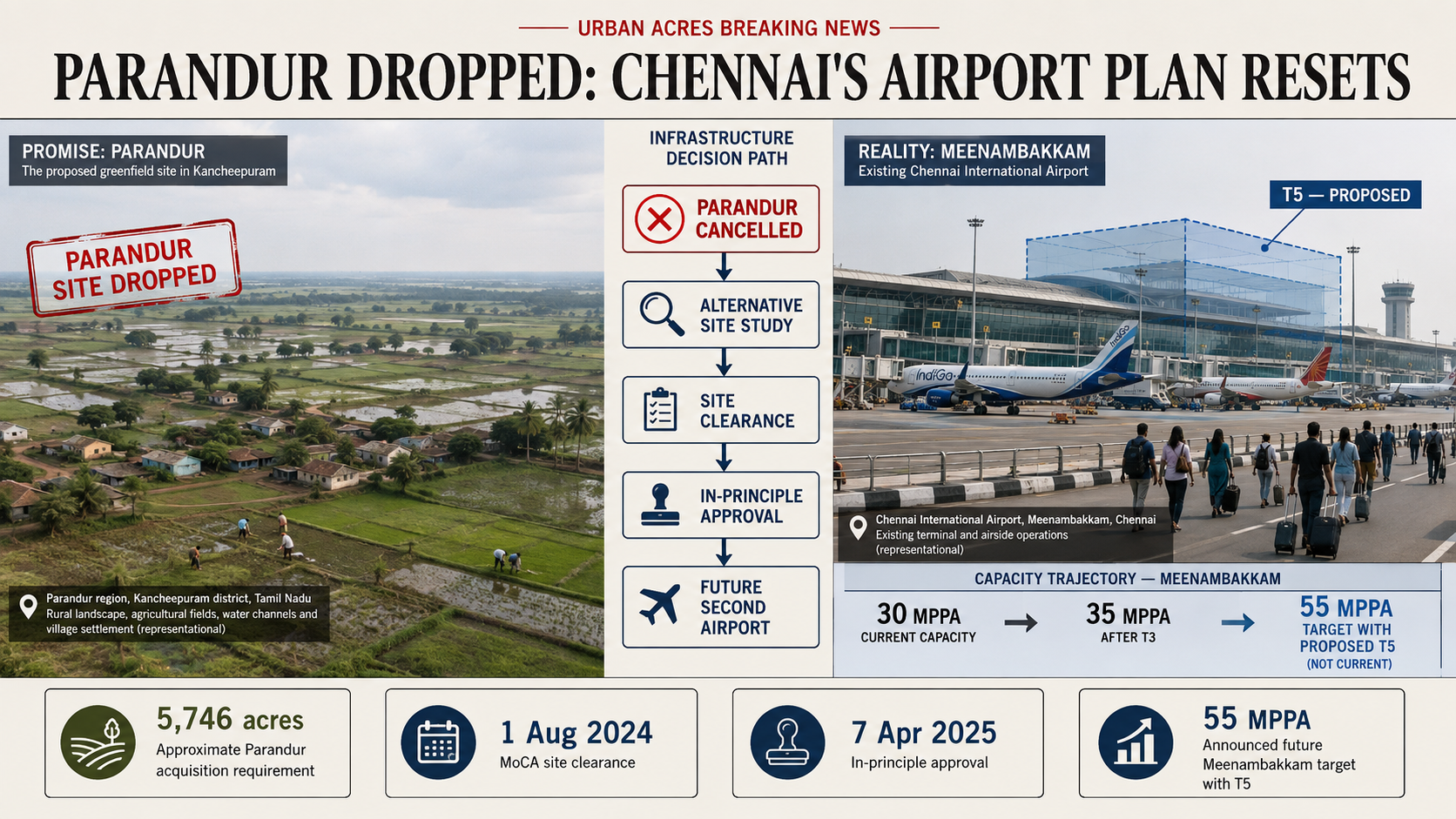
Tamil Nadu has formally abandoned Parandur as the location for Chennai’s proposed second airport, resetting one of the State’s largest infrastructure programmes after years of aviation approvals, environmental appraisal, land acquisition and local opposition.
Chief Minister C. Joseph Vijay announced the decision in the Tamil Nadu Assembly on August 24, saying the government would examine alternative locations that would minimise the loss of agricultural land and displacement of settlements. The government also intends to work with the Airports Authority of India to expand Chennai International Airport at Meenambakkam while the search proceeds.
The critical qualification is that Chennai’s second airport has not itself been cancelled. What has been cancelled is the Parandur location and the project developed around that site.
That distinction matters because finding another site is not simply an administrative substitution.
Under India’s Greenfield Airports framework, a new location will have to pass through aviation feasibility and a two-stage Union approval process involving site clearance followed by in-principle approval. Land, environmental appraisal, rehabilitation, financing and project procurement then remain separate delivery requirements.
Parandur had already travelled far down that approval chain
Tamil Nadu began the modern site-selection process by asking AAI to evaluate four possible locations. A July 2022 Rajya Sabha answer records that AAI found Parandur and Pannur comparatively more feasible and advised TIDCO on further obstacle-limitation and site work. The responsibility for finalising the site and seeking statutory approval remained with the State.
Tamil Nadu subsequently settled on Parandur.
The Union government granted site clearance on August 1, 2024 and in-principle approval on April 7, 2025. Those dates are important because they show that the project being abandoned was no longer merely a political announcement or DPR exercise.
TIDCO’s planning documents envisaged an airport ultimately capable of handling 100 million passengers annually, while its 2024 pre-feasibility report placed the approximate block cost at ₹29,143.95 crore.
Land acquisition had also advanced.
Contemporary reporting from March and June 2026 placed privately acquired land at around 1,700 acres. The wider project required roughly 5,746 acres, with substantial government-owned land also falling inside the proposed acquisition footprint.
This makes the cancellation materially different from dropping an unapproved concept. The State now has to resolve the administrative and financial consequences of work already undertaken.
Environmental controversy cannot be reduced to a political claim
Parandur’s opponents consistently argued that the airport would displace farming communities and interfere with wetlands, water bodies and drainage systems.
The project’s own environmental documentation gives those concerns a factual foundation.
TIDCO’s pre-feasibility material recorded about 1,425 acres of water bodies, two existing water channels through the proposed project area, Nelvoy Eri within the site, Parandur lake approximately 1.4 km away and roughly 36,635 trees potentially affected.
Those findings do not prove that an airport could never have been engineered there. Nor do they prove that mitigation would necessarily have been sufficient.
They establish something more useful: the environmental issue was a genuine project constraint requiring hydrological, wetland and environmental appraisal rather than a rhetorical dispute.
Conversely, Urban Acres finds no basis for describing Parandur as a site that AAI had rejected as technically unsuitable. Official records show it progressing through the aviation-approval process.
Meenambakkam is being asked to carry the transition
The government’s immediate aviation strategy now depends heavily on squeezing more capacity from the existing Chennai airport.
AAI’s current modernisation programme is already intended to increase Chennai Airport’s annual passenger capacity from 30 million to 35 million through Terminal 3.
That programme itself has been delayed. The Union government originally expected Phase II earlier, while recent reporting based on a parliamentary reply puts the revised completion deadline at December 2026. ₹1,762.08 crore had reportedly been spent on the ₹2,467-crore modernisation programme by June 2026.
Terminal 5 would be the next step.
But it should not be reported as though construction has begun.
The Chennai Airport Director said as early as June 13 that plans were being drawn up for a satellite Terminal 5 serving passenger and cargo functions. Vijay’s government has now placed that proposal at the centre of its interim strategy and says total airport capacity could eventually reach 55 million passengers a year.
Urban Acres has not yet verified a final T5 DPR, administrative sanction, expenditure sanction, tender value, contract award, construction commencement date or operational deadline.
Terminal 5 therefore remains proposed/planned infrastructure.
The capacity problem has been deferred, not solved
That is the deeper infrastructure consequence of the August 24 decision.
Parandur was intended to create an entirely new airport system with new runways, terminals, cargo infrastructure and eventually a very large passenger capacity.
A satellite terminal at Meenambakkam can expand terminal capacity, but terminal floor area alone does not determine the ultimate throughput of an airport.
The complete aviation service chain includes:
airspace → runways → taxiways → aprons → terminal capacity → road access → public transport → cargo facilities → operational slots → passenger service.
Consequently, a future claim that “Chennai Airport capacity has risen to 55 MPPA” should be tested against airside and access-road capacity as well as terminal construction.
Reuters reports that industry representatives continue to regard additional airport capacity as important for Chennai’s manufacturing, logistics and services economy and have urged rapid selection of an alternative location.
The government therefore faces two simultaneous delivery tests: obtain near-term capacity from Meenambakkam without overstating what terminal expansion can accomplish, and identify a second-airport location without reproducing Parandur’s environmental, displacement and land-acquisition conflict.
Cancellation also creates a public-accounting obligation
The State should now disclose what becomes of the Parandur project assets and obligations.
That includes acquired private land, government land transferred into the project, compensation already paid, acquisition notifications, resettlement planning, consultancy appointments, environmental studies and associated transport infrastructure designed specifically around Parandur.
The policy change may ultimately be justified on social or environmental grounds. But cancellation does not make expenditure and contractual obligations disappear.
Nor should the next airport location merely transfer the same burdens to another set of villages.
Before the government announces its replacement site, the public should be able to compare candidates using a common matrix: agricultural land affected, households displaced, government versus private land, wetlands and drainage, road and rail connectivity, aviation constraints, total infrastructure cost and expected delivery period.
That would convert the next site-selection exercise from a political announcement into a transparent infrastructure decision.
