


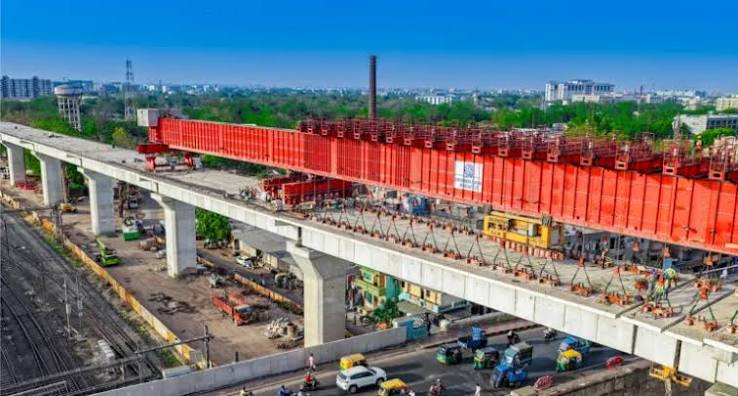
Ahmedabad, August 14, 2026: India’s first dedicated high-speed rail corridor is moving towards passenger operations, with the Mumbai–Ahmedabad project now entering a phase where construction progress must translate into safe, usable and financially accessible mobility. The 508-km corridor is expected to begin services in August 2027, with the initial operational section planned between Surat and Vapi.
The Ahmedabad bullet train project will connect 12 stations across Gujarat, Maharashtra and the Union Territory of Dadra and Nagar Haveli. The planned stops include Ahmedabad, Sabarmati, Anand, Vadodara, Bharuch, Surat, Bilimora, Vapi, Boisar, Virar, Thane and Mumbai. The network is designed for an operational speed of 320 kmph, with the fastest Mumbai–Ahmedabad journey expected to take about 1 hour 58 minutes. For passengers, however, speed is only one part of the proposition. The eventual fare will determine whether the service functions mainly as premium inter-city transport or becomes a realistic option for a broader section of working commuters and businesses. Current comparisons with first-class rail fares have generated estimates around ₹3,000, but an official passenger fare has not yet been established. Any assessment of affordability therefore remains provisional.
The project also represents a significant shift in how India plans connections between major economic centres. Its stations are intended to interface with existing rail, metro and road networks, creating opportunities for multimodal travel rather than treating high-speed rail as a standalone system. Construction progress has accelerated across the corridor. As of March 2026, the project had recorded 430 km of pier construction, 341 km of girder work, 174 km of track-bed construction and 153 km of overhead electrification mast installation. All required land had been acquired and statutory clearances obtained, according to government data. Yet the final test will be whether faster rail produces wider urban benefits.
Ahmedabad and other cities along the alignment will need reliable last-mile transport, pedestrian access and well-integrated interchange facilities if the investment is to reduce dependence on private vehicles rather than simply accelerate journeys between city centres. The Ahmedabad bullet train corridor could strengthen links between Gujarat’s industrial and commercial centres. Its longer-term value will depend not only on opening dates and travel times, but on how effectively surrounding cities connect residents to the new network.
Also Read: Adambakkam MRTS Safety Fix Still on Paper Five Months After Chennai Extension Opened
Ahmedabad Bullet Train Moves Closer To Public Service
