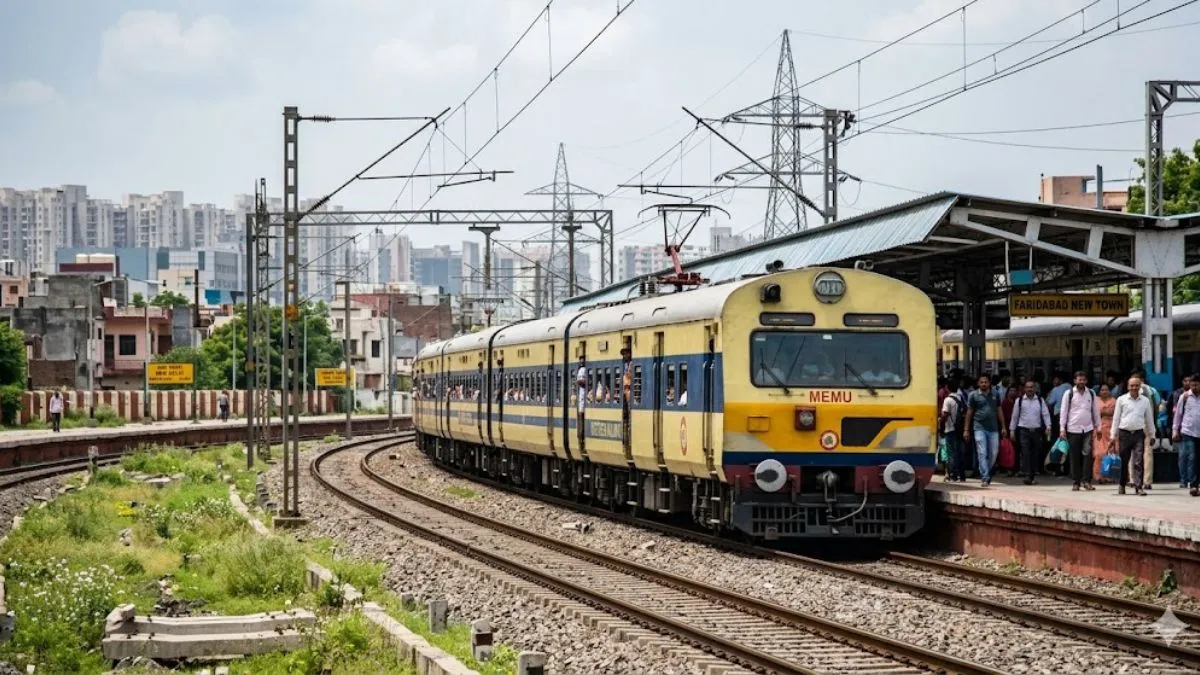
Faridabad MEMU Link Boosts Regional Mobility Access
A new MEMU rail corridor connecting Delhi and Faridabad is set to reshape daily mobility across the National Capital Region, with the Centre approving an electric suburban rail service aimed at easing congestion on one of north India’s busiest commuter stretches. The move is expected to benefit thousands of workers, students and small business operators who travel between the two cities every day.
Transport officials said the Mainline Electric Multiple Unit, or MEMU, service will strengthen short-distance rail connectivity between Delhi and Faridabad, a rapidly expanding urban cluster facing mounting pressure on roads and public transit systems. The approval comes amid rising concerns over traffic bottlenecks, increasing fuel consumption and deteriorating air quality across NCR corridors heavily dependent on private vehicles and road-based transport. Urban planners say the MEMU rail service could play an important role in shifting commuters towards lower-emission mobility systems, particularly in densely populated satellite cities where public transport demand has outpaced infrastructure growth. Faridabad, which has witnessed accelerated residential and industrial expansion over the past decade, remains closely tied to Delhi’s labour and services economy, generating high-volume intercity movement throughout the week.
Unlike conventional passenger trains, MEMU systems operate through self-propelled electric coaches that are better suited for routes with frequent halts and rapid passenger turnover. Railway experts note that such systems improve operational efficiency while reducing turnaround time at stations. The trains generally operate at moderate speeds suitable for regional urban travel, offering an alternative to overcrowded buses and private commuting options. The Delhi Faridabad MEMU service also aligns with broader efforts to improve multimodal transit integration across NCR. Policymakers have increasingly focused on strengthening rail-led mobility as cities in the region grapple with land constraints, rising vehicular density and climate-linked urban stress. Mobility analysts believe suburban rail systems, if expanded systematically, can reduce travel costs for lower- and middle-income residents while improving access to employment hubs.
Officials familiar with the project indicated that demand for enhanced rail frequency on the Delhi-Faridabad stretch had grown steadily in recent years as existing transport networks struggled during peak hours. The corridor witnesses significant daily movement linked to office districts, educational institutions and manufacturing zones spread across south Delhi and Haryana’s urban belt. Infrastructure observers also point out that investment in electric commuter rail systems carries wider environmental implications. By reducing dependence on road transport, the Delhi Faridabad MEMU service may contribute to lower traffic emissions and reduced pressure on arterial highways connecting NCR cities. However, experts caution that long-term success will depend on last-mile connectivity, station accessibility and integration with metro, bus and non-motorised transport networks. As NCR’s urban footprint continues to expand beyond traditional city boundaries, transport-led planning is increasingly being viewed as central to economic resilience and sustainable regional growth. The launch timeline and operational schedule for the new service are expected to be announced following coordination between railway and regional transport authorities.