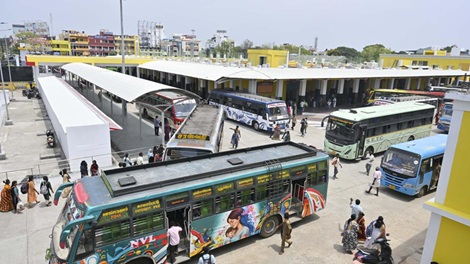
Chennai’s expanding western corridor is set to gain a significant public transport upgrade as redevelopment works at the Ayyappanthangal bus terminus move towards completion, reflecting the growing pressure on suburban mobility systems amid rapid urbanisation around Porur and adjoining neighbourhoods.
The modernisation project, led by the Chennai Metropolitan Development Authority (CMDA), is being positioned as a critical intervention in one of the city’s fastest-growing residential and commercial belts. Urban planners say the revamp highlights a broader challenge facing Chennai the need to upgrade ageing transport infrastructure in peripheral growth zones where population density and real estate activity have surged faster than civic amenities. Spread across nearly 1.5 acres, the redeveloped facility is being built at an estimated cost of ₹19 crore and is designed as a multi-level transit space intended to improve operational efficiency and commuter comfort. The existing bus stand has long struggled with overcrowding, inadequate passenger facilities, traffic bottlenecks and limited circulation space for buses serving the western suburbs and interconnecting arterial roads.
Transport officials indicate that the upgraded terminus is expected to accommodate increasing passenger volumes while streamlining bus movement through improved bay management, dedicated waiting zones and better integration of pedestrian movement. More than 150 buses currently operate through the junction every day, linking residential clusters with employment centres, educational institutions and commercial districts across Chennai.Urban mobility experts note that transport nodes such as Ayyappanthangal have become increasingly important as the city’s housing growth shifts outward along infrastructure corridors. The western suburbs, particularly around Porur and the Chennai bypass network, have witnessed accelerated apartment development, healthcare investments and warehousing activity over the past decade. However, civic infrastructure in several pockets has struggled to keep pace with this expansion. The redevelopment also signals a gradual shift towards improving everyday commuter infrastructure rather than focusing solely on large-scale mega projects. Analysts say well-designed bus terminals can reduce informal roadside parking, improve last-mile connectivity and encourage greater use of public transport a critical requirement for reducing traffic congestion and transport-related emissions in a city witnessing rising private vehicle ownership.
While the project is expected to ease commuter stress, urban planners caution that long-term effectiveness will depend on integrated planning around the terminus. This includes pedestrian safety, shaded walkways, feeder transport services, universal accessibility and stormwater management infrastructure capable of handling Chennai’s increasingly erratic rainfall patterns. Officials associated with the project suggest the upgraded facility may become operational in the coming months following final construction and utility works. For thousands of daily commuters in Chennai’s western suburbs, the redevelopment represents more than a cosmetic upgrade it reflects the growing demand for reliable, people-centric public transport infrastructure in rapidly transforming urban regions.