


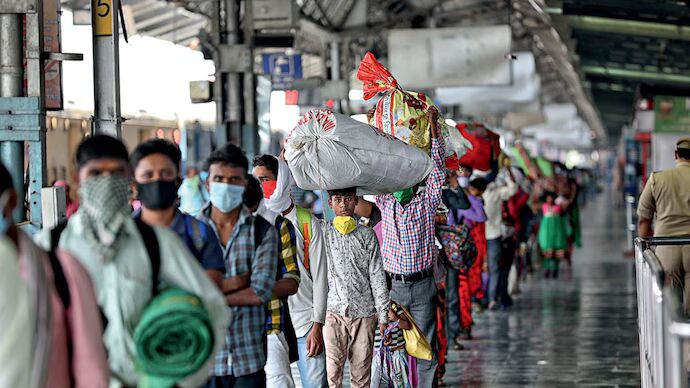
Unusual crowding at railway stations in Surat has drawn attention to a sudden outflow of migrant workers from the industrial city, raising concerns about labour stability and urban economic resilience. The movement, observed over recent days, reflects underlying pressures within one of India’s key manufacturing hubs, where workforce mobility is closely tied to economic activity. Officials monitoring the situation indicate that large numbers of workers have been leaving the city, with transport nodes witnessing heightened activity.
The Surat migrant worker exodus appears to be linked to a combination of economic uncertainty, employment disruptions, and seasonal factors that influence labour patterns in industrial regions. Urban economists note that cities like Surat rely heavily on migrant labour to sustain sectors such as textiles, construction, and small-scale manufacturing. Any sudden shift in workforce availability can disrupt production cycles, supply chains, and local markets. The Surat migrant worker exodus, therefore, has implications not only for employers but also for the broader urban economy. From a civic perspective, such large-scale movement places pressure on urban infrastructure, particularly transport systems. Railway stations and transit networks must accommodate sudden surges in demand, often without prior planning. Experts highlight that this reflects a broader gap in how cities anticipate and manage labour mobility. The situation also underscores the vulnerability of migrant workers within urban ecosystems. Many depend on informal employment and lack long-term security, making them more sensitive to economic fluctuations. Urban planners argue that improving housing, social security, and access to services could help stabilise workforce retention in cities like Surat. The Surat migrant worker exodus further raises questions about the resilience of industrial urbanisation models. Rapid economic growth, when not matched with inclusive planning, can create conditions where workers move frequently in response to shifting opportunities or uncertainties. This can affect both productivity and social stability. Environmental and urban sustainability considerations also come into play. Fluctuating population levels can strain or underutilise infrastructure, complicating long-term planning for transport, housing, and utilities. Cities aiming for sustainable growth need systems that can adapt to such dynamic population changes. Experts suggest that better data tracking and coordination between industries, local authorities, and transport agencies could help manage similar situations more effectively in the future. Real-time monitoring of workforce trends and proactive planning could reduce disruptions and improve urban resilience.
As Surat continues to evolve as a major industrial centre, the current labour movement highlights the importance of building cities that are not only economically productive but also socially stable and adaptable. Ensuring that migrant workers have access to reliable livelihoods and urban services will be key to sustaining long-term growth.
ALSO READ – Nagpur Rail Infra Push Signals Transit Modernisation Shift
Surat Railway Station Crowds Signal Labour Movement Shift
