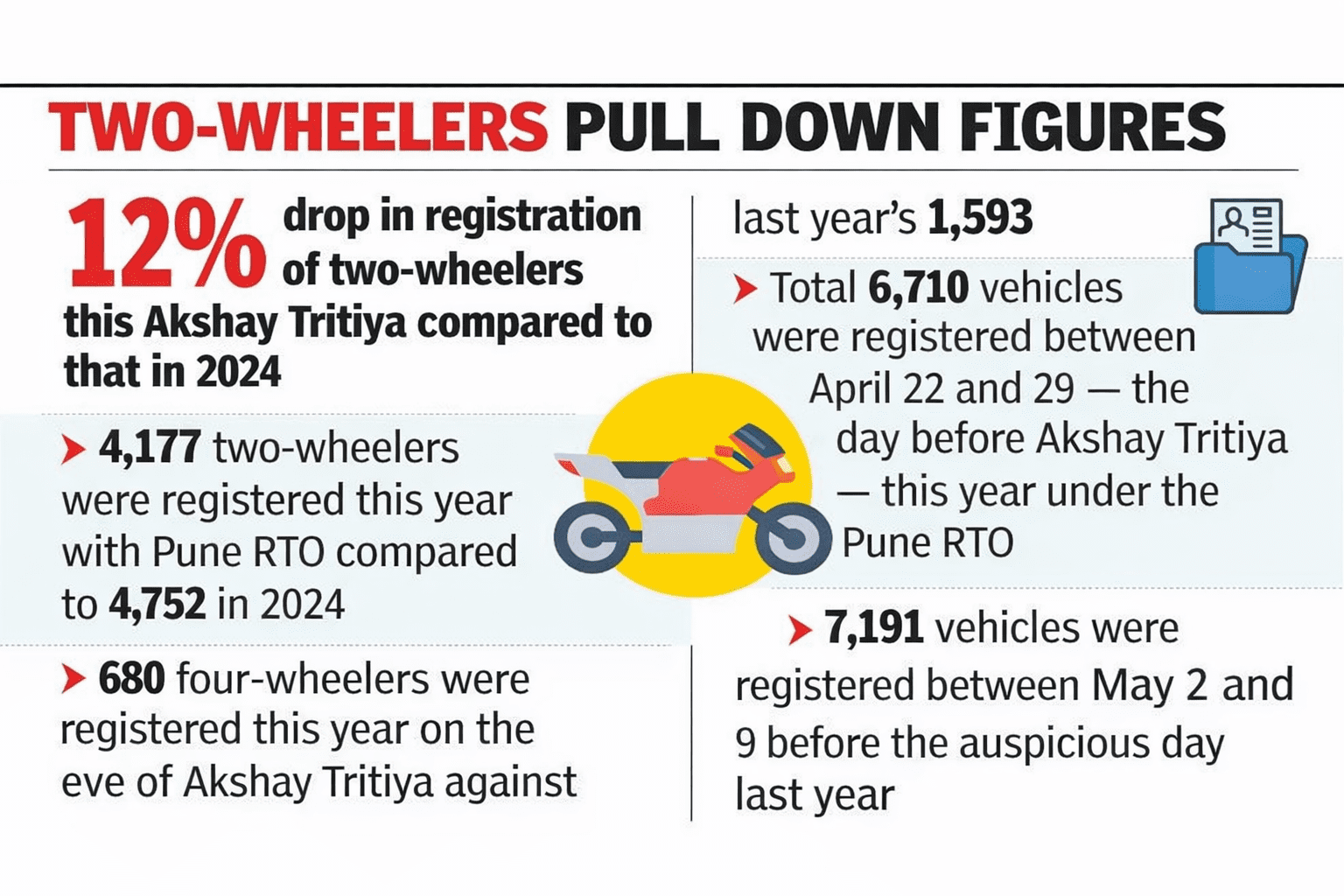
The city’s regional transport office has recorded a 9 percent decline in vehicle registrations during the Akshay Tritiya week this year compared to the same festive period in 2025. But the drop — 7,579 vehicles against last year’s 8,298 — is not a sign of fading demand. It is a sign that Punekars no longer wait for an auspicious date to buy a car or two-wheeler.
Electric vehicle registrations told a sharper story: down 66 percent, from 893 during last year’s festive window to just 306 this year. On the surface, that appears alarming. But transport analysts point to a more complex reality: festival-linked purchasing is becoming irrelevant in a city where unreliable public transport has made personal vehicles a necessity, not a celebration. A senior official confirmed that annual registrations continue to climb. In the last financial year, Pune recorded 3.45 lakh new vehicles — up from 3.04 lakh the previous year. Calendar year 2025 saw 3.3 lakh registrations against 3 lakh in 2024. The dip during Akshay Tritiya, the official argued, simply reflects that buyers are spreading purchases across the calendar rather than clustering them around holidays.
One resident explained the logic bluntly: waiting for a festival meant weeks of struggling with the city’s patchy bus network and expensive private options. He bought a two-wheeler last month out of urgent need — his old one went to a college-going sibling, and office commutes left no room for delay. Urban planners see a troubling feedback loop. Poor public transport pushes more households to buy private vehicles. More vehicles worsen congestion, which makes buses slower and less reliable. That, in turn, pushes even more households to buy. Pune’s 78 lakh vehicles already occupy just 7 percent of road area — a density that no amount of festival discounting can fix.
The EV drop during Akshay Tritiya is particularly instructive. While overall EV adoption is rising in Pune — annual numbers show clear growth — buyers are not treating electric mobility as a festive indulgence. A transport economist noted that EV purchases tend to be more calculated, driven by total cost of ownership and charging access rather than calendar auspiciousness. What the registration data actually reveals is a mature, stressed urban transport market. People are buying vehicles not because they love cars, but because the city has given them few alternatives. Until public transport mode share rises from its current 11 percent, festival dips or spikes will remain noise. The underlying signal is clear: Punekars need to move, and they will buy whatever gets them there — with or without a holy day.
Pune Vehicle Registrations Drop During Akshay Tritiya