Navi Mumbai Third Mumbai Land Acquisition Gains Momentum
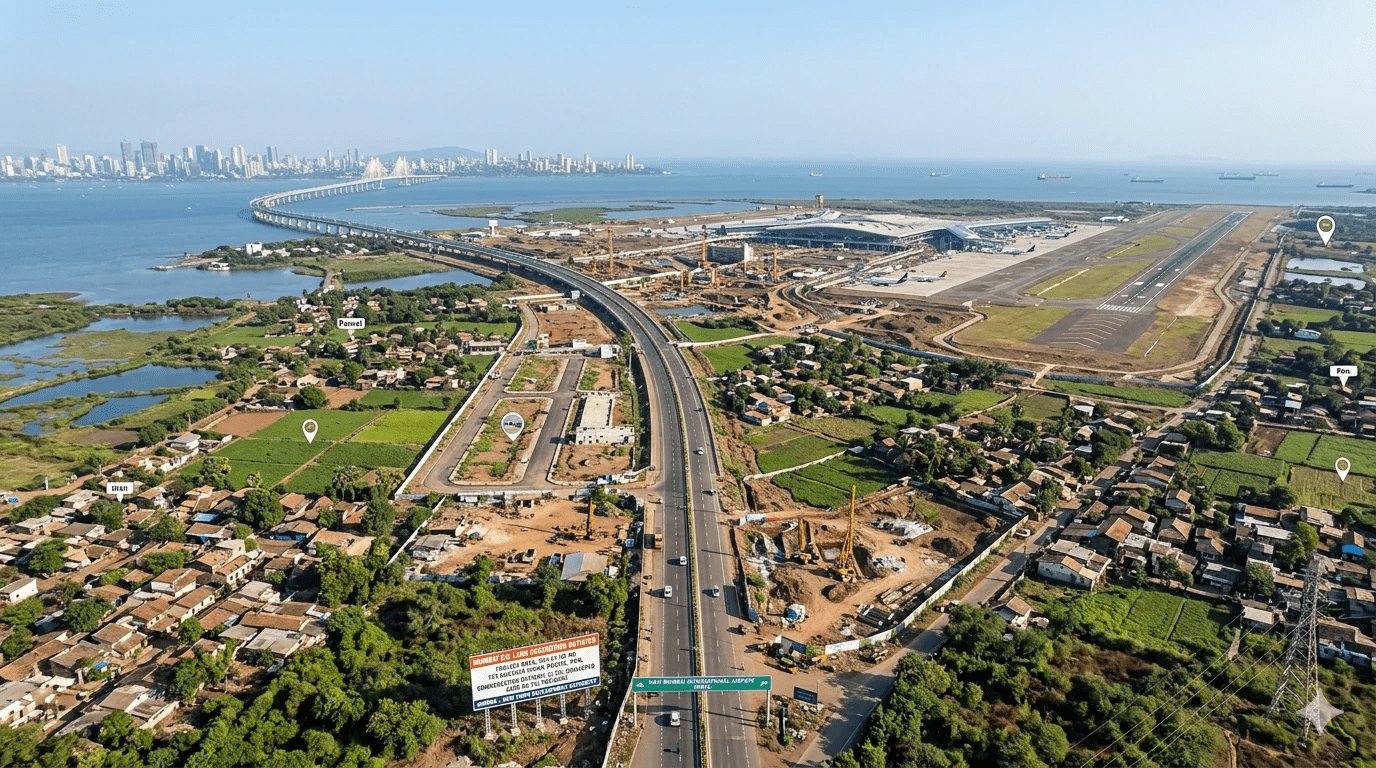
The rollout of Third Mumbai land acquisition has formally begun in Maharashtra, marking a critical shift from planning to on-ground execution for one of the region’s largest urban expansion projects. Authorities have initiated a consent-driven process across 124 villages in Raigad district, seeking participation from farmers and landowners as part of a proposed new urban zone linked to upcoming transport infrastructure. The exercise covers a 323-square-kilometre area spanning Uran, Panvel and Pen, positioned strategically near the Navi Mumbai International Airport and the Mumbai Trans Harbour Link. For a rapidly expanding metropolitan region, the move signals an attempt to redistribute growth pressures away from Mumbai’s saturated core while creating a new economic cluster.
At the centre of this phase is a multi-option compensation framework, allowing landowners to choose between direct financial settlement, development-linked benefits such as additional building rights, or a land pooling model that returns a portion of developed land. Officials indicate that participation is voluntary, with a digital system being introduced to record consent and documentation, potentially improving transparency in a process often criticised for opacity. Urban planners note that the Third Mumbai land acquisition model reflects a broader shift in how Indian cities approach large-scale expansion. Instead of relying solely on compulsory acquisition, authorities are increasingly experimenting with participatory frameworks that align landowners’ interests with long-term urban value creation. However, the success of such models depends heavily on trust, clarity of terms, and timely delivery of promised benefits. The proposed new town is being positioned as a mixed-use urban ecosystem, integrating residential, commercial and institutional zones. Planning frameworks indicate a focus on reducing commute distances through transit-oriented development, with future connectivity expected via highways, metro links and proximity to port infrastructure.
This could enable the region to emerge as a logistics and services hub, attracting investment in sectors such as technology, finance and warehousing. Yet, the transition raises concerns about the social and environmental implications of large-scale land transformation. Experts caution that agricultural livelihoods and local ecosystems could face disruption if safeguards are not rigorously enforced. While authorities have indicated that ecologically sensitive zones such as mangroves and coastal regulation areas will be avoided, implementation will be closely scrutinised as the project progresses. For residents, the process represents both opportunity and uncertainty. The promise of improved infrastructure, employment and urban amenities must be weighed against risks of displacement and changes in traditional land use. The emphasis on voluntary participation may help mitigate resistance, but outcomes will depend on how equitably benefits are distributed.
As the Third Mumbai land acquisition advances, it will test whether India’s next generation of urban projects can balance economic ambition with environmental resilience and social inclusion. The coming months are likely to shape not only the future of this region but also the template for how metropolitan India expands in an era of climate and resource constraints.