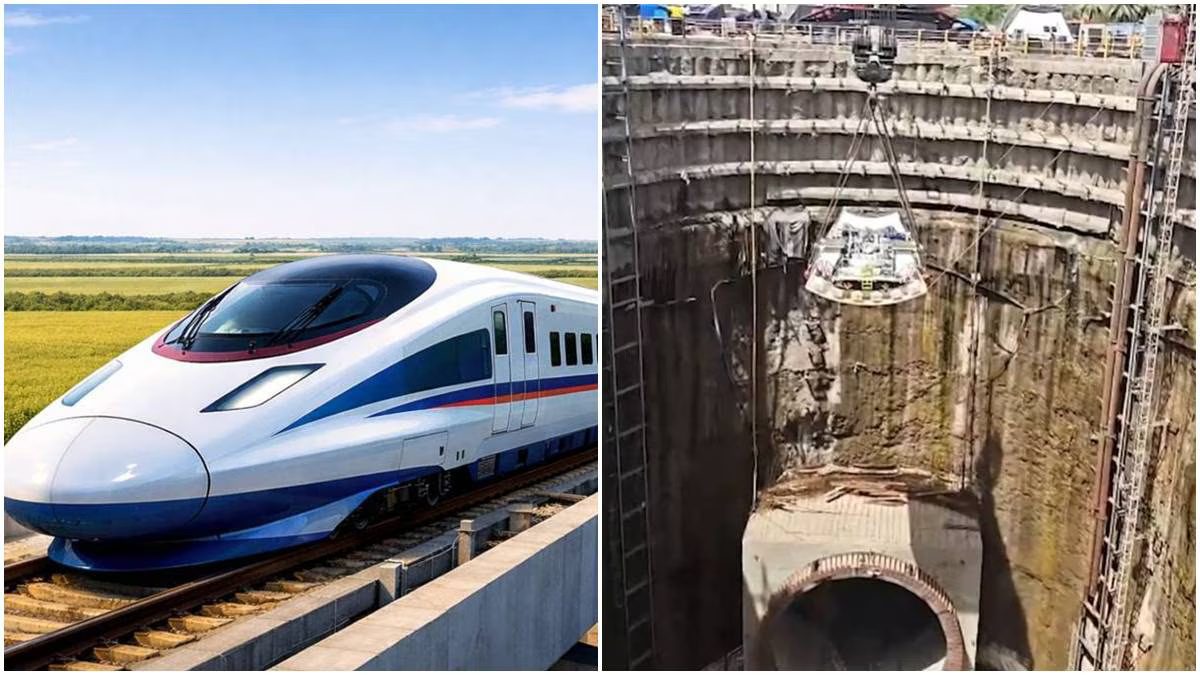
Mumbai’s high-speed rail corridor is moving into a critical construction phase as underground excavation for the bullet train network prepares to begin later this year. The launch of bullet train tunnel boring operations marks a significant step in delivering one of India’s most complex urban infrastructure projects, with implications for mobility, engineering standards, and sustainable transport planning. Work is advancing on the underground section linking key nodes in the Mumbai Metropolitan Region, where large tunnel boring machines (TBMs) are being assembled at deep shafts to carve out a substantial portion of the alignment. This section includes a long undersea stretch beneath Thane Creek, making it among the most technically demanding components of the project.
According to officials overseeing the project, two massive TBMs are being deployed from separate launch points to excavate a 16-kilometre tunnel segment. These machines, each weighing over 3,000 tonnes, are designed to operate in varied geological conditions using specialised slurry-based technology. The scale of the operation reflects the engineering precision required for bullet train tunnel boring, particularly in dense urban environments with existing infrastructure and sensitive ecosystems. Urban planners highlight that such underground alignments are essential in cities like Mumbai, where land scarcity and high population density limit surface expansion. By shifting critical transport infrastructure below ground, projects can reduce displacement pressures while preserving urban land for housing, green spaces, and public amenities. However, this approach also increases construction complexity and cost, requiring advanced monitoring systems to safeguard surrounding structures. The tunnel itself is being designed as a single large-diameter structure capable of accommodating dual tracks. Depth variations across the route, ranging from moderate underground levels to significantly deeper sections, are intended to navigate both built-up areas and natural formations.
Engineers are deploying real-time monitoring instruments to track ground movement and structural stability throughout the excavation process. Experts note that bullet train tunnel boring is not just about excavation speed but controlled progress. Maintaining stability is critical, especially when tunnelling under water bodies and near existing transport corridors. The use of high-capacity TBMs allows for continuous excavation while simultaneously installing tunnel linings, reducing risks associated with ground settlement. Beyond engineering, the project carries broader economic and environmental implications. High-speed rail is expected to reduce dependence on short-haul flights and road travel, potentially lowering emissions over time. Improved connectivity between major economic centres could also support regional growth and decentralisation, easing pressure on megacities. At the same time, the project’s urban footprint remains under scrutiny. Large-scale infrastructure developments must balance speed and efficiency with ecological sensitivity, particularly in coastal and wetland zones. Ensuring minimal disruption during tunnelling will be critical to maintaining environmental integrity.
With tunnelling expected to intensify in the coming months, the focus will shift to execution precision and safety oversight. As Mumbai’s underground rail infrastructure expands, the success of this phase will play a defining role in shaping future high-speed rail projects across India.