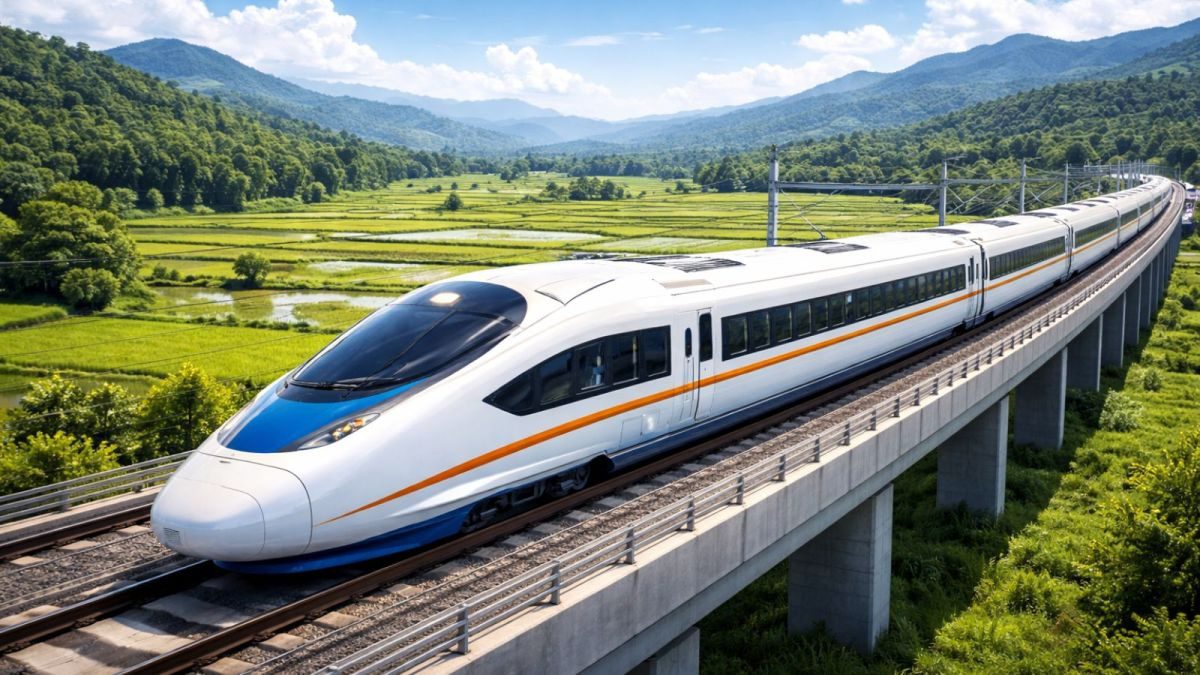
Mumbai Bullet Train Adopts AI Track Safety Systems
India’s first high-speed rail corridor between Mumbai and Ahmedabad is integrating advanced digital monitoring systems to enhance operational safety and reliability, signalling a shift towards predictive infrastructure management in large-scale transport projects. The adoption of AI track safety systems is expected to detect early-stage defects and reduce the risk of failures on one of the country’s most ambitious mobility corridors. The 508-kilometre rail project, currently under development, represents a major step in modernising intercity travel. Designed for speeds exceeding 300 km/h, the corridor requires precision engineering and continuous monitoring to ensure passenger safety. Unlike conventional rail networks, high-speed systems demand real-time diagnostics, as even minor irregularities can escalate rapidly under high velocity conditions.
Officials familiar with the project indicate that the newly introduced AI track safety systems rely on sensors embedded across train components and track interfaces. These sensors capture vibration patterns and mechanical behaviour during operations. The data is processed through onboard computing systems capable of identifying anomalies that may signal emerging faults, such as micro-cracks or component stress. Urban infrastructure analysts note that this transition reflects a broader move away from time-based maintenance towards condition-based monitoring. Instead of relying solely on periodic inspections, predictive systems enable maintenance teams to intervene precisely when needed. This approach not only improves safety outcomes but also reduces operational disruptions and long-term costs. The implications extend beyond engineering efficiency. For rapidly urbanising regions like the Mumbai Metropolitan Region, high-speed rail is expected to reshape commuting patterns, reduce pressure on aviation and highways, and support regional economic integration. Reliable infrastructure is therefore critical to sustaining public trust and ensuring consistent service delivery.
Experts also highlight that such digital systems can contribute to sustainability goals. Efficient maintenance reduces resource consumption and minimises downtime, indirectly lowering the carbon footprint associated with large infrastructure operations. As India expands its transport network, embedding intelligence into assets is increasingly seen as essential for building climate-resilient cities. Alongside track monitoring, the project incorporates multiple safety layers, including environmental sensors that assess weather conditions such as wind and rainfall. These systems are designed to provide early warnings and enable adaptive responses, ensuring safe operations across diverse terrain and climatic zones. While construction progress continues across various sections of the corridor, the integration of AI track safety systems underscores a growing emphasis on technology-led governance in infrastructure development. Industry observers suggest that the success of such systems will depend on seamless data integration, skilled workforce training, and robust regulatory oversight.
As India prepares for the operational phase of its first bullet train, the focus is gradually shifting from construction milestones to long-term performance. The ability to maintain safety, efficiency, and reliability at scale will determine how effectively high-speed rail can serve as a backbone for future urban and economic growth.