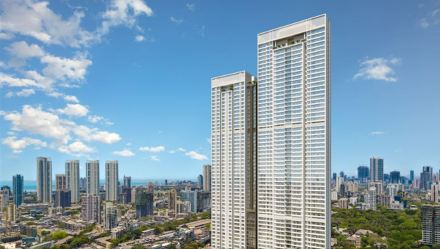
A mid-sized real estate firm focused on South-Central Mumbai has drawn market attention after announcing a new land acquisition in Dadar (West), triggering a sharp rise in its stock price. The move underscores renewed investor confidence in tightly held urban land parcels, even as questions around density, liveability, and sustainability persist in one of India’s most congested city regions.
The company has secured a small plot in the G/North ward at a total estimated cost of about ₹18 crore, factoring in regulatory charges and commitments to existing landholders. The site is expected to be redeveloped into a compact residential project with a projected Gross Development Value (GDV) of nearly ₹100 crore. While modest in scale, such acquisitions are increasingly seen as strategic in Mumbai’s land-scarce micro-markets. Dadar (West), positioned between key commercial zones such as Lower Parel and Bandra Kurla Complex, has long been a redevelopment hotspot. Ageing housing stock, coupled with high land values, continues to attract developers seeking incremental expansion. However, urban planners caution that piecemeal redevelopment often driven by fragmented land parcels can strain already burdened infrastructure unless integrated planning is prioritised.
The latest deal highlights a broader pattern in Mumbai real estate, where smaller developers are leveraging redevelopment opportunities to maintain growth pipelines. Unlike large greenfield projects, these urban infill developments rely on navigating complex ownership structures and regulatory frameworks. Experts note that while such projects can optimise land use, they also raise concerns around construction density, access to public spaces, and pressure on civic amenities.Investor sentiment appears to be responding positively. The company’s stock recorded a significant intraday surge, reflecting both the immediate acquisition news and a wider trend of institutional interest. Recent filings indicate a marginal increase in holdings by both foreign and domestic institutional investors, suggesting cautious optimism around the firm’s execution capabilities and its positioning in the value-luxury segment. Yet, the long-term outlook for such developments is tied closely to Mumbai’s evolving urban policy landscape.
As the city grapples with climate risks, including flooding and heat stress, redevelopment projects are under increasing scrutiny to incorporate resilient design, efficient resource use, and inclusive housing considerations. Industry observers point out that future regulatory frameworks may place greater emphasis on green building standards and infrastructure alignment.For residents, the implications are mixed. Redevelopment can deliver improved housing conditions and modern amenities, but it may also intensify neighbourhood density and alter socio-economic dynamics. In established areas like Dadar, balancing redevelopment with heritage preservation and community needs remains a continuing challenge. As Mumbai’s real estate market recalibrates, such targeted acquisitions signal both opportunity and complexity. The success of these projects will likely depend not just on financial returns, but on how well they align with the city’s broader goals of sustainable and equitable urban growth.