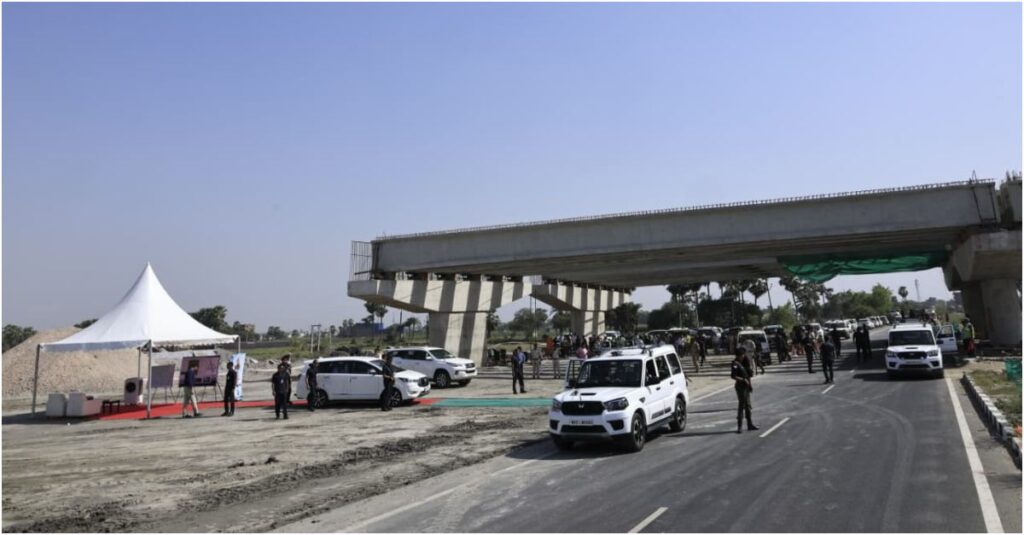
A high-level inspection of the under-construction Patna–Bettiah expressway has triggered renewed urgency around one of Bihar’s most significant road infrastructure projects, with officials directed to accelerate timelines and maintain construction momentum. The review, conducted along a key stretch in Saran district, signals a stronger administrative push to fast-track delivery of a corridor expected to transform connectivity across north Bihar.
The greenfield expressway is being developed as a high-capacity route linking the state capital with Bettiah, a key urban centre in West Champaran. Once completed, the corridor is projected to reduce travel time between the two cities to nearly three hours, a substantial improvement over current conditions. This reduction is expected to unlock economic linkages across districts that have historically remained on the periphery of Bihar’s growth corridors. During the inspection, senior officials outlined progress on the first operational segment, with a targeted completion timeline set for 2027. The emphasis on deadlines reflects a broader shift in infrastructure governance, where execution speed and on-ground monitoring are increasingly being prioritised alongside project announcements. Urban and regional planners view the Patna Bettiah expressway as more than a transport upgrade. By directly connecting districts such as Vaishali, Saran, East Champaran and West Champaran to Patna, the corridor is expected to reshape mobility patterns, reduce logistical bottlenecks and support more balanced regional development. In a state where road infrastructure has historically constrained economic integration, such corridors are emerging as critical enablers of market access and service delivery.
The project also reflects a growing focus on decongesting existing highways and redistributing traffic flows. By offering an alternative high-speed route, the expressway is likely to ease pressure on older road networks while improving freight efficiency—an important factor for agriculture-driven economies in north Bihar. From a sustainability and planning perspective, the Patna Bettiah expressway highlights the evolving role of greenfield corridors in shaping urban expansion. While they improve connectivity, they also influence land use patterns, potentially triggering new residential and commercial clusters along the route. Managing this growth through planned development will be essential to avoid unregulated sprawl and ensure infrastructure keeps pace with demand. The inspection also underscores the importance of continuous political and administrative oversight in large-scale infrastructure delivery. Frequent reviews, combined with clear accountability mechanisms, are increasingly seen as necessary to prevent delays that have historically affected public works in the region.
As Bihar accelerates its infrastructure pipeline, projects such as this expressway are expected to play a defining role in integrating regional economies with urban centres. The coming months will test whether tighter timelines and monitoring translate into measurable progress on the ground—determining how quickly the benefits of improved connectivity reach citizens and local businesses.