


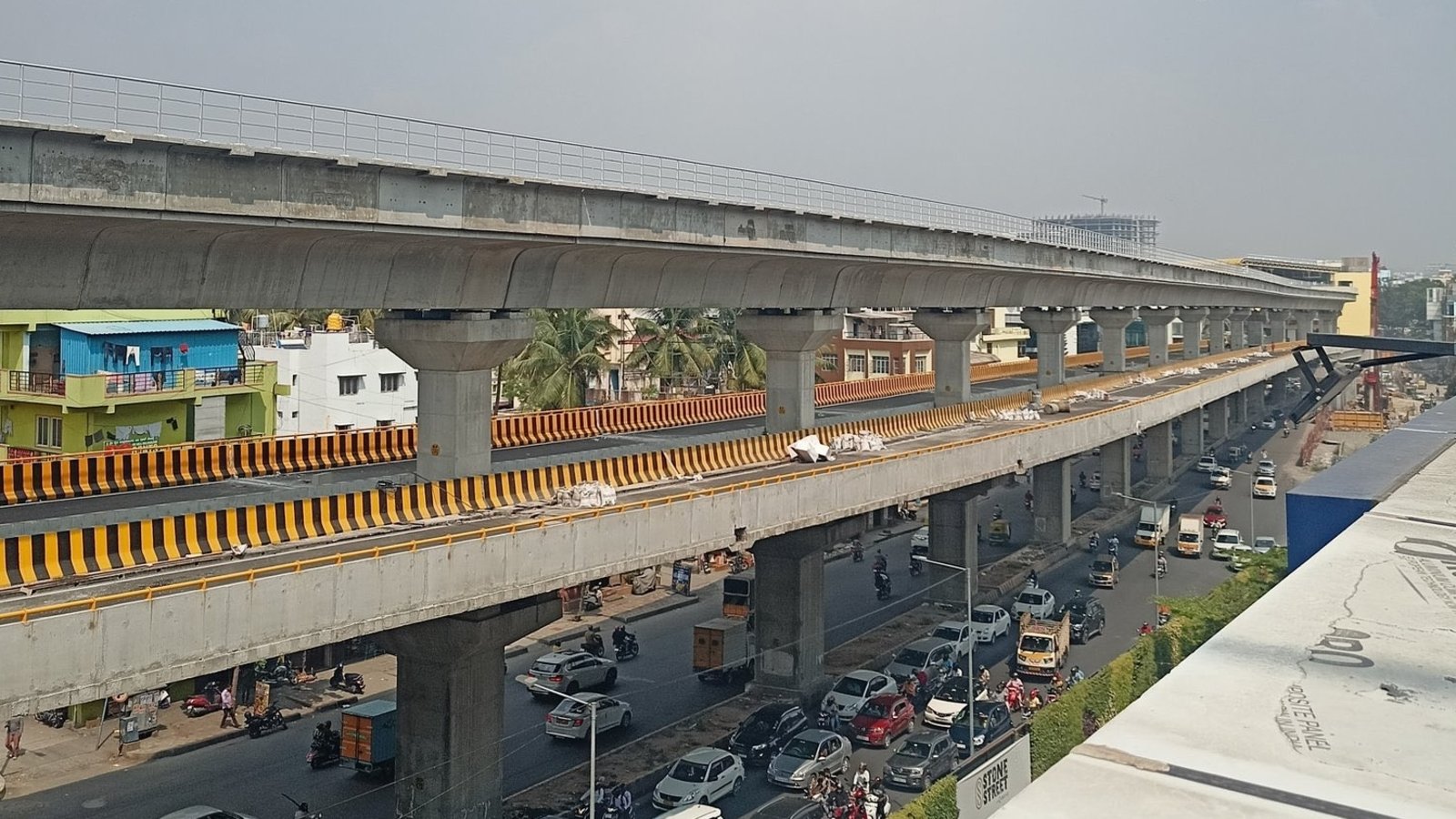
A major elevated road project in Bengaluru is set to become fully operational within days, with authorities expecting a significant reduction in congestion along one of the city’s busiest corridors connecting HSR Layout and the Jayadeva junction.
The completion of the Bengaluru double decker flyover marks a key milestone in the city’s ongoing efforts to address chronic traffic bottlenecks through multi-level infrastructure solutions. Designed to segregate traffic flows, the structure combines a conventional flyover with an upper deck aligned alongside a metro corridor, aiming to optimise limited road space in a dense urban setting.Transport officials indicate that once fully opened, the corridor could reduce traffic load in the surrounding areas by as much as 80 percent during peak hours. The stretch has long been a critical choke point, affecting daily commuters, public transport services, and freight movement across south and central Bengaluru.Urban mobility experts see the Bengaluru double decker flyover as part of a broader shift towards integrated transport planning, where road infrastructure is developed in coordination with mass transit systems. By aligning elevated roadways with metro lines, planners seek to maximise land efficiency while minimising the need for large-scale land acquisition—an increasingly complex challenge in built-up areas.However, experts caution that while such infrastructure can provide immediate congestion relief, its long-term effectiveness depends on complementary measures.
Without parallel investments in public transport, last-mile connectivity, and demand management, there is a risk that improved road capacity may eventually attract more private vehicles, leading to renewed congestion—a phenomenon widely referred to as induced demand.The economic implications of the project are notable.Reduced travel time along the corridor is expected to enhance productivity, improve logistics efficiency, and support commercial activity in adjoining areas. For real estate markets in neighbourhoods such as HSR Layout, improved accessibility could translate into increased demand, particularly for residential and mixed-use developments.At the same time, the environmental dimension remains a critical consideration.Elevated road projects often raise concerns around air quality, noise pollution, and urban heat accumulation. Integrating green buffers, noise barriers, and pedestrian-friendly design elements will be essential to ensure that infrastructure expansion aligns with the city’s sustainability goals.Civic planners also emphasise the need to monitor traffic patterns post-implementation.Data-driven evaluation of the Bengaluru double decker flyover will be crucial in determining whether similar models should be replicated in other high-density corridors across the city.
As Bengaluru continues to grapple with rapid urbanisation and rising mobility demands, the project highlights both the potential and limitations of engineering-led solutions. While the new flyover may ease immediate pressure on a critical junction, the city’s long-term mobility future will depend on balancing road expansion with sustainable, people-centric transport systems.
Also Read:Bengaluru Building Deviation Policy Raises Urban Concerns
